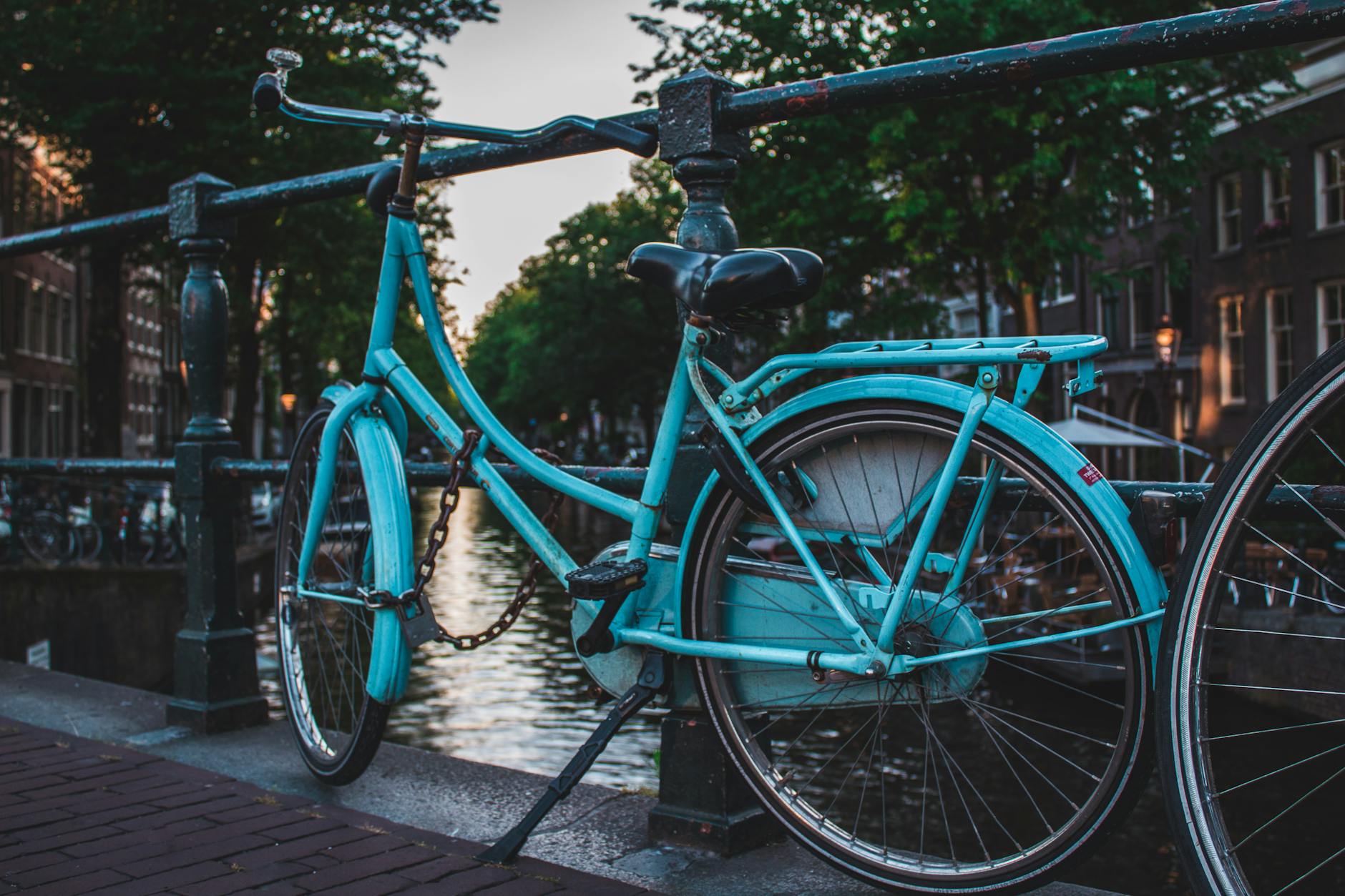
Amsterdam is one of Europe’s easiest and most enjoyable cities to navigate. The compact city center is walkable from end to end in under an hour, an extensive tram and metro network connects every major neighborhood, and a world-class cycling infrastructure makes biking the fastest way to get almost anywhere. Unlike many European capitals where getting around feels like a chore, moving through Amsterdam is genuinely part of the experience — whether you are watching the city glide past from a tram window, pedaling along a canal at sunset, or crossing the IJ river on a free ferry to reach the creative neighborhoods of Noord.
This is the complete guide to getting around Amsterdam, written to help you choose the right transport for every situation. We cover every option from trams and metro to bikes and boats, break down the ticketing system so you never overpay, explain how to get from Schiphol Airport to the city, and share the practical knowledge that makes navigating Amsterdam feel effortless. Whether this is your first visit or your tenth, this guide will help you move through the city like a local.
The short answer: the best way to get around Amsterdam is a mix of walking and trams, with a bike added on the day you want to cover more ground. The centre is small enough to cross on foot, trams fill the longer gaps, and the free IJ ferries handle trips to Noord. To pay, just tap a contactless card or phone (OVpay) as you board and exit. Reach for the train for Schiphol and day trips.
Amsterdam Transport at a Glance
Here is how the main options compare before we dig into each one. Treat the figures as 2026 estimates and confirm live fares and times in the GVB and NS apps, since prices tend to creep up most years.
| Mode | Best for | Typical cost (2026) | Notes |
|---|---|---|---|
| Walking | The canal ring and centre | Free | ~20-30 min end to end |
| Tram | Crossing town, sightseeing | ~EUR 1.50-3 per ride via OVpay | Every 5-10 min; see the tram routes guide |
| Metro | Longer hops to outer districts | Same fare system as trams | Fast; limited central stops |
| Free IJ ferry | Reaching Amsterdam Noord | Free | 5-min crossing, day and night |
| Rental bike | Covering ground like a local | ~EUR 12-18 per day | See the bike rental guide |
| Train (NS) | Schiphol and day trips | ~EUR 5-6 to/from Schiphol | ~17-20 min airport to Centraal |
| Taxi / Uber | Late nights, heavy luggage | ~EUR 15-30 cross-city | Slowest in centre traffic |
Amsterdam’s Public Transport System: Trams, Metro, and Buses
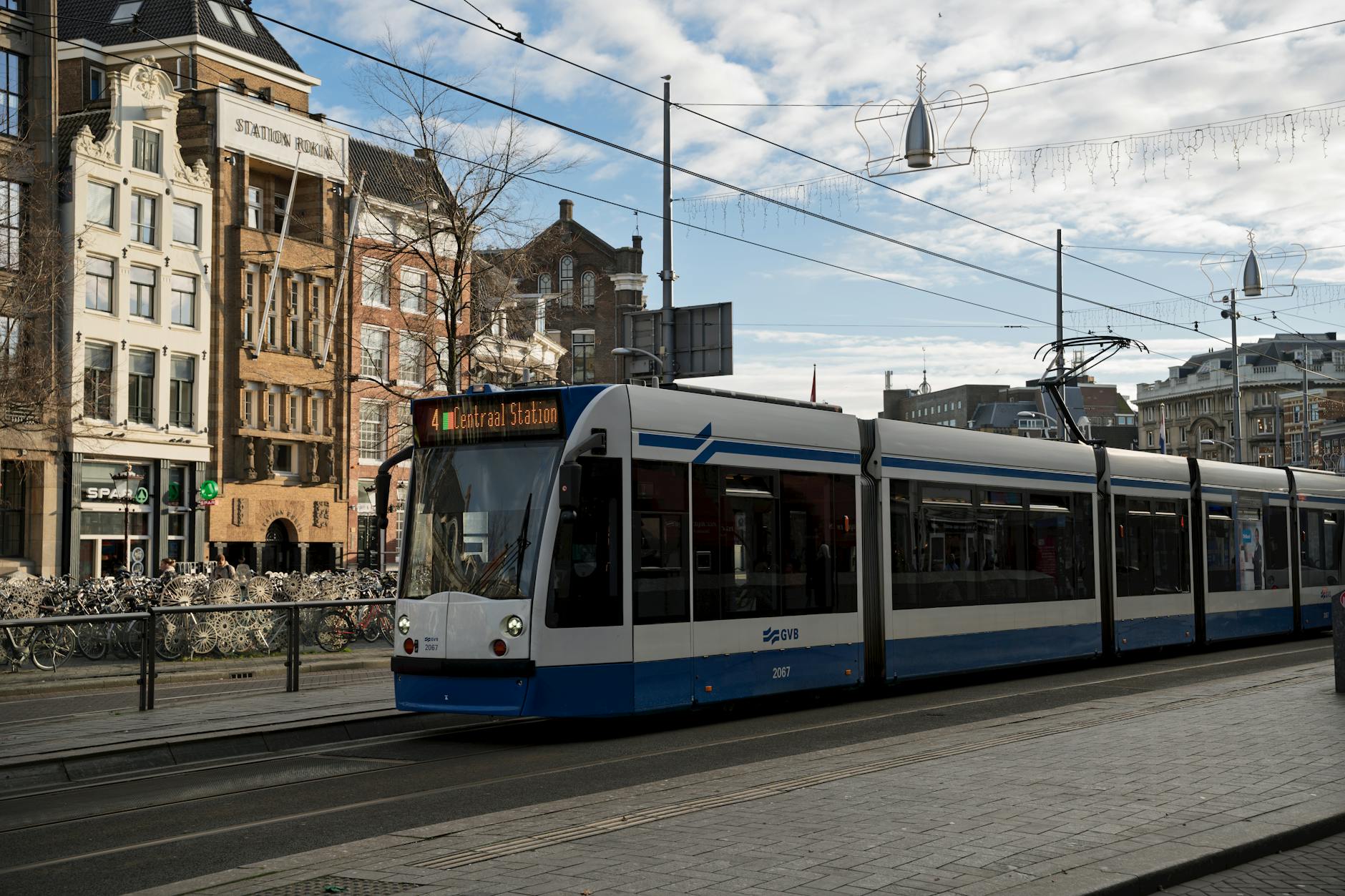
Amsterdam’s public transport is operated by GVB (Gemeentelijk Vervoerbedrijf) and covers the entire city with an integrated network of trams, metro lines, buses, and ferries. The system is clean, reliable, and runs from approximately 06:00 until midnight on weekdays, with night buses filling the gap. For visitors, understanding the system is straightforward once you know the basics, and our dedicated Amsterdam public transport guide for tourists walks through every mode in more depth.
Trams
Trams are the backbone of Amsterdam’s public transport and the mode you will use most often as a visitor. The network consists of 16 lines that crisscross the city center, connecting major tourist areas like Centraal Station, Dam Square, Leidseplein, Museumplein, and De Pijp. Trams run frequently — every 5 to 10 minutes during the day — and are the most efficient way to cover distances that are slightly too far to walk comfortably. Key tram lines for visitors include Line 2 (Centraal Station to Museumplein via Leidseplein), Line 4 (Centraal Station to the RAI via Rembrandtplein), Line 12 (Centraal Station to Amstelstation through the Jordaan), and Line 24 (to De Pijp via Vijzelgracht). Tram stops are well-marked with the distinctive GVB blue posts showing the line number and route, and all trams have electronic displays showing the next stop. For a line-by-line breakdown of which tram reaches which attraction, see our Amsterdam tram routes guide.
Metro
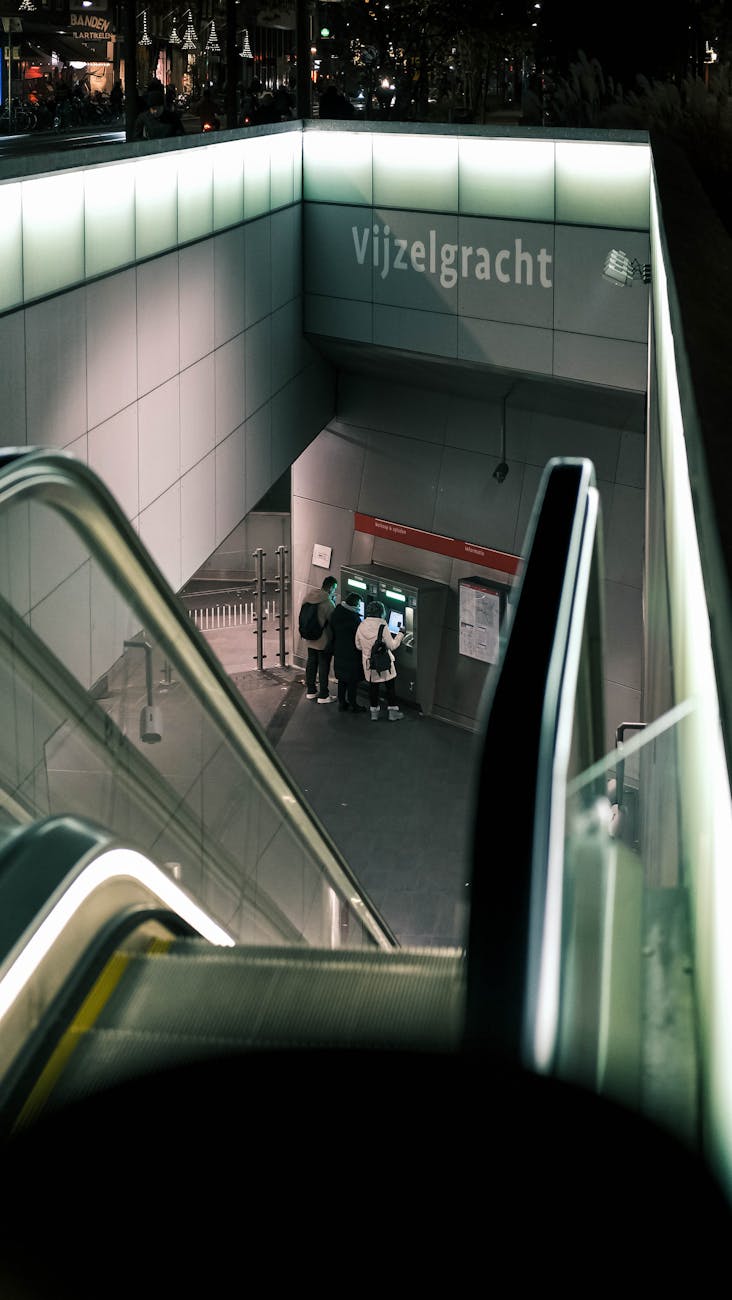
Amsterdam’s metro system has five lines and 39 stations, but most visitors will primarily use it for reaching destinations beyond the city center ring. The most useful line for tourists is the Noord/Zuidlijn (North-South Line, Line 52), which opened in 2018 after decades of construction and connects Amsterdam Noord (via Centraal Station) to the World Trade Center and RAI convention area in the south. The metro is faster than trams for longer distances and runs from approximately 06:00 to 00:30. Other metro lines (50, 51, 53, 54) serve the suburban areas of Amstelveen, Diemen, and Amsterdam Zuidoost (home to the Johan Cruyff Arena and Ziggo Dome concert venue). Metro fares use the same ticketing system as trams and buses.
Buses
Buses in Amsterdam supplement the tram and metro network, covering areas that rail-based transport does not reach. Most visitors will not need regular buses unless traveling to specific destinations like the NDSM Werf (though the ferry is often more convenient), Amsterdam-Oost neighborhoods off the main tram routes, or suburban areas. Night buses (nachtbussen) are important to know about: they run from approximately 00:30 to 06:00 when trams and metro stop operating, covering major routes across the city. Night bus fares are the same as daytime transport if you have a valid day pass or multi-day ticket.
Tickets, Passes, and How to Pay for Amsterdam Transport
Amsterdam’s public transport ticketing system has been modernized significantly and now offers several convenient payment options. Understanding your choices will save you both money and confusion at the tram stop.
OVpay (Contactless Payment)
The simplest way to pay for public transport in Amsterdam is OVpay — simply tap your contactless bank card, credit card, or phone (Apple Pay, Google Pay) on the card reader when you board and again when you exit. The system charges you per kilometer traveled, with a boarding fee of €1.16 plus €0.217 per kilometer in 2026. This is the most convenient option for visitors making occasional trips, as there is nothing to buy or set up in advance. There is a daily cap, so you will never pay more than the equivalent of a day pass even if you make many trips. Important: always remember to check out (tap when exiting) or you will be charged the maximum fare. For a full comparison of OVpay, the OV-chipkaart and every tourist pass, see our OV-chipkaart and OVpay guide.
GVB Day and Multi-Day Passes
If you plan to use public transport frequently, GVB day and multi-day passes offer unlimited travel on all GVB trams, buses, metro, and ferries within Amsterdam. In 2026, prices range from approximately €9 for a 1-day pass to around €39 for a 7-day pass — working out to between €5.50 and €9 per day depending on the duration. These passes are excellent value if you plan three or more trips per day. You can buy them online through the GVB app (which also serves as your digital ticket), at GVB ticket offices at Centraal Station, or at ticket machines at metro stations. Children aged 4-11 travel for €5 per day, and children under 4 ride free.
Amsterdam & Region Travel Ticket
The Amsterdam & Region Travel Ticket provides unlimited travel not just on GVB services but also on Connexxion buses, R-net, EBS, and NS trains within the Amsterdam region. This is particularly useful if you plan to visit areas outside central Amsterdam, such as the Zaanse Schans windmills, Muiden Castle, or the beaches at Zandvoort. Available in 1, 2, and 3-day versions, it offers broader coverage than the standard GVB pass at a slightly higher price. The ticket can be purchased online or at the I amsterdam Visitor Centre at Centraal Station.
OV-chipkaart
The OV-chipkaart is a rechargeable smart card used across all public transport in the Netherlands. The anonymous version costs €7.50 and can be loaded with credit at stations and convenience stores. While it was the standard for years, the introduction of OVpay has made it less necessary for short-term visitors. It remains useful if you are staying longer than a week or traveling extensively beyond Amsterdam by train, as it works on all Dutch public transport including NS intercity trains. Note that the OV-chipkaart requires a minimum balance of €4 for bus, tram, and metro, or €20 for train travel.
Cycling in Amsterdam: The Definitive Visitor’s Guide
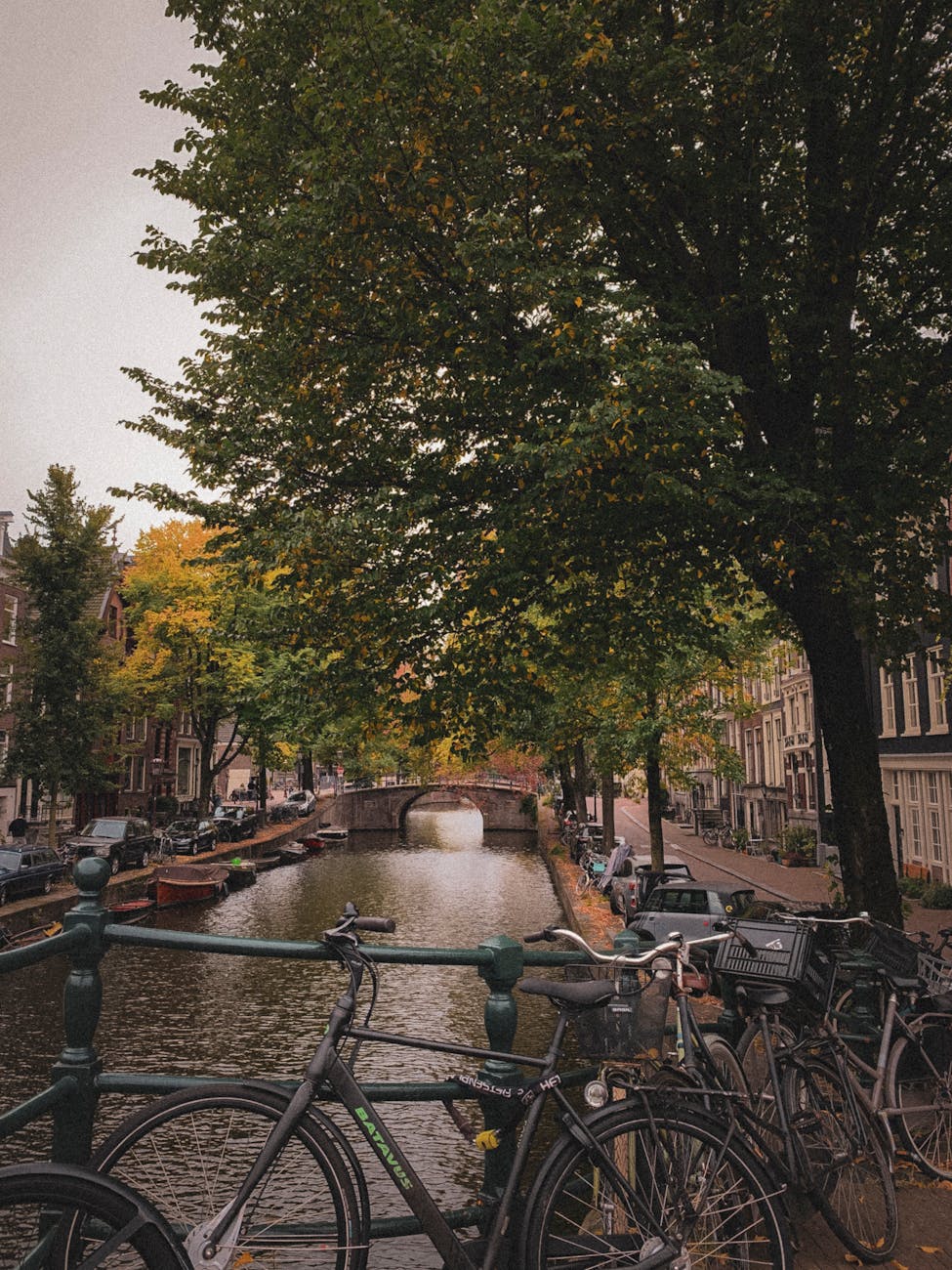
Amsterdam is the cycling capital of the world. There are more bicycles than residents in the city (roughly 880,000 bikes for 870,000 people), and cycling accounts for over half of all trips within the city center. For visitors, renting a bike transforms the Amsterdam experience: you cover ground faster than walking, see more than you would from a tram, and participate in one of the most defining aspects of Dutch culture. That said, cycling in Amsterdam requires some awareness and confidence, especially if you are not used to urban cycling.
Renting a Bike
Bike rental shops are everywhere in Amsterdam, concentrated around Centraal Station, Leidseplein, Dam Square, and Vondelpark. Major rental companies include MacBike (the most visible, with bright red bikes), Black Bikes (popular with locals and offering black bikes that blend in better), Yellow Bike, and A-Bike. Standard bike rental costs €12-18 per day in 2026, with discounts for multi-day rentals. Electric bikes (e-bikes) are available at most shops for €25-35 per day and are excellent if you plan to cover larger distances or visit areas outside the center. You will need a valid ID or credit card as a deposit (typically €50-100), and most shops include a lock. Helmets are not legally required in the Netherlands and almost no one wears them, but most rental shops can provide one on request. Our bike rental guide for first-time cyclists compares the main shops and maps out beginner-friendly routes.
Essential Cycling Rules and Etiquette
Amsterdam’s cycling infrastructure is world-class, with dedicated bike lanes (fietspaden) on nearly every street, separated from both cars and pedestrians. However, cycling here has unwritten rules that locals follow instinctively and that visitors need to learn quickly. Always ride in the bike lane — never on the sidewalk, which is illegal and dangerous. Signal your turns clearly by extending your arm in the direction you are turning. Check over your shoulder before changing lanes or turning. Never stop suddenly in the middle of a bike lane. Use your bell (every rental bike has one) to warn pedestrians who wander into the bike lane — this happens constantly. Lights are mandatory after dark, and your rental bike will have them. Ride on the right side of the bike lane. Do not cycle side by side in busy areas. Never ride while looking at your phone. The most important rule: be predictable and confident. Amsterdam cyclists move fast and expect others to behave consistently.
Bike Parking and Theft Prevention
Amsterdam has extensive bike parking infrastructure, including massive underground parking garages at Centraal Station, Leidseplein, and Museumplein. Always lock your bike to a fixed object (not just to itself) using the built-in wheel lock and the chain lock provided by your rental shop. Bike theft is a real problem in Amsterdam — roughly 50,000 bikes are stolen annually — so never leave your bike unlocked, even for a moment. Park only in designated areas; bikes parked illegally may be removed by the gemeente (city council), and retrieving them costs around €25 plus a daily storage fee. Your rental shop will explain the insurance situation and what to do if your bike is stolen.
Walking in Amsterdam
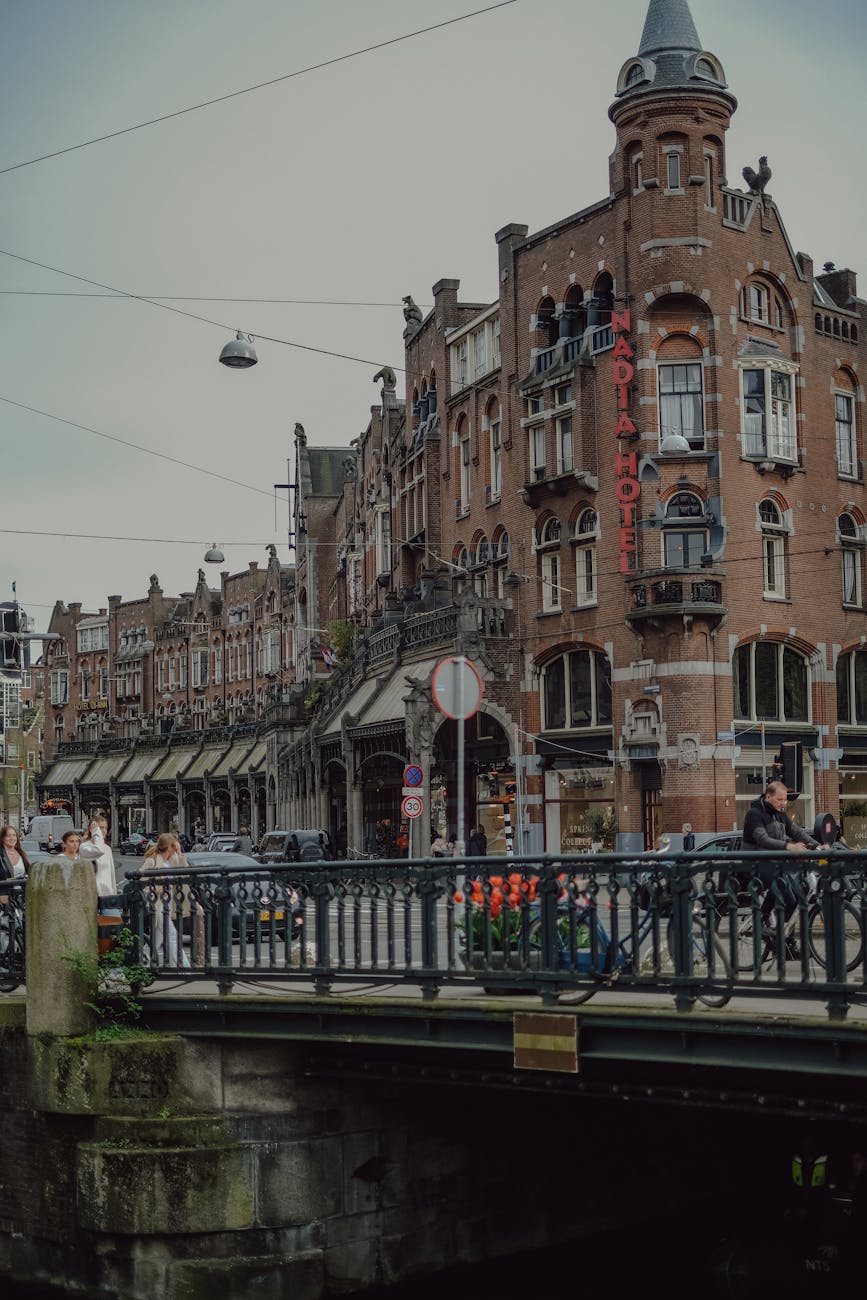
Amsterdam’s compact size makes walking one of the best ways to experience the city. The entire canal ring (a UNESCO World Heritage Site) is walkable within about 45 minutes from end to end, and most major attractions are within a 20-30 minute walk of each other. Walking allows you to discover the details that make Amsterdam special — the gabled canal houses, hidden courtyards (hofjes), quirky shop fronts, and picturesque bridges that you simply miss from a tram or bike.
Some of Amsterdam’s best walking routes include the canal ring (Herengracht, Keizersgracht, and Prinsengracht running parallel, connected by charming side streets), the Jordaan neighborhood with its narrow streets and intimate courtyards, the Plantage area from Artis Zoo to the Hortus Botanicus, and the waterfront walk from Centraal Station east along the IJ toward the NEMO Science Museum and the Eastern Docklands. For more ideas on what to discover on foot, see our comprehensive guide to things to do in Amsterdam, and our Amsterdam neighbourhoods guide for how the districts fit together.
Practical walking tips: watch out for bike lanes — they are often at the same level as the sidewalk and differentiated only by color (usually reddish-brown). Walking in a bike lane will earn you angry bell-ringing from cyclists and is genuinely dangerous. Cobblestones are common in older neighborhoods; comfortable shoes with good grip are essential, especially when it rains. Amsterdam is generally flat, so walking is easy for all fitness levels. Google Maps and Citymapper both work well for walking directions.
Canal Boats and Water Transport
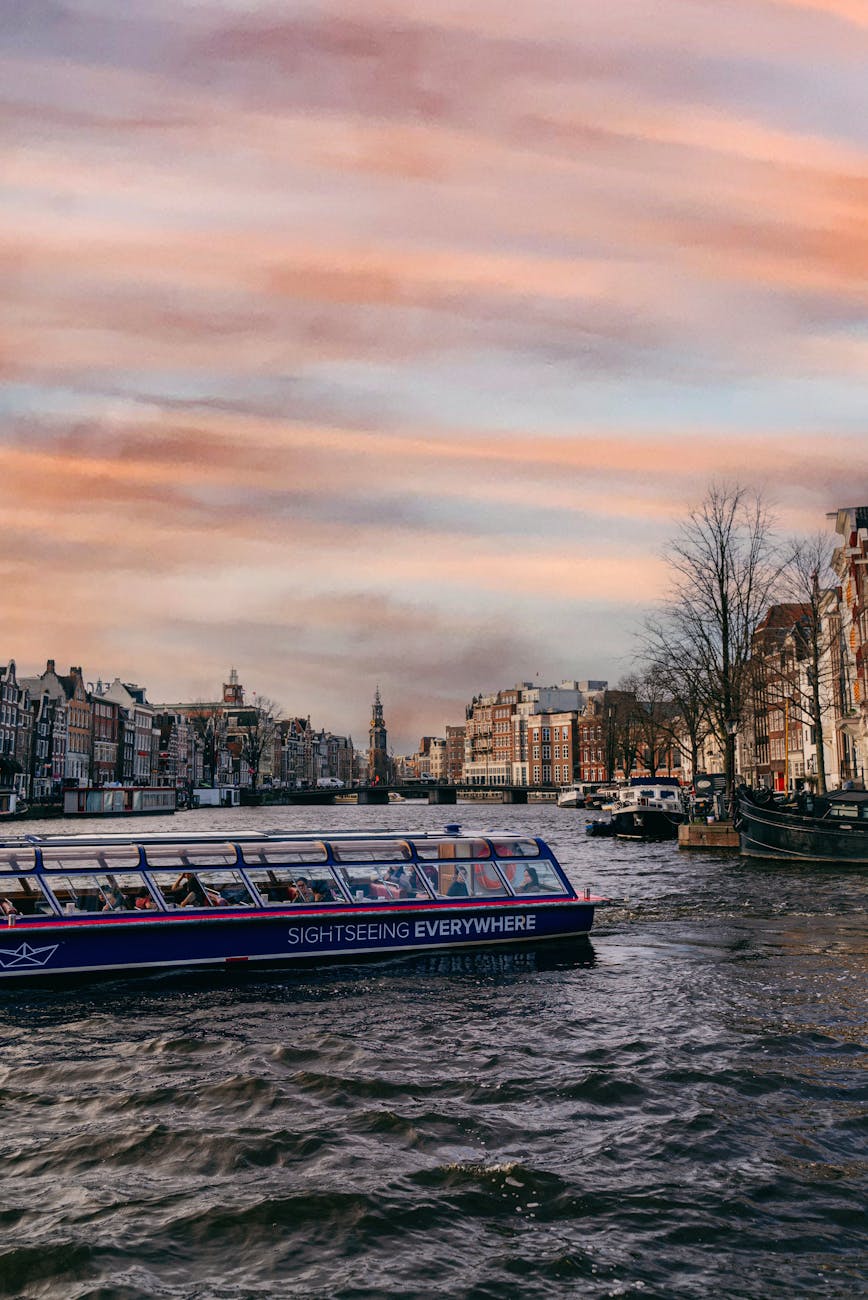
Amsterdam has 165 canals totaling over 100 kilometers, and the water is as much a transport route as the streets above. Beyond the classic sightseeing canal cruises, there are several practical and recreational ways to use Amsterdam’s waterways.
Canal Cruises and Sightseeing Boats
A canal cruise is one of Amsterdam’s quintessential experiences and arguably the best way to appreciate the city’s Golden Age architecture. Major operators include Stromma (formerly Canal Company), Blue Boat Company, and Lovers Canal Cruises, with departure points concentrated near Centraal Station, the Rijksmuseum, and Leidseplein. A standard 1-hour cruise costs €16-20 per person. For a more intimate experience, smaller operators like Those Dam Boat Guys and Flagship Amsterdam use electric boats that can navigate narrower canals the large tour boats cannot reach. Evening cruises with wine and cheese are popular for a more atmospheric experience. Advance online booking is recommended during peak season (April-September) as popular time slots sell out.
Free Ferries Across the IJ
One of Amsterdam’s best-kept transport secrets is the free GVB ferry service across the IJ river, connecting Centraal Station to Amsterdam-Noord. These ferries run 24 hours a day and carry both passengers and cyclists. The most useful routes are the Buiksloterweg ferry (every 6 minutes, 24/7) to the heart of Noord, the NDSM ferry to the creative NDSM Werf area, and the IJplein ferry. The short crossing takes just 5-10 minutes and offers spectacular views of the Amsterdam skyline. The NDSM ferry is particularly worth taking to explore the converted shipyard with its restaurants, street art, and monthly markets.
Renting Your Own Boat
For a uniquely Amsterdam experience, you can rent your own small electric boat (sloep) to navigate the canals at your own pace. No boating license is required for boats under a certain speed limit. Companies like Boaty, Mokumboot, and Sloepdelen offer electric boats seating 6-12 people starting from around €60-90 per hour. This is an excellent option for small groups and offers the freedom to explore quiet canal stretches that tour boats skip. Pack a picnic and some drinks (drinking on boats is legal) and spend an afternoon cruising — it is one of the most memorable things you can do in Amsterdam. Be aware that canal traffic rules exist: stay to the right, watch for commercial vessels, and respect speed limits.
Getting from Schiphol Airport to Amsterdam City Center
This section covers the journey into town. For the airport itself – how the single terminal is laid out, how early to arrive, and what to do on a long layover – read our full Schiphol Airport guide.
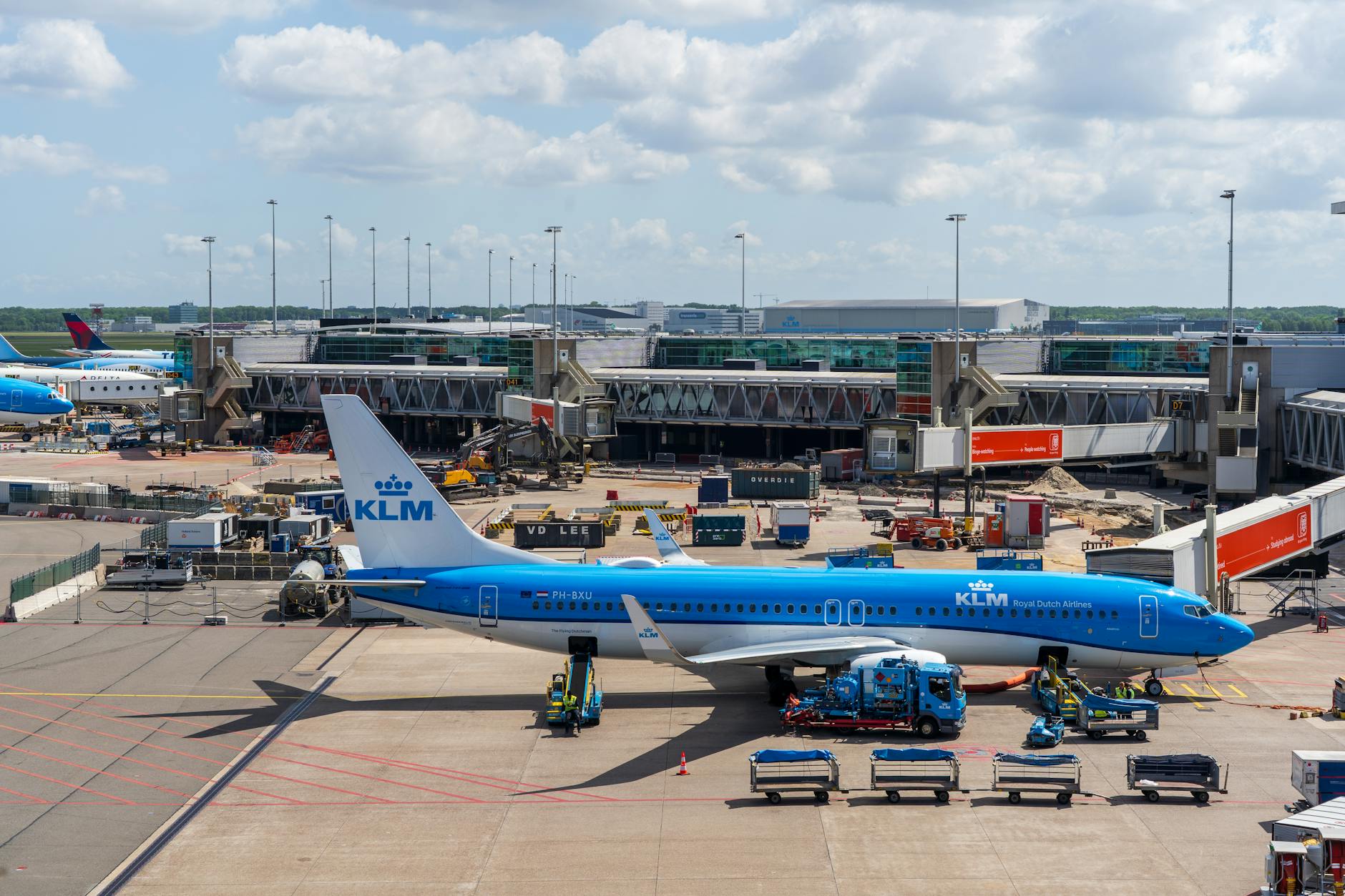
Amsterdam Schiphol Airport (AMS) is located about 17 kilometers southwest of the city center and is extremely well-connected by public transport. Here are your options, ranked by convenience and value; for the full breakdown including night transfers, see our Schiphol to Amsterdam transfer guide.
Train (Recommended)
The train is the fastest, most reliable, and best-value option for most visitors. Direct trains to Amsterdam Centraal Station run eight times per hour from the station located directly beneath the airport terminal, with a journey time of approximately 17 minutes. A one-way ticket costs €4.90 in 2026. Trains also stop at Amsterdam Sloterdijk and Amsterdam Lelylaan if your accommodation is near those stations. You can pay with a contactless bank card (OVpay) by tapping in at the gates — no need to buy a ticket in advance. The train runs from approximately 06:00 to 01:00, with a few night trains on weekends. This is the transport method we recommend for the vast majority of visitors.
Airport Express Bus (397)
The Amsterdam Airport Express bus (line 397) is a good alternative if your hotel is in the museum district or near Leidseplein, as it stops at Museumplein, Rijksmuseum, and Leidseplein — locations the train does not directly serve. A one-way ticket costs €6.50, a return €11.75, and the journey takes 30-40 minutes depending on traffic. Buses run every 10 minutes during the day. The Niteliner N97 night bus covers the same route hourly between midnight and 05:00. Tickets can be purchased from the driver (contactless only) or in advance online.
Taxi and Ride-Hailing
Taxis from Schiphol to the Amsterdam city center cost a fixed rate of approximately €39 for the official Schiphol Taxi, though other taxi companies may charge €40-65 depending on the destination and time of day. The taxi rank is located just outside the Arrivals hall. Uber operates at Schiphol with a designated pickup point; expect to pay €25-45 depending on demand. Taxis are most worthwhile for groups of 3-4 sharing the cost, for late-night arrivals when trains are not running, or when traveling with heavy luggage to a hotel far from a train station.
Hotel Shuttle and Private Transfer
Some hotels offer shuttle services from Schiphol, either free or for a small fee. Shared shuttle services like Connexxion Schiphol Hotel Shuttle serve major hotels for around €18-22 one-way. Private transfers can be pre-booked for €40-60 and are convenient if you want door-to-door service without navigating public transport with luggage. These options are best for families with young children or travelers with mobility considerations.
Taxis, Ride-Hailing, and Car Rental in Amsterdam
Traditional taxis in Amsterdam are widely available but expensive compared to other transport options. A typical cross-city taxi ride costs €15-30, and taxis are not recommended as a primary way to get around. That said, they are useful for late-night travel, airport transfers, and situations where you have heavy luggage. Official Amsterdam taxis are recognizable by their TCA (Taxicentrale Amsterdam) branding. Uber, Bolt, and Free Now all operate in Amsterdam and are usually 20-30% cheaper than street taxis. Always use the app rather than hailing a taxi from the street, as tourist-area taxis occasionally overcharge.
Car rental is actively discouraged for exploring Amsterdam. Driving in the city center is stressful (narrow streets, trams, cyclists everywhere), parking is extremely expensive (€5-7.50 per hour in the center, up to €50-60 per day), and there are increasing restrictions on car access in the canal ring. A rental car only makes sense if you plan extensive day trips to the Dutch countryside, Hoge Veluwe National Park, or destinations in Belgium and Germany. If you do rent a car, park at a P+R (Park and Ride) facility on the city outskirts for around €1 per day and take public transport into the center. For destinations beyond the city, our day trips from Amsterdam guide shows what the trains can reach, and our where to stay in Amsterdam guide covers neighborhoods with better driving access.
Choosing the Best Transport for Your Situation
With so many options available, choosing the right transport depends on your specific situation. Here is a practical guide to matching transport to common scenarios.
For sightseeing in the city center, walking combined with occasional tram rides is ideal. The canal ring, Jordaan, and museum district are all best explored on foot, with trams covering the gaps between areas. For reaching the museum district from Centraal Station, take tram 2 or 12 to Museumplein — the ride takes about 15 minutes and drops you right at the Rijksmuseum and Van Gogh Museum.
For a full day exploring multiple neighborhoods, rent a bike. Cycling lets you cover De Pijp, the Jordaan, Oud-West, and the Plantage area in a single day at a comfortable pace, something that would be exhausting on foot and impractical by tram. For visiting Amsterdam-Noord, take the free ferry from behind Centraal Station — it is the fastest option and the crossing itself is enjoyable.
For evening entertainment, trams and metro are convenient until midnight. After midnight, night buses cover major routes, or taxis and ride-hailing apps fill the gap. For traveling with children or mobility limitations, trams and the metro are fully accessible, with low-floor boarding and wheelchair spaces. For a relaxing experience, a canal cruise is perfect — it requires no physical effort and provides an excellent orientation to the city’s layout.
Practical Transport Tips for Amsterdam Visitors
Money-Saving Tips
Amsterdam is very walkable, so do not overestimate how much public transport you actually need. Many visitors buy multi-day passes and then walk everywhere anyway. For a short stay of 1-2 days focused on the center, OVpay contactless payment for occasional tram rides is usually cheaper than a day pass. For 3+ days with regular transport use, a multi-day GVB pass saves money. The I amsterdam City Card includes unlimited transport plus museum entry — worth calculating if you plan to visit three or more paid attractions. The free ferries to Noord and free walking through the city center mean much of Amsterdam’s transport is already free.
Navigating Amsterdam Digitally
Google Maps provides excellent real-time public transport routing in Amsterdam, including tram, metro, and bus options with live departure times. The GVB app shows live departures and is useful for planning trips. The 9292 app (or 9292.nl) is the Dutch national public transport planner and covers all operators across the Netherlands. Citymapper also works well in Amsterdam. For cycling, Google Maps cycling directions are reliable and show dedicated bike routes. Download offline maps before your trip in case of data issues.
Accessibility
Amsterdam’s public transport is generally accessible, though the historic city center presents challenges. All trams, metro stations, and buses are wheelchair accessible with low-floor boarding. However, many of Amsterdam’s cobblestone streets and canal bridges with steps can be difficult for wheelchair users or those with mobility impairments. Canal cruise companies offer accessible boats — check when booking. The GVB accessibility guide, available on their website, provides detailed information about accessible routes and stations. Major museums including the Rijksmuseum, Van Gogh Museum, and Anne Frank House are all wheelchair accessible.
Keep Exploring Amsterdam Transport
Each mode of transport has its own detailed guide. Once you have the overview above, dive into the specifics that matter for your trip, and pair them with our wider Amsterdam trip planning guide to put the costs in context.
- Amsterdam public transport guide – trams, metro, buses and ferries explained for visitors.
- OV-chipkaart and OVpay guide – which card or ticket is cheapest for your stay.
- Schiphol Airport guide – terminals, layovers, lounges, sleeping and luggage storage.
- Schiphol to Amsterdam guide – every airport transfer option compared.
- Bike rental guide – shops, prices, beginner routes and the cycling rules.
- Amsterdam tram routes guide – the best lines for reaching each attraction.
- Night transport — night buses, trams and taxis after the last service.
- I amsterdam City Card review — the maths on whether it pays for your trip.
- Taxi & Uber costs — what rides really cost and how to pay.
- Free ferries to Noord — routes, times and how to use them.
Once you leave the city the rules change slightly — our guide to the Netherlands by train explains national fares, tapping between operators and where OV-fiets fits in.
Amsterdam Centraal is also an international terminus. Our guide to trains from Amsterdam to Paris, Brussels and London covers Eurostar times and fares, the 30-minute check-in rule that applies only to the London service, and the cheaper conventional route into Belgium.
Arriving by car changes the maths entirely. Our guide to parking in Amsterdam covers the €6 P+R rate, the ten Park and Ride sites, and the ticket condition that quietly cancels the discount if you tap a bank card.
The gap between check-out and a late train is its own logistics problem: our guide to luggage storage in Amsterdam compares free hotel holds, €2 app drop-offs and the €16 lockers at Centraal.
Almost every journey in this guide starts in the same building. Our Amsterdam Centraal station guide maps the two exits, the three tunnels and the platform lettering that sends people to the wrong city.
If you are weighing a hire car, read our guide to driving in Amsterdam and car rental for tourists first — the 100 km/h daytime motorway limit, the average-speed camera network and the cyclist priority rules all differ from what most visitors are used to.
Arriving by sea puts you fifteen minutes’ walk from Centraal: our guide to the Amsterdam cruise port covers the terminal, the walk, the IJtram and what the 2026 cap on calls means for itineraries.
Frequently Asked Questions About Getting Around Amsterdam
What is the best way to get around Amsterdam?
For most visitors, a combination of walking and trams is the most practical approach. The city center is compact enough to walk between most attractions, with trams filling the gaps for longer distances. If you are comfortable cycling, renting a bike is the fastest and most enjoyable way to explore. For a special experience, add a canal cruise to your itinerary — it provides a unique perspective and is wonderfully relaxing.
Do I need a car in Amsterdam?
No. A car is more of a hindrance than a help in Amsterdam. Driving is stressful, parking is extremely expensive (€5-7.50 per hour in the center), and public transport and cycling cover everything you need. The only scenario where a car makes sense is for extensive day trips to rural areas. Even then, trains connect Amsterdam to most popular day trip destinations including Haarlem, Leiden, Delft, The Hague, and Utrecht.
How much does public transport cost in Amsterdam?
Individual trips using OVpay cost a €1.16 boarding fee plus €0.217 per kilometer in 2026 — a typical cross-city tram ride works out to approximately €2-3. GVB day passes cost around €9 for unlimited travel. Multi-day passes reduce the daily cost to around €5.50-7 per day. Children under 4 ride free, and children aged 4-11 pay a flat €5 per day. The free IJ ferries cost nothing.
Is it safe to cycle in Amsterdam as a tourist?
Yes, if you follow the rules and ride confidently. Amsterdam has the best cycling infrastructure in the world, with separated bike lanes on nearly every street. The main risks come from being unpredictable (stopping suddenly, weaving, not signaling) rather than from traffic itself. Start with quieter routes like Vondelpark before venturing into busy areas like Leidseplein or Dam Square. If you are not comfortable on a bike, trams and walking are perfectly good alternatives — you will not miss out on the Amsterdam experience.
How do I get from Schiphol Airport to my hotel?
The train is the best option for most visitors: direct trains to Amsterdam Centraal Station leave every 7-8 minutes, take 17 minutes, and cost €4.90. You can tap your contactless bank card at the gates without buying a ticket. If your hotel is near Museumplein or Leidseplein, the Airport Express bus 397 drops you closer. Taxis cost €39-65 and are best for groups or late-night arrivals. From Centraal Station, trams connect to every neighborhood in the city.