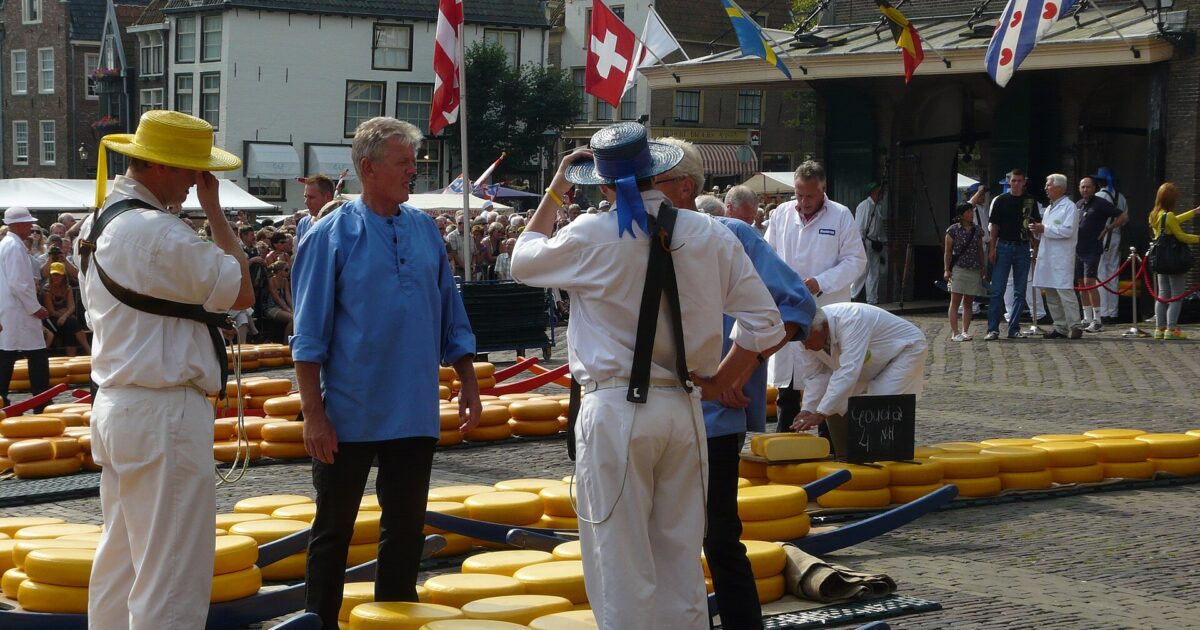
Every Friday morning from spring to autumn, men in white uniforms and coloured straw hats jog across a square in North Holland carrying stacked wheels of cheese on wooden barrows, while other men in blue smocks slap each other’s hands to settle prices that were agreed weeks ago. This is the Alkmaar cheese market, it is free, it takes forty minutes to reach from Amsterdam, and it is one of the most photographed things in the Netherlands.
One thing to know before you set an alarm: this is a performance, not a market. No cheese changes hands here in any commercial sense — the trading was settled in advance and the guild carriers are keeping a four-hundred-year-old craft alive as a piece of living heritage. That is not a criticism. It is genuinely well done, the carriers are members of a real guild with real rules, and watching carriers hurry a barrow holding about 100 kilos of cheese across the square is a proper spectacle. But if you arrive expecting Dutch farmers haggling over their week’s production, you will spend the morning slightly confused. Know what you are watching and it is a good hour.
| Detail | |
|---|---|
| When | Every Friday, 10:00–13:00 |
| Season | Last Friday in March to the last Friday in September |
| Evening market | Tuesdays 19:00–21:00, July and August only |
| Cost | Free — no ticket, no booking |
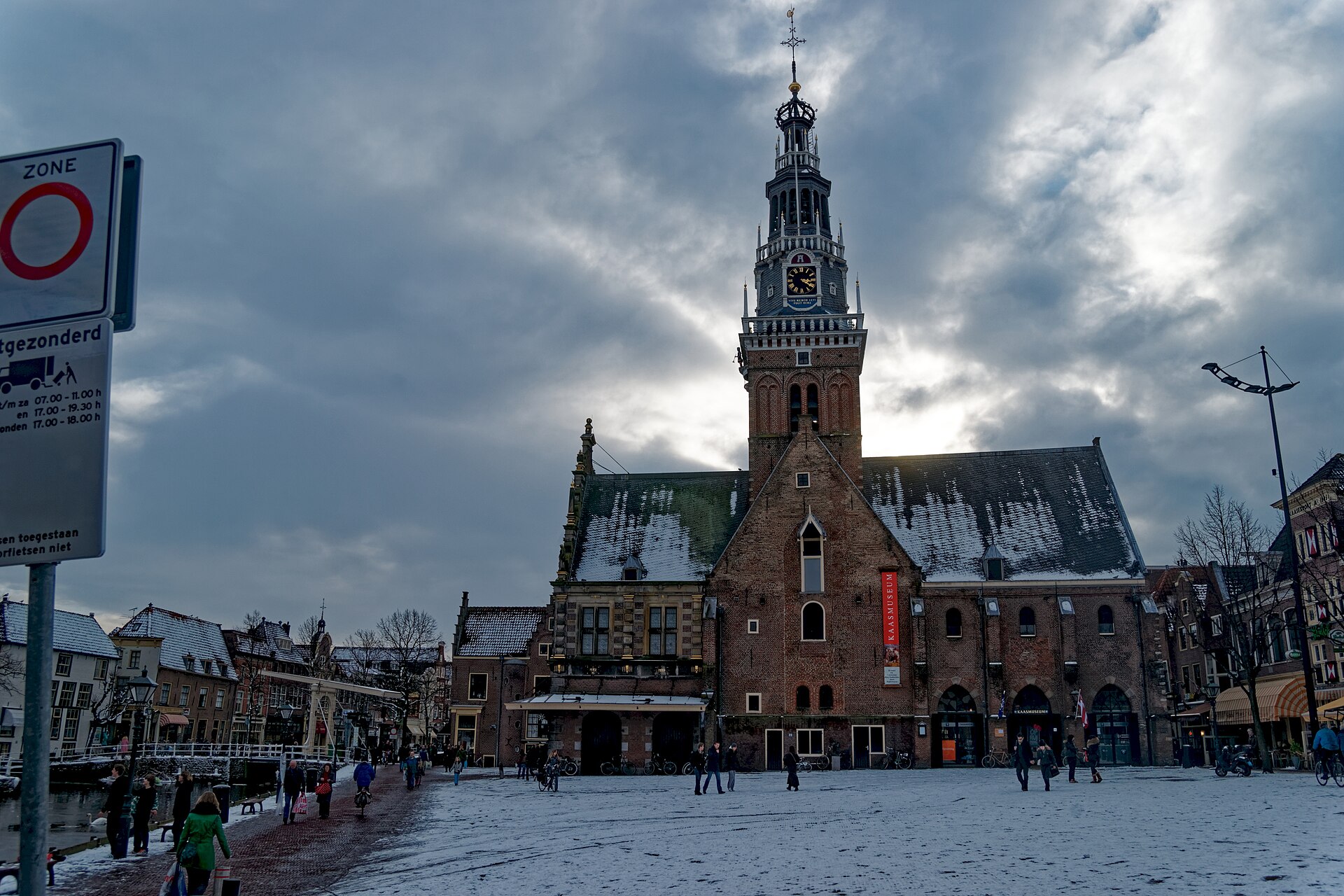
| Where | Waagplein, in front of the Waag weigh house |
| From Amsterdam | 35–40 minutes by direct intercity, around 77 trains a day |
| Dutch Cheese Museum | About €6, on the 2nd and 3rd floors of the Waag |
| Beatles Museum | About €15, Thu–Sat 11:00–16:30, Sun 12:00–16:30, closed Mon–Wed |
| Time to allow | Half a day; a full day if you stay for the town |
| Arrive by | 09:15 for a front-row spot, 09:45 to see anything at all |
Dates and times, precisely
The market runs every Friday from 10:00 to 13:00, from the last Friday in March until the last Friday in September. That is roughly twenty-seven Fridays a year and no other days. Turn up on a Thursday in June or any day at all in November and you will find a pleasant square with a café on it and nothing else.
There is one exception worth knowing: an evening market on Tuesdays from 19:00 to 21:00 during July and August only. It is smaller and less formal than the Friday version, which for many people makes it the better one. If your dates allow a summer Tuesday evening rather than a Friday morning, take it.
Attendance is free. There is no ticket, no booking, no barrier — you simply stand at the railings around the square. This is unusual enough among Dutch attractions to be worth stating plainly, and it means the only thing you are spending is time.
What actually happens
The sequence is fixed and repeats through the morning, which is useful because it means arriving late still gets you a complete cycle.
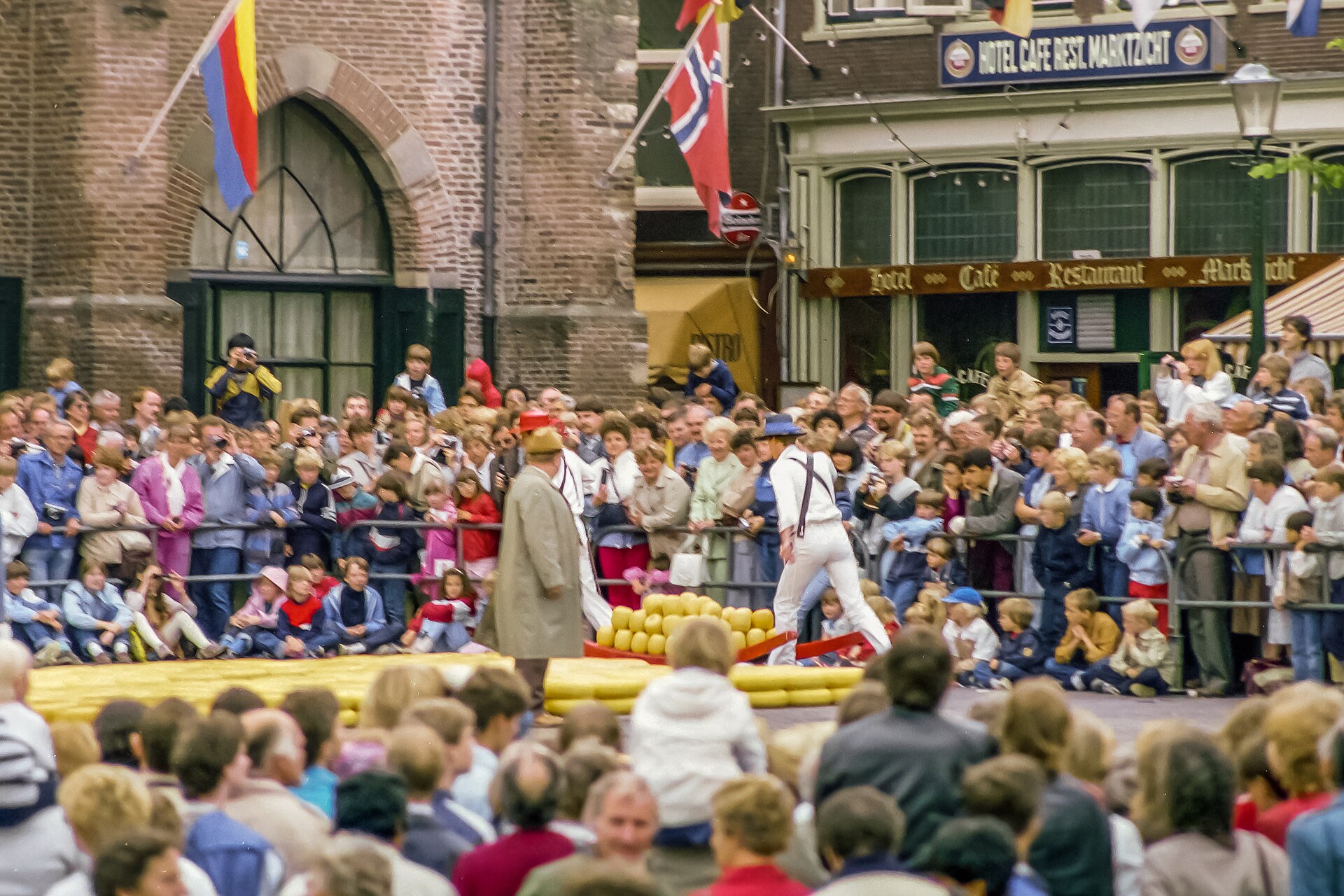
Setting out. Before ten, the cheeses are laid out on the cobbles in long rows — thousands of yellow wheels, mostly Gouda-style, arranged by lot. The Waagplein looks like a field.
The inspection. Buyers in blue smocks work along the rows, cutting small plugs out of the wheels with a cheese iron, smelling, crumbling and tasting. This part is done properly and it is the most interesting thing on the square if you can get close enough to see it.
Handjeklap. Price is settled by handjeklap — hand-clapping — with buyer and seller striking each other’s palms as they call numbers, until a final clap seals the deal. It looks like an argument and ends like a handshake. This is a genuine historic trading practice preserved in performance.
The carrying. The part everyone photographs. Members of the cheese carriers’ guild carry the cheeses out on wooden barrows. A full barrow holds up to eight cheeses of 13 kilos each, about 104 kilos in all. Their straw hats are coloured by company — yellow, blue, red, green — and the guild has its own rules, fines and internal discipline going back centuries.
The weighing. The cheeses are weighed at the Waag, the old weigh house on the square. Then the cycle starts again.
There is commentary throughout, in Dutch and English, and cheese girls and boys in traditional dress circulate to answer questions and hand out samples. The whole thing is well organised and genuinely informative — nobody is pretending it is anything other than a demonstration.
Getting there, and the timing that matters
Direct intercity trains run from Amsterdam Centraal to Alkmaar in about 35 to 40 minutes, with something like 77 services a day, so frequency is not an issue. NS fares are distance-based and fixed — there is no advance-purchase advantage — so tap in and out with OVpay and go when you like. Our OV-chipkaart and OVpay guide covers the mechanics if you have not used it yet.
From Alkmaar station the Waagplein is about a ten-minute walk through the old centre, well signposted and pleasant.
Now the part that decides whether your morning works. The market starts at 10:00 and the railings around the square fill from roughly 09:15. This is a genuinely popular event — coaches from Amsterdam arrive in a block, cruise passengers come in from IJmuiden, and the viewing space is finite.
- Take the train that gets you in around 09:00. That means leaving Amsterdam Centraal around 08:15. You will be at the railings by 09:15 with a clear view.
- Arriving at 10:00 puts you three rows back, watching over shoulders. You will see the carriers, because they are moving and visible; you will not see the inspection or the handjeklap.
- Arriving at 11:30 still gives you the last ninety minutes of the market, which runs until 13:00. Late arrival is a real option if you would rather not get up.
The Waag has a terrace and the buildings around the square have upper-floor cafés — some with a view down onto the market. Those fill early too, but a coffee bought at 09:00 secures a seat and a sightline in one move.
The guild, which is the interesting part
The men in white are not actors hired for the season. The Alkmaar cheese carriers’ guild — the kaasdragersgilde — has existed in some form since 1593, and it still operates as a guild with its own internal structure, discipline and traditions.
It is organised into four companies, each with its own colour of hat: yellow, blue, red and green. Each company has a foreman, the tasman, and above them all sits the kaasvader, the cheese father, who runs the market and settles disputes.
The guild’s own rulebook is where it becomes genuinely charming. Members are fined for swearing, for arriving late, for a dirty uniform, for dropping a cheese. The fines go into a common fund. This is not a re-enactment invented for tourists in the 1970s — it is an institution with roots going back centuries (the weighing rights date from 1365, the carriers’ guild from 1593) that happens to have outlived its commercial purpose and kept going anyway, which is a very Dutch outcome.
Knowing this changes what you watch. The half-run is not showmanship, it is load management. The hat colours are not costume, they are employer. The hand-clapping is a real pricing language. Once you see the morning as a working guild doing its craft in public rather than a show put on for you, it gets considerably better.
Is it worth the trip?
Our honest answer is a qualified yes, with two conditions.
Go if you are in Amsterdam on a Friday in season, you can leave by 08:15, and you are prepared to treat it as one part of a day in Alkmaar rather than the whole point. Forty minutes each way for a free, genuinely distinctive piece of living heritage is a good trade, and the town around it holds up.
Do not go if your only free Friday is precious and you would otherwise spend it in Utrecht or Rotterdam, or if you cannot make an early start. The market is forty minutes of watching, and standing at the back of a large crowd for a staged event is a well-known route to disappointment.
And a word on the coach tours. Several operators sell an Alkmaar cheese market excursion from Amsterdam, usually bundled with Zaanse Schans or Volendam. They cost considerably more than a train ticket of about €8–10 each way, and they arrive in the block that creates the crowd you then have to stand behind. The train is faster, cheaper and puts you there first. Our page on guided day tours from Amsterdam is honest about which organised trips genuinely add something — this is not one of them.
The rest of Alkmaar
Leaving at 13:00 with the crowd is a mistake: the town becomes rather lovely once the market is over. It is a proper old Dutch centre with canals, and it takes a couple of hours to walk.
Dutch Cheese Museum
On the second and third floors of the Waag itself, about €6, with a view straight down onto the Waagplein. It covers how cheese is made, the history of the trade and the guild, and the equipment. Modest, cheap and genuinely worth the half hour — and the view alone justifies the ticket on a market day if you can get up there before the crowd.
The Beatles Museum
Yes, really. Alkmaar’s Beatles Museum describes itself as the largest in the world. About €15, open Thursday to Saturday 11:00 to 16:30 and Sunday 12:00 to 16:30, closed Monday to Wednesday. It is entirely incongruous and, if you have any interest in the band, disproportionately good. If you do not, skip it without guilt.
The old town and the canals
Alkmaar has a compact ring of canals and a well-preserved centre. The Grote Sint-Laurenskerk is a large late-Gothic church with a famous organ. The Bierkade and the streets running off the Waagplein hold the cafés. Boat trips run round the canals in season and are a decent way to see the place from the water at a fraction of Amsterdam prices — our canal cruises compared page gives you the benchmark.
There is also a serious piece of history here that the cheese rather overshadows. Alkmaar withstood a Spanish siege in 1573 — Van Alkmaar begint de victorie, “victory begins at Alkmaar”, is a phrase every Dutch schoolchild learns, and it marks a turning point of the Eighty Years’ War. Our Amsterdam history timeline and Dutch Golden Age pages cover what followed.

Buying cheese, properly
A market day is a poor time to buy cheese well. The stalls around the edge sell to a captive crowd, the range is aimed at souvenirs, and everything is priced accordingly.
If you want cheese to take home, go to a real cheese shop — in Alkmaar or back in Amsterdam — where you can taste before you commit, ask about age, and have it vacuum-packed for travel. Age is the variable that matters: jong at four weeks is mild and rubbery, belegen at four months is where most people find the sweet spot, and oude at a year or more goes crystalline and sharp. Hard aged cheese travels perfectly well in either hold or hand luggage — it is not a liquid. Our guide to Dutch cheese and where to buy it names the shops worth the walk and explains the labels.
One thing to skip: the airside cheese at Schiphol, which is marked up hard against a city shop and chosen for the packaging rather than the contents. We go through what is and is not worth buying at the airport in Schiphol shopping and tax-free.
Combining it with something else
A market morning ends at 13:00, which leaves most of a day. Three sensible options:
- Stay in Alkmaar. Lunch on the Bierkade, the Cheese Museum, the old town, a canal boat. Home by six, relaxed.
- Head to the coast. Bergen aan Zee and Egmond aan Zee are short bus rides west, with wide North Sea beaches and dunes. In summer this is the better half of the day.
- Do not try to add Zaanse Schans. It is technically on the way back and it will be at peak crowd by the time you arrive. Pick one windmill experience and give it a proper morning — our Zaanse Schans guide explains why timing is everything there.
For the wider picture of what else is reachable, our pillar on the Netherlands beyond Amsterdam ranks everywhere the trains go, and our day trips from Amsterdam page covers the shorter hops.
Where to stand, and where to eat
The Waagplein is not a big square, and the viewing positions are not equal.
The area in front of the Waag itself is where the weighing happens, which makes it a good place to start.
The long sides along the cheese rows put you closest to the inspection and the hand-clap pricing, which are the parts most people miss entirely because they are looking for the running. If you have seen photographs and want to see something else, stand here.
The café terraces around the edge, and particularly the upper floors, are the comfortable option: a coffee bought at 09:00 buys you a seat, a table and a sightline for three hours. It costs the price of a drink and it removes every complaint on this page about standing on cobbles.
For lunch afterwards, walk away from the square. The Bierkade and the streets running off it hold the places locals use, and prices drop noticeably within two minutes of the Waagplein. Order a broodje with a decent aged cheese and be honest with yourself that this is the closest you will come to eating the thing you just watched.
Practical notes
- It runs in the rain. The market goes ahead in most weather. Take a waterproof — see our weather by month guide.
- Standing, not sitting. Two to three hours on cobbles if you commit to the whole thing. Shoes matter.
- Children see nothing from behind adults. Front row or a café window, or accept that this is a grown-up morning.
- Cashless. As across the Netherlands, card or phone almost everywhere.
- Check the operator’s calendar before you travel. The season’s start and end dates shift with the calendar each year, and individual Fridays are occasionally affected.
- Gouda has its own version on Thursday mornings in summer, which is smaller and less rehearsed. If Alkmaar’s Friday does not fit, that is the alternative.
More on the other cheese town, its Thursday market and its old market square in our Gouda travel guide.
Keep Exploring
- The Netherlands Beyond Amsterdam
- Day Trips from Amsterdam
- Zaanse Schans Windmills
- Volendam & Marken
- Haarlem Day Trip
- Utrecht Travel Guide
- Dutch Cheese: Where to Buy It
- Must-Try Dutch Foods
- Amsterdam Markets Guide
- OV-chipkaart & OVpay Guide
- Guided Day Tours from Amsterdam
- Weather Month by Month
Frequently Asked Questions
When is the Alkmaar cheese market held?
Every Friday from 10:00 to 13:00, running from the last Friday in March to the last Friday in September. There is also an evening market on Tuesdays from 19:00 to 21:00 during July and August only. It does not run outside those windows.
Is the Alkmaar cheese market free?
Yes. There is no ticket, no booking and no barrier — you stand at the railings around the Waagplein. The Dutch Cheese Museum inside the Waag charges about €6 and has a view down onto the square, which is worth it on a busy market day.
How do you get to Alkmaar from Amsterdam?
Direct intercity trains from Amsterdam Centraal take 35 to 40 minutes, with around 77 services a day. Fares are distance-based and fixed, so tap in and out with OVpay. The Waagplein is a ten-minute signposted walk from Alkmaar station.
What time should I arrive at the Alkmaar cheese market?
Early, for a place at the railings: the market starts at 10:00 with the bell, so aim to be on the square before then and plan your train from Amsterdam Centraal around that. The market runs until 13:00, so arriving at 11:30 still catches the last ninety minutes.
Is real cheese actually traded at Alkmaar?
No — the deals are settled in advance and what happens on the square is a preserved demonstration of how the trade was conducted. The carriers belong to a genuine guild with real rules, and the inspection and hand-clap pricing are authentic practices, but no commercial trading depends on the morning.
Can you buy cheese at the market?
Stalls around the square sell to visitors, but a market day is a poor time to buy well — the range is souvenir-focused and priced for a captive crowd. A proper cheese shop, in Alkmaar or Amsterdam, will let you taste, tell you the age and vacuum-pack for travel.
Is Alkmaar worth visiting apart from the market?
Yes, and the town is at its best after 13:00, once the market is over. There is a canal-ringed old centre, the Grote Sint-Laurenskerk, the Dutch Cheese Museum, an unexpectedly good Beatles Museum, and beaches at Bergen aan Zee and Egmond aan Zee a short bus ride west.
Should I book a coach tour to the cheese market?
We would not. Coach excursions cost considerably more than a cheap return train, and they arrive in the block that creates the crowd you then stand behind. The train is faster and puts you at the railings first.