Maastricht sits at the bottom of a narrow strip of the Netherlands that hangs down between Belgium and Germany, two and a half hours from Amsterdam, and it does not feel like the same country. It is Roman in origin, Catholic in culture, Burgundian in its attitude to lunch, and built in pale limestone rather than brick. This guide covers the Maastricht things to do that make the journey worthwhile, and is direct about the one thing that matters most: this is not a day trip.
You can technically reach Maastricht and return in a day, and you should not. Five hours of trains for six hours in the city is a poor trade when the city’s whole character is unhurried — long lunches, a bookshop you want to sit in, cave tours that take an hour and ten minutes each, squares designed for sitting on. Two nights turns a strained excursion into a genuine second destination, and Maastricht hotel rates run well below Amsterdam’s. If you only have three days in the Netherlands, go to Utrecht instead and save this one.
| Detail | |
|---|---|
| From Amsterdam | About 2h 30m by direct intercity |
| From Utrecht | 1h 58m, roughly €29–45 |
| To Groningen | No direct train — about 4h 29m via Utrecht, €60–73 |
| Bonnefanten Museum | €22 adult, €11 student · Tue–Sun 11:00–17:00 · Avenue Ceramique 250 |
| Grotten Noord cave tour | About 1h 10m, daily year-round |
| Grotten Zonneberg | About 1h 10m, selected dates, WWII shelter galleries |
| Fort Sint Pieter | About 1 hour, daily year-round |
| Cave tour group size | Up to 14 people on a regular tour |
| Language | English tours exist but schedules are not published — check before booking |
| How long you need | Two nights minimum; three if you want the Belgian side too |
Why Maastricht feels foreign
A little history explains almost everything you will notice.
The Romans forded the Meuse here and built a settlement — Mosae Trajectum, the Meuse crossing — which makes Maastricht one of the oldest cities in the Netherlands. It stayed on the main road between Cologne and the coast, which meant trade, fortification and repeated sieges. It also stayed Catholic through the Reformation while the north went Protestant, and that single fact separates it from Amsterdam more than the distance does.
The consequences are physical. Maastricht has two enormous Romanesque churches rather than the tall brick Gothic of the north. It has squares with terraces where the northern cities have canals with terraces. It was fortified into the nineteenth century, so there are city walls and a fort where Amsterdam simply spread. And the local limestone — marl, quarried from the hill on the city’s southern edge — gives the buildings a pale, warm colour that looks Belgian or French rather than Dutch.
The food follows. This is the Burgundian south: lunch is a meal rather than a sandwich, the beer culture leans towards Belgian abbey styles, and Limburgse vlaai — a wide, flat fruit tart — appears on every café table. People in Maastricht will tell you they are closer to Brussels, Cologne and Liège than to Amsterdam, and they are right on all three counts.
The essential things to do
Boekhandel Dominicanen
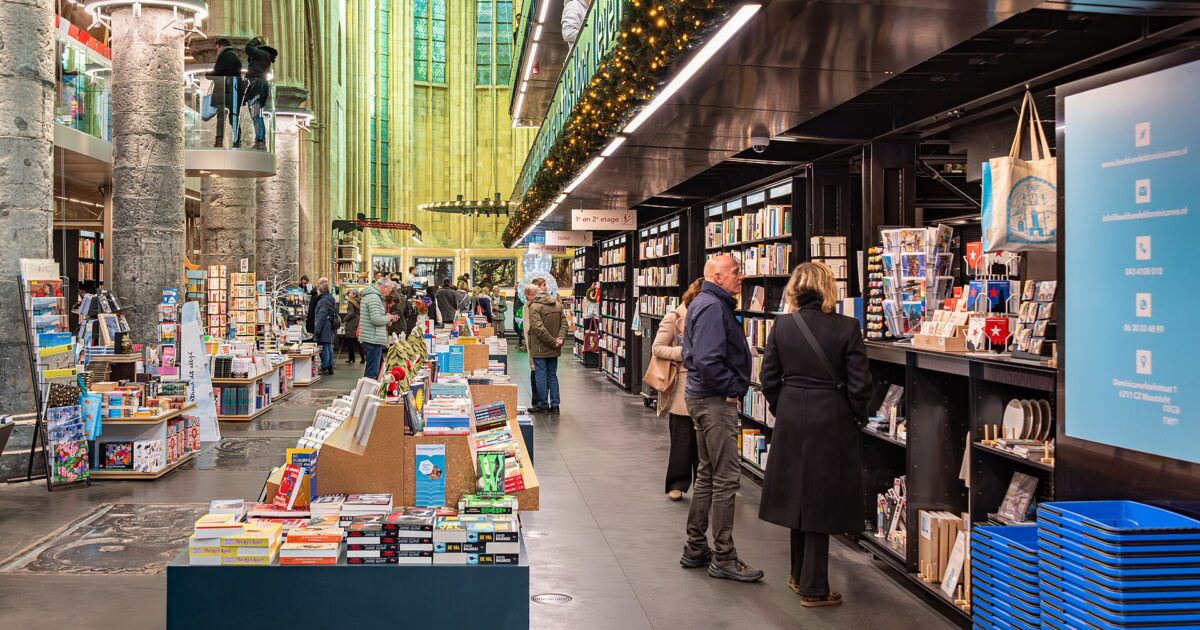
A bookshop in a thirteenth-century Dominican church, with a three-storey black steel structure inserted down one side of the nave so you browse at clerestory height while the Gothic vaulting carries on above you. It turns up on many “world’s most beautiful bookshops” lists, and unusually for such things it deserves the position.
What makes it work is that it is a functioning shop rather than a monument — people buy books here, there is a café in the choir under a surviving fresco, and nobody hurries you. Go in even if you do not read Dutch; the English and art sections are substantial and the building is the point.
The Sint-Pietersberg caves
The hill south of the city is riddled with a man-made labyrinth of tunnels, cut over centuries by marl quarriers. Estimates of the total run into thousands of passages. Two sections are open to visitors, both by guided tour only, both about an hour and ten minutes, and you cannot enter alone — the tunnels are genuinely dangerous without a guide.
- Grotten Noord (North Caves) — runs daily year-round, and is the one to pick for the charcoal drawings, carved inscriptions and paintings left on the walls across several centuries. Tunnel heights vary considerably.
- Grotten Zonneberg — runs on selected dates, and is the more structured gallery system. This was the sheltering place prepared for up to 50,000 people during the Second World War, and there is an optional museum section including a replica of Rembrandt’s Night Watch, a nod to the wartime evacuation of Dutch national treasures into caves like these.
Regular tours take up to fourteen people; larger groups need to book privately. English-language tours exist, but the operator does not publish which departures run in which language — check before you travel rather than turning up hopefully. It is around 10°C underground year-round, so take a layer even in August.
Fort Sint Pieter
On the same hill, an eighteenth-century pentagonal fort with underground galleries, casemates and a view over the Meuse valley and into Belgium. Tours run about an hour, daily year-round. It combines naturally with a cave tour and the walk up through the Sint-Pietersberg nature reserve is pleasant in itself.
The two great churches
The Sint-Servaasbasiliek on the Vrijthof is built over the grave of Saint Servatius, the first bishop in the Low Countries, who died here in the fourth century — and a church has stood over the grave since the sixth century. The treasury holds a genuinely extraordinary collection of medieval reliquaries.
The Onze-Lieve-Vrouwebasiliek, a few minutes away, is older-feeling still — a heavy, fortress-like Romanesque westwork that looks defensive because it was. Inside, the chapel of the Star of the Sea is lit with hundreds of candles and is one of the more quietly affecting spaces in the country, regardless of what you believe.
Bonnefanten Museum
€22 adult, €11 student, open Tuesday to Sunday 11:00 to 17:00, at Avenue Ceramique 250 across the river in the Céramique district. Aldo Rossi’s building — with its distinctive rocket-shaped zinc cupola on the riverbank — is worth the walk on its own. Inside, the collection splits between early Netherlandish and Italian medieval painting and a strong contemporary holding, which is an unusual and rather good combination.
The Vrijthof and Onze-Lieve-Vrouweplein
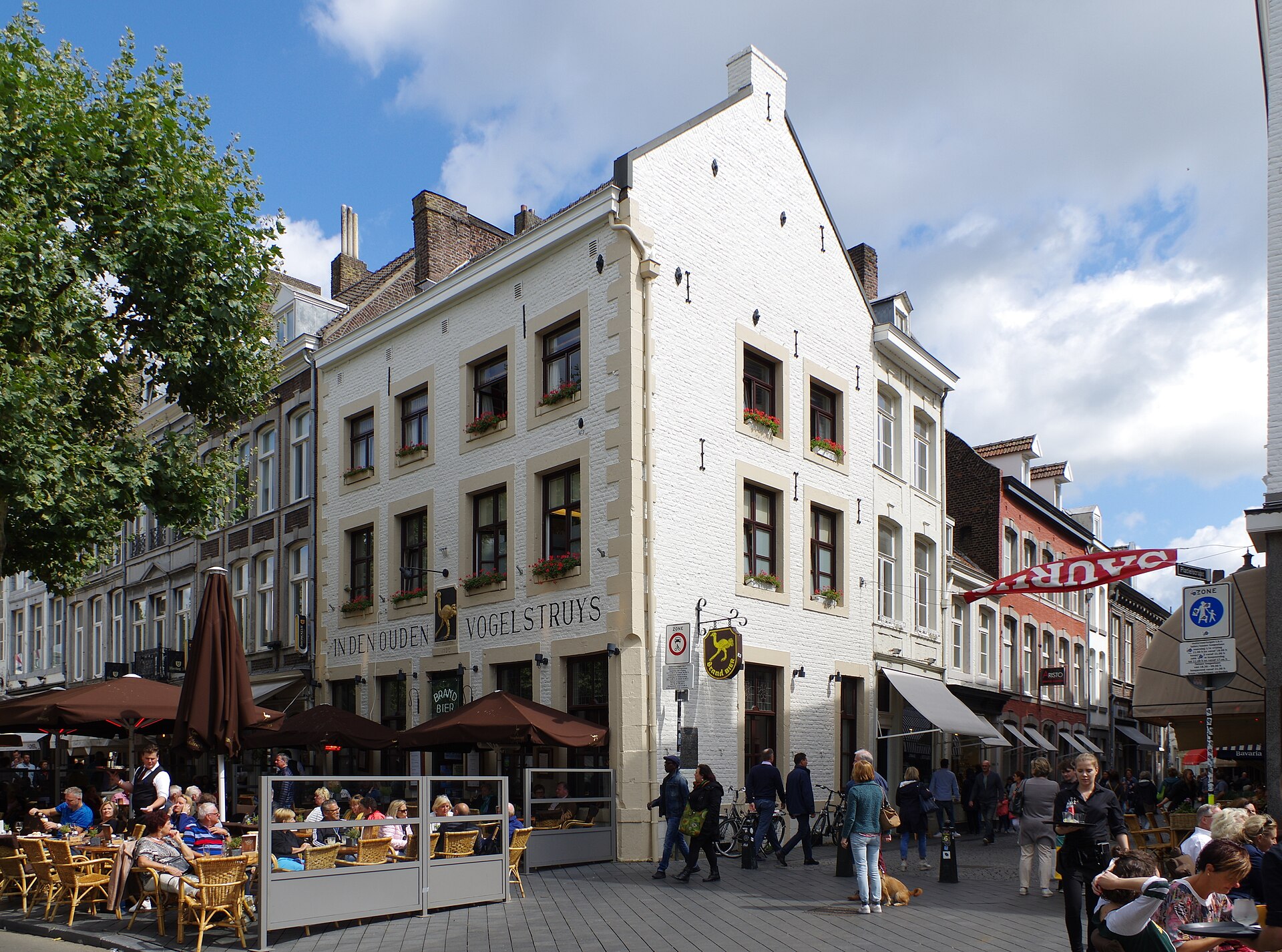
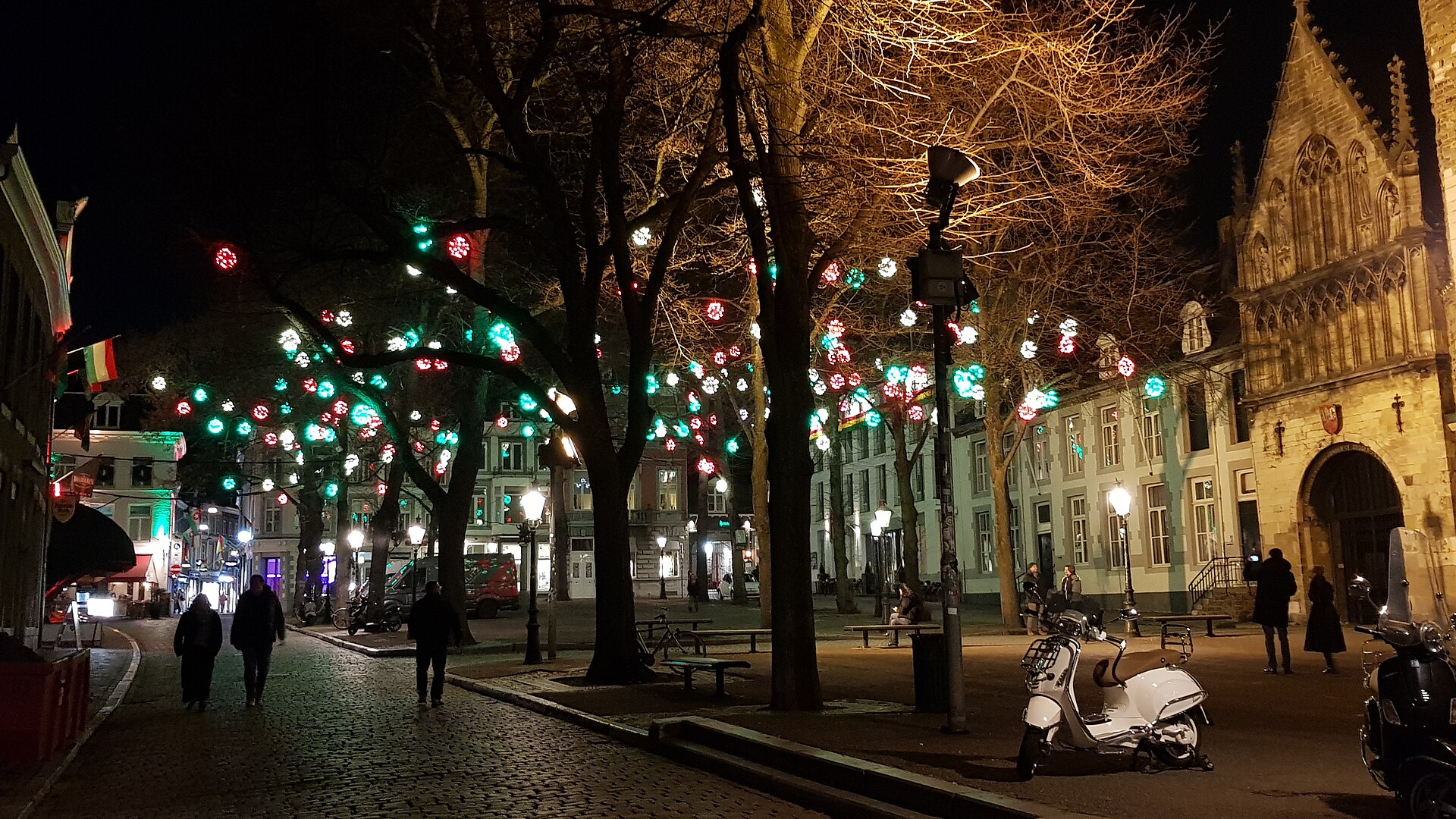
Maastricht’s two great squares, and they serve different purposes. The Vrijthof is the big one — wide, tree-lined, ringed with terraces, and the venue for the city’s carnival and for André Rieu’s summer concerts, which fill the city and every hotel room in it. The Onze-Lieve-Vrouweplein is smaller, shadier and more intimate, and is where residents go when the Vrijthof is full of visitors.
Walking the city
Maastricht’s centre is small and split by the Meuse, and the walk itself is one of the pleasures.
- Sint Servaasbrug — the thirteenth-century stone bridge across the Meuse, pedestrianised, and the best view back at the old town.
- Helpoort — the oldest surviving city gate in the Netherlands, dating from around 1230, with a stretch of medieval wall running away from it through a park.
- Jekerkwartier — the quarter along the small Jeker river, with mill races, student houses and the old city walls. The prettiest and least commercial part of the centre.
- Stokstraatkwartier — a restored quarter of seventeenth- and eighteenth-century houses, now the expensive shopping streets.
- Wyck — across the river by the station, once the poor relation and now the good-food district, with the independent kitchens and the better coffee.
- Céramique — the modern district south of Wyck, built on a former ceramics works, with the Bonnefanten and a good deal of contemporary Dutch architecture.
Two hours covers the lot at a walking pace. Cross the river at least twice; the two banks feel different and the Meuse is the reason the city exists.
Eating and drinking
This is the part northern Dutch people are slightly envious about. Maastricht takes lunch seriously and eats later than the rest of the country. The Limburg specialities worth ordering:
- Limburgse vlaai — the flat open fruit tart, sold everywhere, best with apricot or cherry. Not optional.
- Zuurvlees — beef stewed in vinegar and gingerbread until it goes sweet-sour and thick. The regional dish, usually with fries.
- Rommedoe — a pungent local soft cheese for the brave.
- Abbey and trappist beers — the Belgian border is a few kilometres away and the beer lists reflect it far more than they do in Amsterdam. Our craft beer guide covers the northern scene for contrast.
Wyck across the river is where to look for a proper dinner. The Vrijthof terraces are for drinking and watching rather than for eating well; that is a fair trade and everyone knows it. For the national context, our guide to must-try Dutch foods covers what the rest of the country eats — and how different this is.
Getting there and getting around
Direct intercity trains run from Amsterdam Centraal to Maastricht in about two and a half hours, via Utrecht and Eindhoven. From Utrecht it is 1 hour 58 minutes at roughly €29–45. Fares are distance-based and fixed, so there is no advance-booking advantage — tap in and out with OVpay and go when you like. Our OV-chipkaart and OVpay guide covers the mechanics.
One warning about onward travel: Maastricht is at the end of the line, and cross-country journeys are slow. There is no direct train to Groningen — that is about four and a half hours via Utrecht at €60–73. Plan Maastricht as an out-and-back from the Randstad rather than a stop on a loop.
In the city, walk. The centre is compact and the station is a ten-minute walk from the Vrijthof across the Sint Servaasbrug. Buses exist and take OVpay, but you will rarely want one. The caves and Fort Sint Pieter are about forty-five minutes on foot from the centre, or a short bus ride, or a very pleasant walk along the Meuse.
Belgium and Germany are both close enough to matter. Liège is about half an hour by train, Aachen — Charlemagne’s capital, with a cathedral to match — about an hour by bus, and Brussels is reachable in an afternoon. If you are already down here, using Maastricht as a base for a day across a border is one of the better ideas available. Our pillar on the Netherlands beyond Amsterdam sets out how the wider country connects.

Where to stay
Maastricht is small enough that location matters less than it does in a big city, but the districts do have characters.
The old town, around the Vrijthof and the Stokstraatkwartier, puts you in the middle of everything and is where the historic hotels are — several of them in converted monasteries and churches, which is a local speciality worth seeking out. It is also the noisiest, particularly on a Friday when the terraces run late.
Wyck, across the river beside the station, is the pragmatic choice: five minutes from the train, ten minutes from the Vrijthof over the bridge, and where the better restaurants are. If you are arriving with a bag and leaving early, stay here.
The Jekerkwartier is the quietest and prettiest, with smaller guesthouses and the city walls at the end of the street. Best if you are staying three nights or more and want to feel resident rather than visiting.
A couple of nights is the argument of this guide, and it is easiest to arrange outside carnival, the July concert period and any weekend when the MECC conference centre has something large on, when the city can sell out entirely. Book ahead for those and take whatever you can get.
When to go, and when not to
Late spring and early autumn are ideal: terrace weather, everything open, no crowds to speak of.
Carnival, in February before Lent, is the big one. Maastricht celebrates it properly — three days of costumed chaos, brass bands and a city that stops functioning in the normal sense. It is a genuine cultural experience and it is not a good time to visit if you wanted quiet museums; the Netherlands north of the rivers barely marks it, which tells you a great deal about the Catholic south.
Early July brings the André Rieu concerts on the Vrijthof, which fill every hotel room in the region and raise every rate. Wonderful if that is why you came; expensive and difficult if it is not.
December is quietly lovely — Magisch Maastricht turns the Vrijthof into a Christmas market with a rink, and the Catholic south does Christmas with more conviction than the north. Compare it against our Amsterdam Christmas guide if you are choosing.
Check the calendar before booking either way. A city of 120,000 people with a limited hotel stock empties very quickly when something is on.
Two days in Maastricht
Day one. Arrive late morning, drop bags, walk over the Sint Servaasbrug into the old town. Vrijthof for lunch on a terrace — take your time, that is the local instruction. Sint-Servaasbasiliek and its treasury in the afternoon, then Boekhandel Dominicanen and an hour you did not intend to spend there. Dinner in Wyck. Finish with a drink on the Onze-Lieve-Vrouweplein.
Day two. Walk out to Sint-Pietersberg in the morning for a cave tour and Fort Sint Pieter — book both ahead and confirm the language. Back down along the Meuse for lunch, then the Bonnefanten in the afternoon. Spend the last of the light in the Jekerkwartier, one of the prettiest and quieter parts of the city.
If you have a third day, cross a border. Liège for the vertiginous station and the Sunday market, or Aachen for the cathedral. Both are closer than Rotterdam.
Is it worth the journey?
Yes, with the condition stated at the top: give it two nights. Maastricht is the best argument in the country for the idea that the Netherlands is not Amsterdam — a Catholic, stone-built, food-obsessed, Roman-founded city that shares a nationality with the canal ring and very little else.
It is not, however, a substitute for anything. If you have never been to the Netherlands and have four days, spend them in Amsterdam with a day in Utrecht or Haarlem. Maastricht is a second-visit city, or a longer-trip city, or the reason to add three days onto a trip you were going to take anyway. On those terms it is one of the most rewarding places in the country.
Keep Exploring
- The Netherlands Beyond Amsterdam
- Utrecht Travel Guide
- Efteling Theme Park Guide
- Day Trips from Amsterdam
- Rotterdam Day Trip
- OV-chipkaart & OVpay Guide
- Must-Try Dutch Foods
- Craft Beer & Brewery Guide
- Dutch Culture & Etiquette
- One Week in Amsterdam
- Christmas in Amsterdam
- Eindhoven & Rotterdam Airports
Frequently Asked Questions
How do you get from Amsterdam to Maastricht?
Direct intercity trains run from Amsterdam Centraal in about two and a half hours, via Utrecht and Eindhoven. Fares are distance-based and fixed, so no advance booking is needed — just tap in and out with OVpay. From Utrecht it is 1 hour 58 minutes at roughly €29–45.
Is Maastricht worth a day trip from Amsterdam?
Not really. Five hours of travel for six hours in a city whose whole character is unhurried is a poor trade. Two nights turns it into a proper second destination, and Maastricht hotel rates are well below Amsterdam’s. For a day trip, Utrecht or Rotterdam serve far better.
Can you visit the Sint-Pietersberg caves without a guide?
No. The tunnels are a genuine labyrinth and entry is by guided tour only. Grotten Noord runs daily year-round and Grotten Zonneberg on selected dates, each about an hour and ten minutes, with up to fourteen people per regular tour. It is around 10°C underground, so bring a layer.
Are the Maastricht cave tours available in English?
English tours exist, but the operator does not publish which departures run in which language on its overview pages. Check the booking page or contact them directly before you travel rather than assuming — and book ahead, since group sizes are capped at fourteen.
What is Maastricht famous for?
The 1992 Maastricht Treaty that created the European Union, the Sint-Pietersberg cave labyrinth, Boekhandel Dominicanen — a bookshop inside a thirteenth-century church — Vastelaovend, its three-day carnival, and a Burgundian reputation for food and drink.
How much does the Bonnefanten Museum cost?
€22 for adults and €11 for students, open Tuesday to Sunday 11:00 to 17:00 at Avenue Ceramique 250. Aldo Rossi’s building with its rocket-shaped riverside cupola is worth the walk in itself, and the collection pairs early Netherlandish and Italian painting with strong contemporary work.
Why does Maastricht feel different from the rest of the Netherlands?
It is Roman in origin, stayed Catholic through the Reformation while the north turned Protestant, is built in pale local limestone rather than brick, and sits closer to Brussels, Liège and Cologne than to Amsterdam. The food, the squares and the carnival all follow from that.
When is the worst time to visit Maastricht?
Early July, when the André Rieu concerts on the Vrijthof fill every hotel room in the region and raise every rate — unless that is why you are coming. Carnival in February is chaotic in the best way but not a time for quiet museum visits.