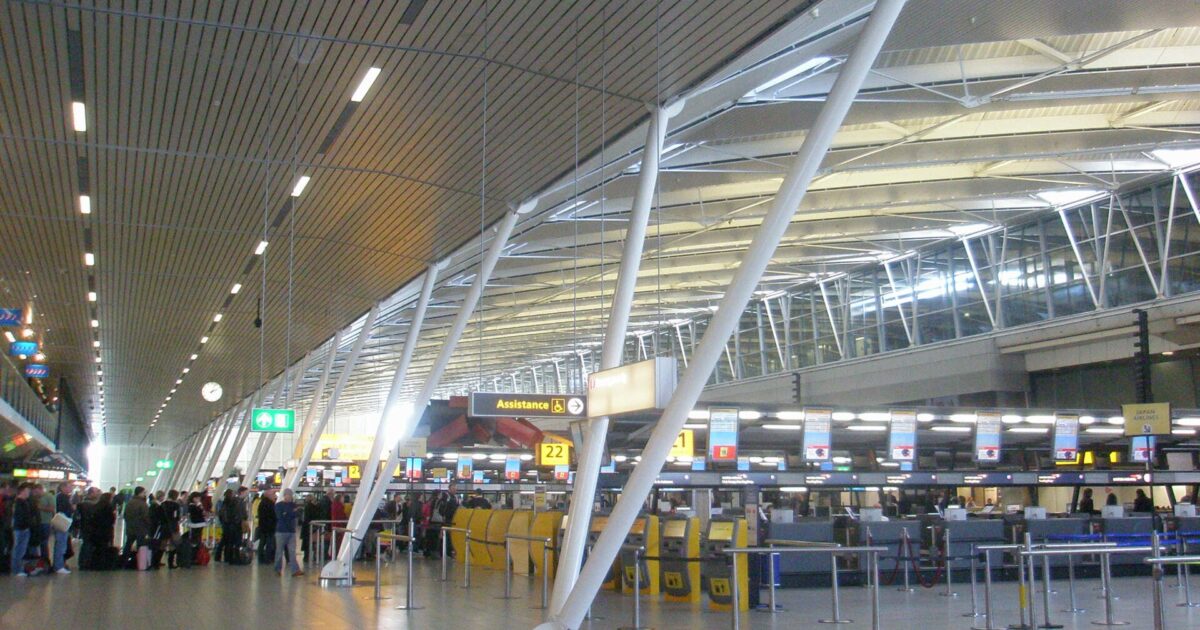
The single most searched question about this airport is some version of the Schiphol security wait time, usually asked at eleven at night by someone deciding whether to set an alarm for four or half past four. This page answers it properly: what the queues are actually doing in 2026, how the free time-slot system works, how early to arrive for each kind of flight, and which of the paid fast-track options is worth money.
The framing that saves most people from a bad morning is this: Schiphol has two queues, not one, and they are completely different problems. Security screening is the one everybody plans for, and it is now largely solved by a free booking system almost nobody uses. Passport control is the one that has gone badly wrong in 2026, since the EU’s Entry/Exit System came in, and no amount of arriving early at security helps you with it. Work out which queue applies to you before you decide what time to leave.
How early to arrive at Schiphol
The airport’s own guidance, with the 2026 adjustments that actually matter.
| Your flight | Be at the airport | The real constraint |
|---|---|---|
| Schengen, hand luggage only | 2 hours | Security, and the walk to the pier |
| Schengen, with a checked bag | 2–2.5 hours | Bag drop closes early |
| Non-Schengen, EU passport | 3 hours | Security plus a short border check |
| Non-Schengen, non-EU passport | 3 hours minimum | EES exit registration |
| Connecting, Schengen to Schengen | 40 min published minimum | The walk between piers |
| Connecting, into a Schengen flight | 2–2.5 hours realistically | The border, not security |
What changed in 2026
Two things, and conflating them is the source of most of the confusion online.
Security screening changed hands in May. On 18 May 2026 Schiphol transitioned to a new security organisation, and waits lengthened noticeably around that changeover. The operation has settled since, but the airport has been more cautious in its advice ever since, and it is worth taking that advice at face value rather than assuming padding. Industrial action in the security workforce has also disrupted individual days during 2026 — not something you can plan around, but a reason to check the airport’s own channels the night before rather than relying on a wait time you read in a forum.
The border changed in April. The EU Entry/Exit System came into force on 10 April 2026, replacing passport stamps with biometric registration for non-EU travellers. Waits at Schiphol passport control have run to around two hours, roughly fifty per cent longer than before, and this affects departures as well as arrivals: leaving the Schengen area now means an exit registration too. Schiphol installed 161 self-service kiosks so travellers can pre-register before reaching a border guard, which helps, but does not eliminate the queue. A temporary permission to switch off the biometric step during peak congestion ran only to early September 2026, so check the current position rather than assuming a shortcut still exists.
If you hold an EU or Schengen passport, the second problem is largely not yours. If you do not, it is the only one that matters. Our layover guide works through what that does to connecting flights.
The free time slot, which is the actual answer
Schiphol lets you reserve a free time slot for the security check, and it is the single most useful thing on this page. It launched for Schengen departures in April 2026 and has since been extended to all international travellers, Schengen and non-Schengen alike.
How it works:
- Book online or in the Schiphol app, from three days before your departure date.
- You choose a fifteen-minute window.
- At the airport, go to the lane marked Reserved for time slots and scan your QR code.
- It costs nothing.
The catch, such as it is, is that slots for the busiest windows go early, so book as soon as the three-day window opens rather than on the way to the airport. And the slot covers security only — it does nothing for bag drop and nothing at all for passport control, which is where the long queue now lives.
Our view is straightforward: book one for every departure, every time. It is free, it takes a minute, and on a bad morning it is the difference between twenty minutes and an hour.
Liquids, laptops and what stays in the bag
Schiphol’s rules here are a slightly odd combination that catches out people who have flown through other European airports recently.
The 100ml limit applies. Since 1 September 2024, following European Commission guidance, Schiphol has been back to the international standard: liquids and gels only in containers of 100ml or less, all of them in a single transparent, resealable one-litre bag. Some other EU airports with approved scanners have lifted the limit; Schiphol has not. Do not arrive with a 500ml bottle of shampoo because a friend flew through Milan with one.
But it stays in your bag. Schiphol’s CT scanners mean you do not have to take the liquids bag or your laptop out of your hand luggage at the checkpoint. You keep everything packed and put the whole bag on the belt. This is what makes the queue move quickly once you are in it, and it is why the trays here are emptier than you expect.
So: pack to the 100ml rule as if it were 2019, then behave at the belt as if it were 2030. Get either half wrong and you will be the person holding up the line.
Bag drop is the other deadline
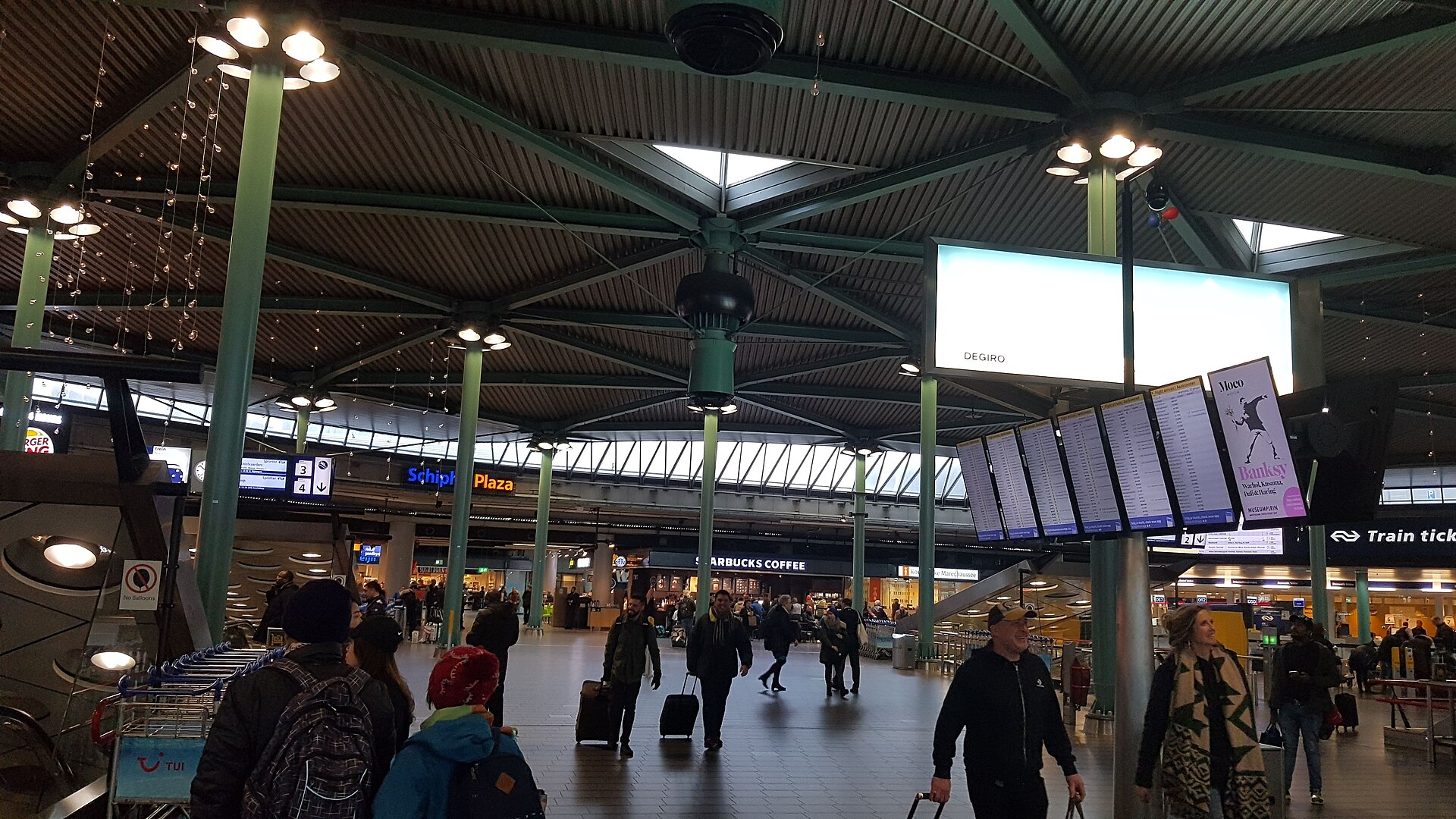
People fixate on security and then miss the counter. Most airlines close bag drop 40 to 60 minutes before departure, and some long-haul carriers close it earlier still. Check your airline’s stated time, because it is a hard cut-off — there is no discretion at the desk once the flight is closed.
Schiphol has extensive self-service bag drop and automated tagging in all three halls, and it is fast when it works. It is slower than the desk when something is wrong with your booking, so if you have a complicated ticket, an infant, sports equipment or an oversized bag, join the staffed queue rather than fighting a machine.
If you are travelling hand luggage only, all of this disappears and two hours is genuinely enough for a Schengen flight. Our packing list makes the case for doing exactly that on a short trip.
Paid fast track and Privium
Because the time slot is free, the paid options at Schiphol are worth less than at airports where they are the only way to skip a queue. Still, two are worth knowing about.
Privium is Schiphol’s own membership scheme and the serious option for frequent flyers. Membership runs from about €180 a year for the basic tier, around €235 for the version that adds parking benefits, and up to roughly €305 for the top tier. What you get is a priority security lane and, crucially, iris-scan border crossing for non-Schengen flights, which is the queue that actually matters in 2026. There is also a Privium ClubLounge landside between Halls 1 and 2 for the higher tiers.
The arithmetic is simple. If you fly through Schiphol two or three times a year, it is not worth it — use the free time slot. If you fly through monthly and you hold a non-EU passport, the iris-scan border crossing alone justifies the fee several times over at current queue lengths.
Airline and class-based fast track comes with business class and top-tier frequent flyer status on KLM and its partners. If you have it, use it; it is not usually purchasable separately in the way it is at some airports.
What is not worth buying is a third-party “skip the queue” product that turns out to be a reseller of the free time slot. Book the slot yourself on Schiphol’s own site or app.
When the airport is busy
Schiphol handled 32.7 million passengers in the first half of 2026 across 223,597 flights, and expects 68 to 72 million over the year under a government cap of 478,000 flight movements. It is one of Europe’s busiest airports operating deliberately below its old peak, which is why the experience is better than the numbers suggest — but the peaks are still peaks.
- The worst window is 06:00 to 09:00, when the long-haul departure bank and the European morning wave overlap.
- A second peak runs late afternoon, roughly 16:00 to 19:00.
- Sunday evenings and Monday mornings add the business traffic on top.
- School holidays — Dutch ones, which do not always match your own — produce the heaviest family traffic, particularly the May and summer breaks.
- Midday and late evening are genuinely quiet, and a flight at those hours needs less padding than the table above suggests.
Schiphol publishes live security wait times through its app and website, updated continuously. Check them the morning of your flight rather than relying on a number from a blog, including this one.
Do not forget the walk
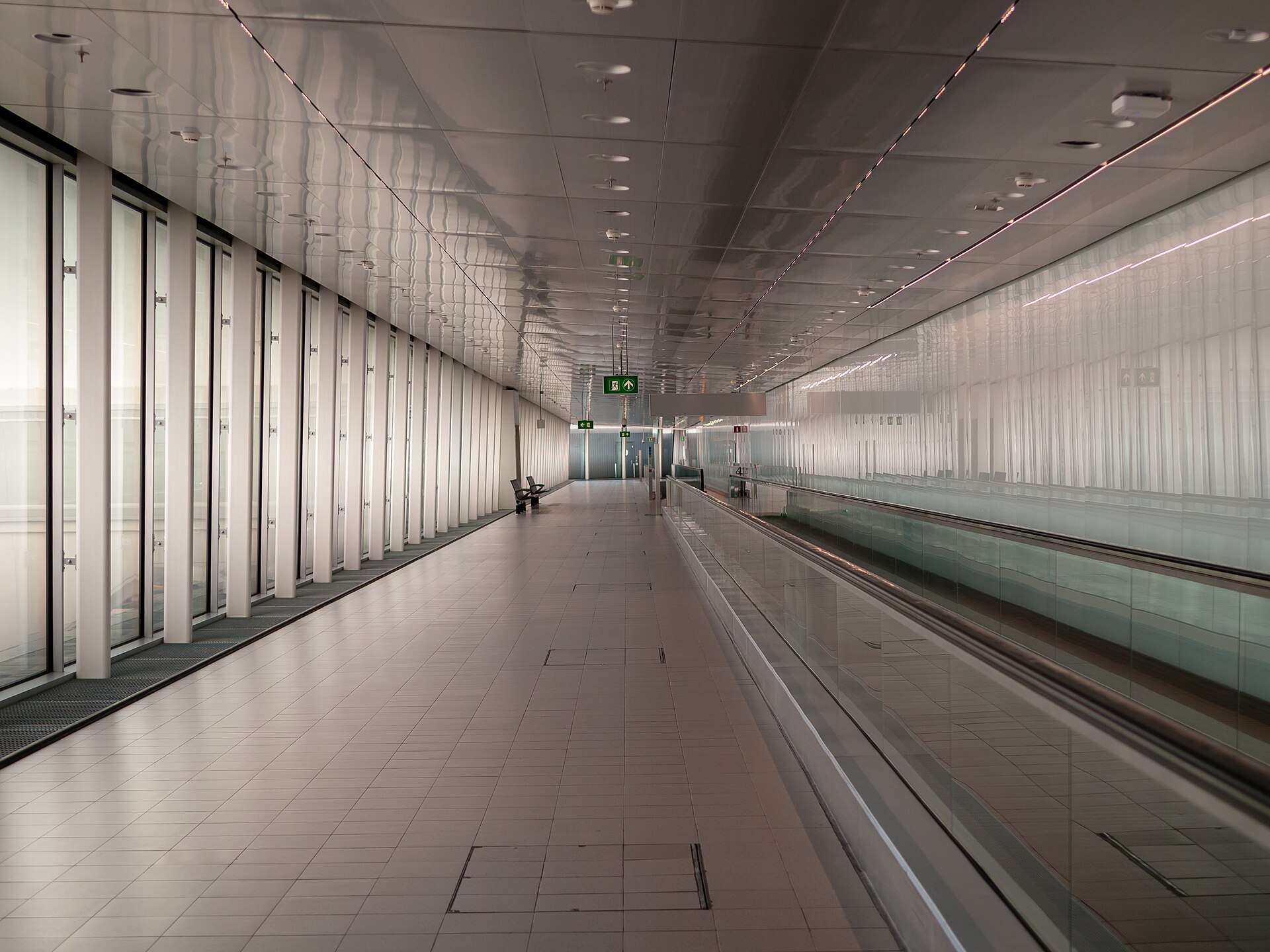
Schiphol is a single terminal, which sounds convenient and means the building is enormous. Piers B, C and D handle Schengen flights; E, F, G and H/M handle non-Schengen, with Pier D split across two levels serving both. From a security checkpoint to a gate at the far end of Pier M is a genuine twenty-five minute walk, more with children or a bag.
Gates are also assigned late here and change more often than at most airports. Check the screens rather than your boarding pass, and if your gate is at the far end, start walking before boarding is called instead of sitting in the central concourse waiting for a number.
Arriving, rather than departing
Half the questions about Schiphol queues are really about the other direction, and the answer is different. Arriving on a Schengen flight, there is no passport control at all — you walk off the aircraft, collect a bag if you have one, and you are in Schiphol Plaza within twenty minutes. It is one of the smoothest arrivals in Europe.
Arriving from outside the Schengen area is where 2026 bites. Non-EU passport holders go through EES registration, and this is the two-hour queue people have been writing about. Use the self-service kiosks first if they are open, keep your passport and onward details to hand, and expect the process to be slower on your first crossing since the biometrics are captured then rather than merely verified. On subsequent trips it should be faster, which is the entire premise of the system.
Practical consequence: if you have booked a tight connection onward to another Dutch city, or a tour that starts the same morning, build the queue into your plan. A first-day itinerary that assumes you clear the airport by ten will not survive a 07:00 arrival from outside Europe this year.
What the airport is actually like once you are through
Worth saying, since so much of this page is about queues: Schiphol airside is a good place to be. It is bright, calm and well signposted, the seating away from the central concourse is genuinely comfortable, and the wifi is free and unlimited. There are free showers on the upper level of Lounges 2 and 3, a silence centre, an indoor park area, and lounges from roughly €45 to €75 if you want a paid one.
Which means the calculation on arriving early is not the one most people make. Two extra hours at a bad airport is a punishment; two extra hours at Schiphol is a shower, a proper meal and an unhurried walk to the gate. If your flight is important and your morning is flexible, buy the buffer. It is cheaper than the alternative.
Getting through faster, on your own account
- Book the free time slot three days out. This is the whole game.
- Check in online and use self-service bag drop unless your booking is complicated.
- Pack liquids to 100ml in a one-litre transparent bag — but leave it in your hand luggage at the belt, along with your laptop.
- Belt, coat, watch off before you reach the front, not at the tray.
- Nothing in your pockets. Put everything in your bag rather than in a tray; it is faster at both ends.
- Use the hall your airline uses. Wandering to another hall because it looks quieter usually costs more than it saves.
- Non-EU passport, non-Schengen flight: use the self-service EES kiosks before joining the border queue.
- Check live wait times and any disruption in the app the night before and again on the morning.
Our complete Schiphol guide covers the layout, the lounges and what is actually worth doing in the building, and our Schiphol to Amsterdam guide covers getting there in the first place — the train takes 15 to 20 minutes from Centraal for about €6, which is one variable fewer than a taxi at €50 to €65 in morning traffic.
Keep Exploring
- Schiphol Airport: the complete guide
- Schiphol layover guide
- Hotels near Schiphol Airport
- Getting from Schiphol to Amsterdam
- Amsterdam packing list
- Visa requirements for the Netherlands
- Tax-free shopping and VAT refunds
- Travel insurance for Amsterdam
- Practical Amsterdam information
Frequently asked questions
How long is the security wait at Schiphol?
It varies hour by hour, which is why Schiphol publishes live wait times in its app and on its website. The reliable answer is to book a free security time slot three days ahead, which puts you in a dedicated lane and makes the published average largely irrelevant to you.
How early should I arrive at Schiphol?
Two hours for a Schengen flight and three for non-Schengen, on the airport’s own advice, plus extra if you are checking a bag. Non-EU passport holders on a non-Schengen departure should treat three hours as a minimum because of EES exit registration.
Is the security time slot free?
Yes, completely. Book it online or in the Schiphol app from three days before departure, choose a fifteen-minute window, then use the lane marked “Reserved for time slots” and scan your QR code. Anyone charging you for it is reselling something free.
Can I take liquids over 100ml through Schiphol?
No. Schiphol returned to the 100ml international standard on 1 September 2024 and has kept it, even though some other EU airports with approved scanners have lifted the limit. Liquids go in a single transparent, resealable one-litre bag.
Do I have to take my laptop out?
No. Schiphol’s CT scanners let you leave laptops, other electronics and your liquids bag inside your hand luggage. Put the whole bag on the belt as it is — the 100ml packing rule still applies, but the unpacking ritual does not.
What is EES and does it affect me?
The EU Entry/Exit System, live since 10 April 2026, which registers biometrics for non-EU travellers instead of stamping passports. It affects you if you are a non-EU national crossing the Schengen border in either direction, and waits at Schiphol have run to around two hours.
Is Privium worth it?
If you fly through Schiphol monthly and hold a non-EU passport, yes — the iris-scan border crossing alone justifies the €180 to €305 annual fee at current queue lengths. For two or three trips a year, no. Use the free time slot instead.
Can I buy fast track on the day?
Not in the way you can at some airports. The free time slot is the mechanism Schiphol wants you to use, and airline fast track comes with business class or elite status rather than being sold separately at the checkpoint.
What time is Schiphol busiest?
06:00 to 09:00 is the worst window, with a second peak from about 16:00 to 19:00. Sunday evenings and Monday mornings add business traffic, and Dutch school holidays add families. Midday and late evening are genuinely quiet.
How long does it take to walk to the gate?
Up to twenty-five minutes from security to a gate at the far end of Pier M. Piers B, C and D are Schengen and E, F, G and H/M non-Schengen, with Pier D split across two levels. Check the screens, because gates change here frequently.
When does bag drop close?
Usually 40 to 60 minutes before departure, earlier on some long-haul flights, and it is a hard cut-off. Check your airline’s own stated time — it is a more common reason for missing a flight than the security queue.
What happens if there is a strike?
Industrial action has disrupted individual days at Schiphol during 2026. It is not something you can plan around, but check the airport’s own channels the night before your flight and again in the morning, and give yourself an extra hour if anything is announced.
Is arriving at Schiphol quicker than departing?
On a Schengen flight, considerably — there is no passport control at all and you can be out in twenty minutes. From outside the Schengen area, non-EU passport holders face the EES queue, which has been the two-hour one this year.
Should I just arrive very early?
If your morning is flexible, yes. Schiphol airside is a pleasant place with free showers, free wifi and good food, so an extra hour costs you very little and removes every variable. It is the cheapest insurance available on a travel day.
Are there separate queues for families?
Schiphol has family lanes at the security checkpoints in the busier halls, which are slower per person but much less stressful with small children. Staff will point you to one if you ask — and book a time slot as well, since the two work together.