Everyone has eaten the cheese. Almost nobody has been to the town. Gouda is an easy train ride south of Amsterdam, has a market square with a Gothic town hall standing free in the middle of it, holds a great church full of stained glass, and runs a Thursday cheese market that is a different proposition from Alkmaar’s. This guide covers the Gouda things to do that make the trip worthwhile, and is clear about how it compares with the cheese market everyone else goes to.
Gouda is a small town and you will see it in a day with time to spare. It is not trying to be a destination, the centre is compact, and outside market hours on a Thursday morning it is very quiet indeed. That quiet is the point. Where Alkmaar’s cheese market pulls coaches from Amsterdam and fills a square with several thousand people, Gouda’s runs for a shorter season, at a smaller scale, on a square that is genuinely lovelier — and you can stand at the front without setting an alarm.
| Detail | |
|---|---|
| Cheese market | Thursdays 10:00–12:30, free, on the Markt |
| 2026 season | 2 April to 27 August — shorter than Alkmaar’s |
| From Amsterdam | 50–60 minutes by direct train |
| From Rotterdam | About 20 minutes |
| Sint-Janskerk | 123 m — the longest church in the Netherlands. 72 stained-glass windows |
| Church tickets | Admission charged; free with Museumkaart. Free audio tour, about 40 min |
| Museum Gouda | Achter de Kerk 14 · Tue–Sun 11:00–17:00, closed Mondays |
| De Goudse Waag | The old weigh house, now the Cheese and Crafts Museum, open year-round |
| Other markets | Gouds Montmartre art market, Wednesdays June–August |
| Time to allow | Half a day for the market, a full day with the church and museums |
The cheese market: dates, times and honest expectations
The Gouda cheese market runs on the Markt every Thursday from 10:00 to 12:30, and in 2026 the season runs from 2 April to 27 August. It is free — no ticket, no barrier, you simply stand on the square.
Note that season carefully, because it is the detail that catches people out. Gouda’s market starts later in spring and finishes at the end of August. Alkmaar’s runs on Fridays from the last Friday in March to the last Friday in September. If you are in the Netherlands in mid-September and want to see a cheese market, Alkmaar is your only option; if you are here on a Thursday in June, Gouda is the better morning.
What happens: cheeses are laid out on the square in front of the Gothic town hall, there is cheese-making on the spot, traditional craft demonstrations, music, and cheese boards to taste from. Visitors can have cheese weighed at De Waag, the seventeenth-century weigh house on the edge of the square — which is a nice touch and something Alkmaar does not offer.
Be clear about what this is. Like Alkmaar, it is a preserved demonstration rather than a working wholesale market. The trading is not real. Nobody pretends otherwise, and the demonstrations are done well, but if you arrive expecting Dutch farmers haggling over their week’s production you will be confused for an hour.
The compensations are real, though. It is smaller, which means you can actually get close to things. It runs on a genuinely beautiful square rather than a merely pleasant one. And the crowd is a fraction of Alkmaar’s, so a 09:45 arrival gets you a front-row position rather than the 09:15 scramble that Alkmaar demands. Our Alkmaar cheese market guide covers the bigger, more theatrical version if that is what you want.
The Markt and the town hall
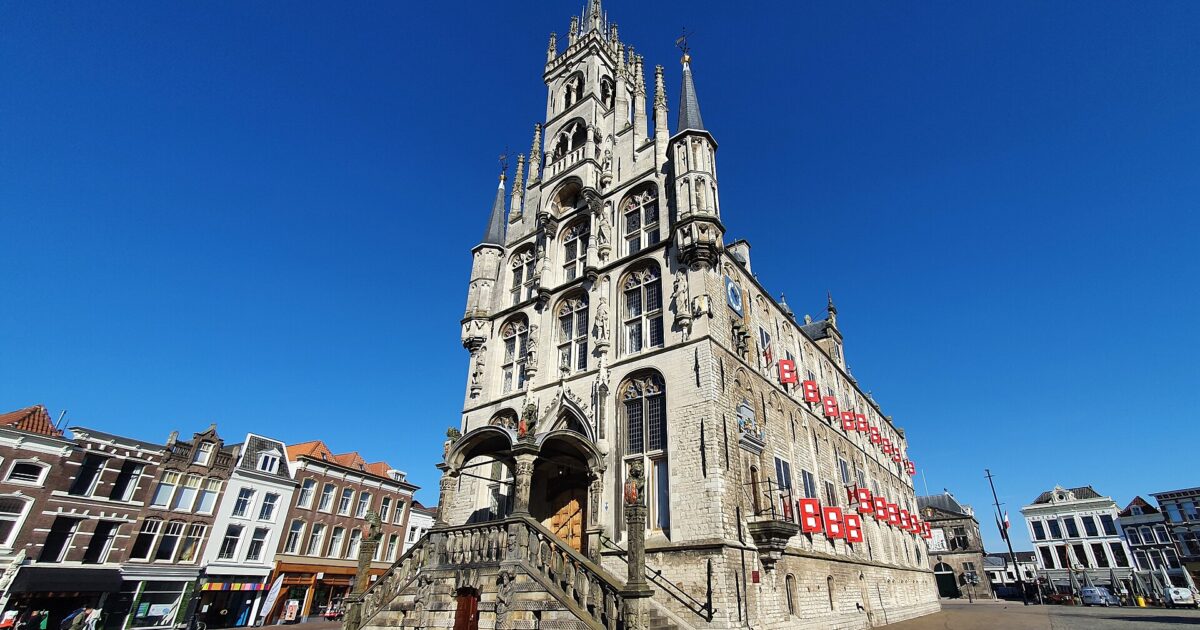
Gouda’s Markt is among the most photographed squares in the country and it deserves to be. What makes it unusual is that the Stadhuis — the town hall — stands free in the middle of the square rather than along one edge. It is a fifteenth-century Gothic building with a stepped facade, a slender tower, red shutters and a carousel of statues, and having it isolated in open space gives it a presence that a town hall in a terrace never has.
On the eastern side stands De Goudse Waag, the 1668 weigh house where cheese was officially weighed for centuries. Today it houses the Cheese and Crafts Museum, which is open independently of the Thursday market and covers the history of the weigh house, of Gouda cheese and of the other trades — pipes, candles, pottery — that made the town’s name. It is a modest museum and a good hour.
Around the square are cafés with terraces, and on market mornings stalls selling stroopwafels made in front of you and poffertjes, the small thick pancakes served with butter and icing sugar. Buy the stroopwafel warm off the iron; the packaged version you can get anywhere is a different food entirely. Our guide to must-try Dutch foods covers the rest of the canon.
Sint-Janskerk, which is the real reason to come
Here is our honest verdict: the cheese market is a pleasant morning, and the church is a genuinely significant building that most visitors to the Netherlands have never heard of.
The Grote of Sint-Janskerk is 123 metres long — the longest church in the Netherlands. That length is startling from inside; it recedes away from you in a way few buildings do. But the length is not why it matters.
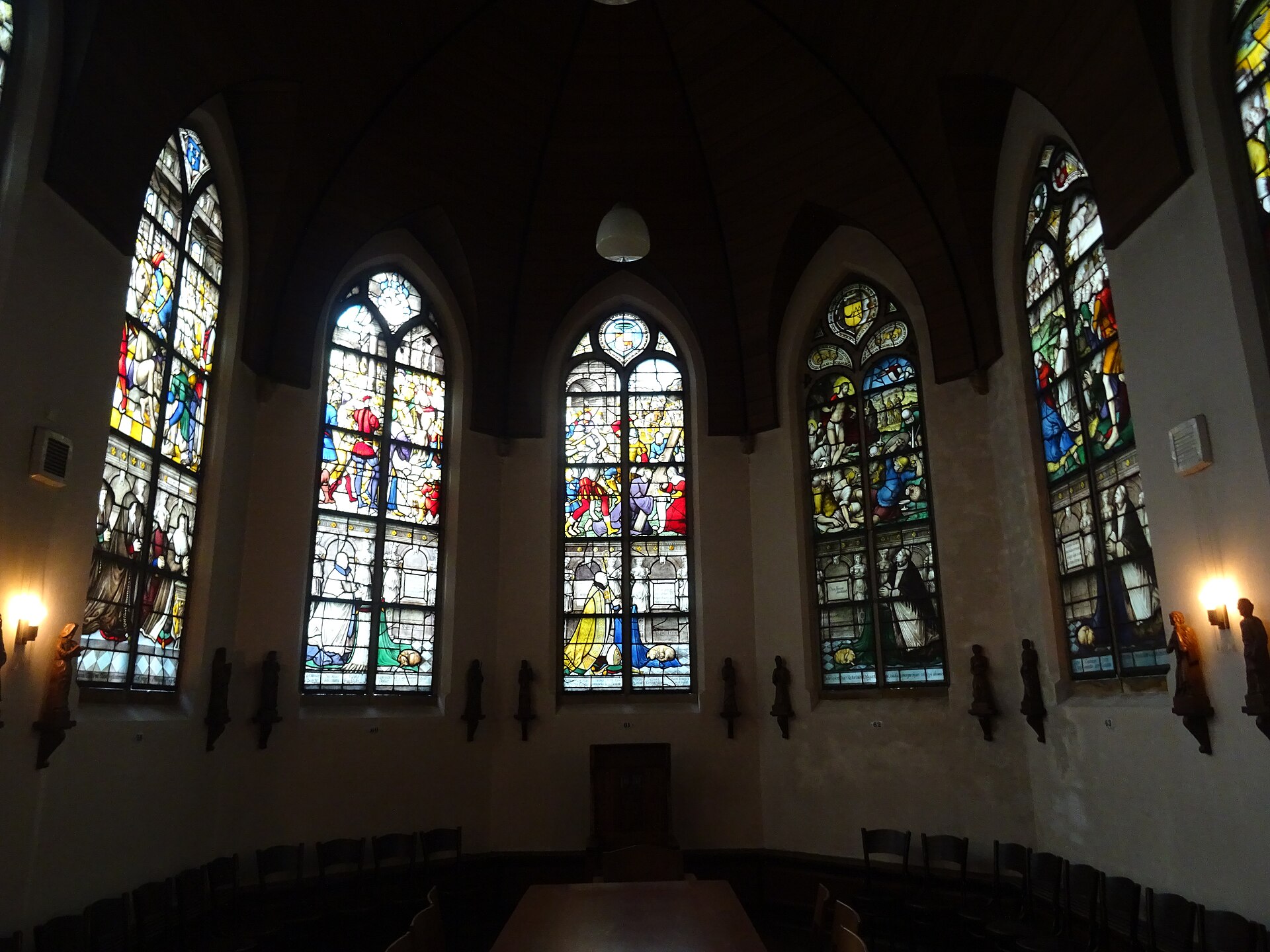
It matters for the Goudse Glazen, the Gouda Windows: seventy-two stained-glass windows, the core of them made and installed by the brothers Dirk and Wouter Crabeth between 1555 and 1571, with further windows added up to 1603 by other artists after a pause for the Reformation. They are among the highlights of European stained-glass art, and — this is the remarkable part — they survived the Reformation, the iconoclasm, and four centuries of war in a country that lost most of its religious art.
What makes them unusual is that they span the religious divide. The earlier windows were commissioned by Catholic patrons, including Philip II of Spain; the later ones by Protestant town councils and the newly independent Dutch cities. You can walk from one theological world into another along a single wall, which is a rare and rather moving thing to be able to do.
An admission ticket is required, and it is free with a Museumkaart. A free audio tour takes about forty minutes and is worth using — the windows repay explanation, and without it you are looking at a great deal of coloured glass without knowing what any of it is doing. A combination ticket with Museum Gouda is available. Current euro prices are published on the church’s own website.
The rest of the town
Museum Gouda
At Achter de Kerk 14, directly behind the church, open Tuesday to Sunday 11:00 to 17:00 and closed Mondays. The city museum, holding altar paintings, civic guard portraits and pottery from the sixteenth to the twentieth century. The altarpieces are the strength — Gouda’s are among the few substantial Dutch Catholic altar paintings to survive the iconoclasm, largely because they were hidden.
The canals and the old town
Gouda is a canal town and the centre is ringed by water. It takes about an hour to walk. Look for the Lange Tiendeweg and the Zeugstraat for the smaller shops, the Gouwe for the prettiest water, and the surviving hofjes — almshouse courtyards — which are quieter here than the more famous ones in Haarlem.
Pipes, pottery and candles
Cheese is not the only thing this town made. Gouda produced clay pipes on an industrial scale from the seventeenth century — you will see them in Dutch still-life paintings — along with pottery and candles. The candle connection survives in Gouda by Candlelight, held on a December evening, when the electric lights on the Markt are switched off and the square is lit entirely by candles in the town hall’s windows. It is genuinely lovely and worth planning a December trip around; our Christmas in Amsterdam guide covers the wider seasonal picture.
Other events
Gouds Montmartre, a weekly art market, runs on Wednesdays in June, July and August. Zotte Zaterdag is a medieval festival held annually in October. Neither is a reason to travel from another country, but both are a good reason to shift a day if you are already in the Netherlands.
Getting there
Direct trains run from Amsterdam Centraal; check the day’s timetable on the NS site at ns.nl. From Rotterdam it is about 20 minutes, and from The Hague or Utrecht it is closer still — Gouda sits at a junction of lines, which is why it is easier to reach than its size suggests.
NS fares are distance-based and fixed, so there is no advance-booking advantage. Tap in and out with OVpay and travel when you like; our OV-chipkaart and OVpay guide covers the mechanics. Gouda station is about a ten-minute walk from the Markt through the old town.
Because of that junction position, Gouda pairs naturally with other stops. Rotterdam is half an hour away, Utrecht about the same, and Kinderdijk is reachable via Rotterdam. A Thursday morning at the cheese market followed by an afternoon in Rotterdam is one of the better combined days available from Amsterdam.
A Thursday in Gouda
- Early morning — Train from Amsterdam Centraal, timed to get you to the Markt before the market opens.
- 09:45 — Walk into the centre and take a position on the Markt. Fifteen minutes is enough here; this is not Alkmaar.
- 10:00–12:30 — The market. You will not need all of it — an hour covers the sequence, and the rest is browsing and eating.
- 11:30 — Slip away to Sint-Janskerk while everyone else is still on the square. The audio tour takes forty minutes.
- 12:45 — Lunch on the Markt or, better, one street back where prices drop.
- 14:00 — De Goudse Waag or Museum Gouda, and a walk round the canals.
- Late afternoon — Train onward to Rotterdam for the evening, or back to Amsterdam.
On a non-Thursday, skip the first three lines and give the church and museums a proper morning instead. The town is a perfectly good half-day without the market, which is more than can be said for a lot of market towns.
What Gouda cheese actually is
Worth clearing up, because the label misleads almost everyone.
Gouda is not a protected name. Unlike Parmigiano-Reggiano or Roquefort, plain “Gouda” can be made anywhere in the world, and most of what is sold under the name outside the Netherlands was made nowhere near here. The genuinely protected designations are Gouda Holland, which must be made in the Netherlands from Dutch milk, and Noord-Hollandse Gouda, which is narrower still. If provenance matters to you, those are the words to look for on the rind.
The town’s role was as the market, not the dairy. Gouda held the regional cheese-weighing rights from the seventeenth century, so cheese made across the surrounding countryside came here to be weighed, priced and sold — and took the name of the market rather than the farm. That is why the weigh house is the important building and why the market square, not a creamery, is where the story sits.
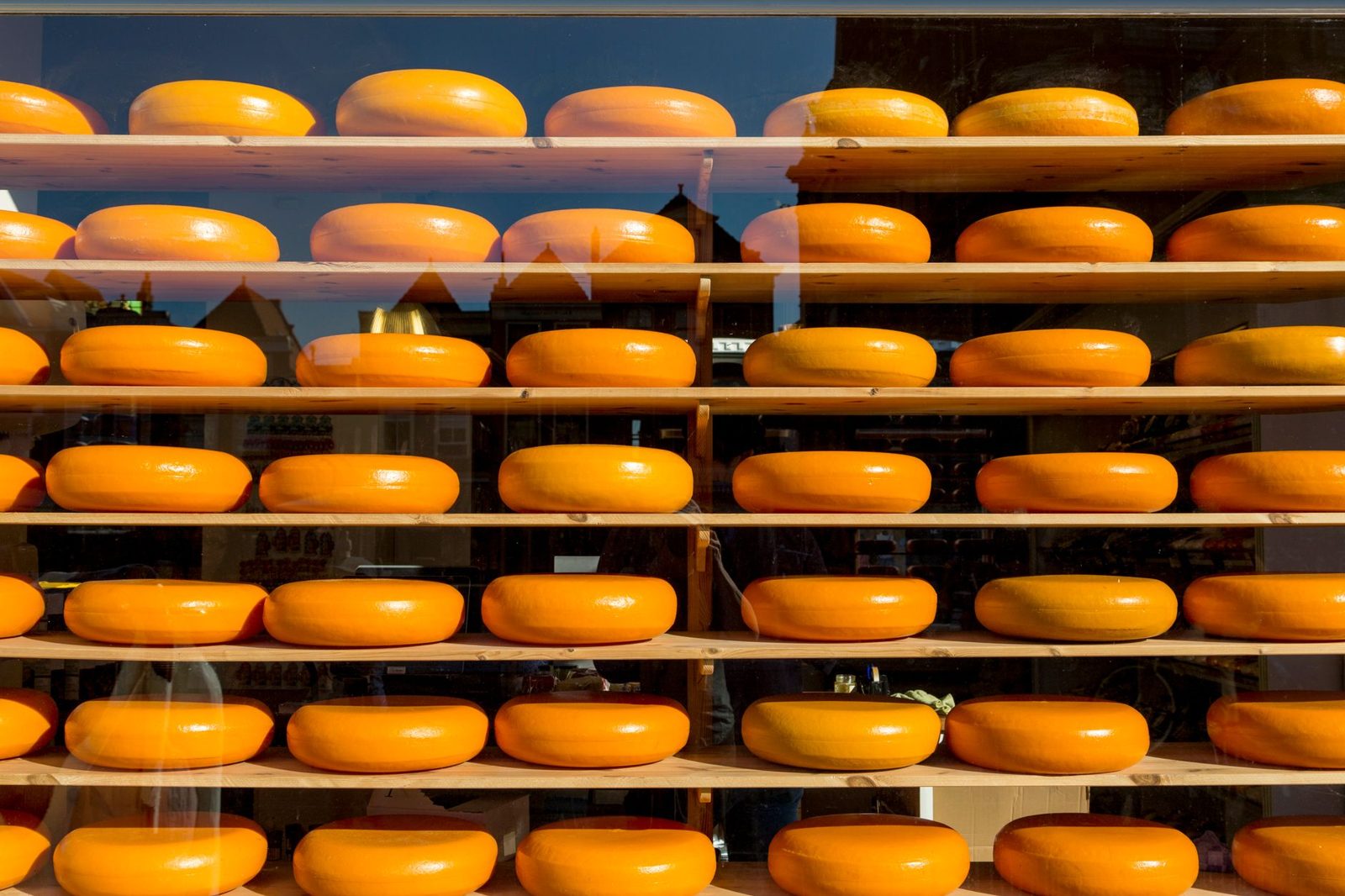
On buying: age is the variable that matters far more than the label. Jong at about four weeks is mild and elastic; belegen at around four months is where most people find the balance; oud at a year or more turns hard, crystalline and sharp, and overjarig beyond that. There is also boerenkaas — farmhouse cheese made from raw milk on the farm — which is a genuinely different and better product, and which you will not find in a supermarket. Ask for it.
Gouda or Alkmaar?
The question most people are actually asking, so here it is plainly.
Alkmaar if you want the full spectacle: the guild carriers running with barrows, the hand-clap pricing, the whole four-hundred-year performance at scale. It is a bigger, better show. It is also on a Friday, has a longer season, is forty minutes from Amsterdam, and requires you to be at the railings by 09:15 or watch over heads.
Gouda if you want a better town and a calmer morning. The market is smaller and less theatrical, but the Markt is a lovelier square, Sint-Janskerk is a significantly more important building than anything in Alkmaar, and you will not be fighting for a view. Thursday, and a shorter season.
Our view: if cheese is genuinely why you are going, Alkmaar. If you want a good day out in a small Dutch town and the cheese market is a bonus, Gouda — and go for the church. There is also a third, much smaller market at Edam on Wednesday mornings in high summer, if your dates are awkward.
And a note on buying: as at Alkmaar, a market day is a poor time to buy cheese well. The stalls sell to a captive crowd. A proper cheese shop will let you taste, tell you the age, and vacuum-pack it for travel — our guide to Dutch cheese and where to buy it explains what to look for.
Practical notes
- Check the season before you travel. Thursdays only, 2 April to 27 August in 2026. Outside that window the Markt is a pleasant square with a café on it.
- Museumkaart can pay here. Check museumkaart.nl for which Gouda venues accept it. At €75 a year the card clears its cost quickly if you are touring — see our city passes compared.
- The church closes on Sundays for services and has variable seasonal hours. Check before building a day round it.
- Museum Gouda closes Mondays, as does most of the Dutch museum sector outside Amsterdam.
- Cashless, as everywhere in the country.
- Eat one street back from the Markt. The square charges square prices.
- The station is a ten-minute walk through the old town, and it is a pleasant one.
Keep Exploring
- The Netherlands Beyond Amsterdam
- Alkmaar Cheese Market
- Dutch Cheese: Where to Buy It
- Rotterdam Day Trip
- Utrecht Travel Guide
- Leiden Travel Guide
- Kinderdijk Windmills
- Day Trips from Amsterdam
- Must-Try Dutch Foods
- City Passes Compared
- OV-chipkaart & OVpay Guide
- Amsterdam Markets Guide
Frequently Asked Questions
When is the Gouda cheese market?
Thursdays from 10:00 to 12:30 on the Markt, running from 2 April to 27 August in 2026. It is free to attend with no ticket required. The season is shorter than Alkmaar’s, which runs Fridays from late March to late September.
How do you get to Gouda from Amsterdam?
Direct trains run from Amsterdam Centraal. From Rotterdam it is about 20 minutes. NS fares are distance-based and fixed, so just tap in and out with OVpay. The Markt is a ten-minute walk from Gouda station.
Is Gouda or Alkmaar better for the cheese market?
Alkmaar has the bigger spectacle — guild carriers, hand-clap pricing, the full performance — but demands an early arrival to see anything. Gouda is smaller and calmer, on a lovelier square, and its Sint-Janskerk is a far more significant building. Go to Alkmaar for cheese, Gouda for the town.
What is Sint-Janskerk in Gouda famous for?
At 123 metres it is the longest church in the Netherlands, and it holds 72 stained-glass windows known as the Goudse Glazen — the earliest by the brothers Dirk and Wouter Crabeth between 1555 and 1571. They are among the finest surviving stained glass in Europe and span both Catholic and Protestant patronage.
How much does Sint-Janskerk cost to enter?
An admission ticket is required and it is free with a Museumkaart. A free audio tour of about forty minutes is included, and a combination ticket with Museum Gouda is available. For current euro prices, see the church’s own website.
Is Gouda worth visiting outside the cheese market?
Yes. Sint-Janskerk alone justifies the trip, and the Markt with its free-standing Gothic town hall, De Goudse Waag cheese museum, Museum Gouda and the canal walk fill a comfortable half-day. The town is quieter without the Thursday market, which some will prefer.
Can you buy cheese at the Gouda market?
Yes, and you can have it weighed at De Waag, which is a nice touch. But as at Alkmaar, a market day is a poor time to buy well — the stalls sell to a captive crowd. A proper cheese shop will let you taste, tell you the age and vacuum-pack it for travel.
What is Gouda by Candlelight?
A December evening when the electric lighting on the Markt is switched off and the square is lit entirely by candles, including in the town hall windows. It reflects the town’s historic candle-making trade and is one of the more atmospheric small Dutch events of the year.