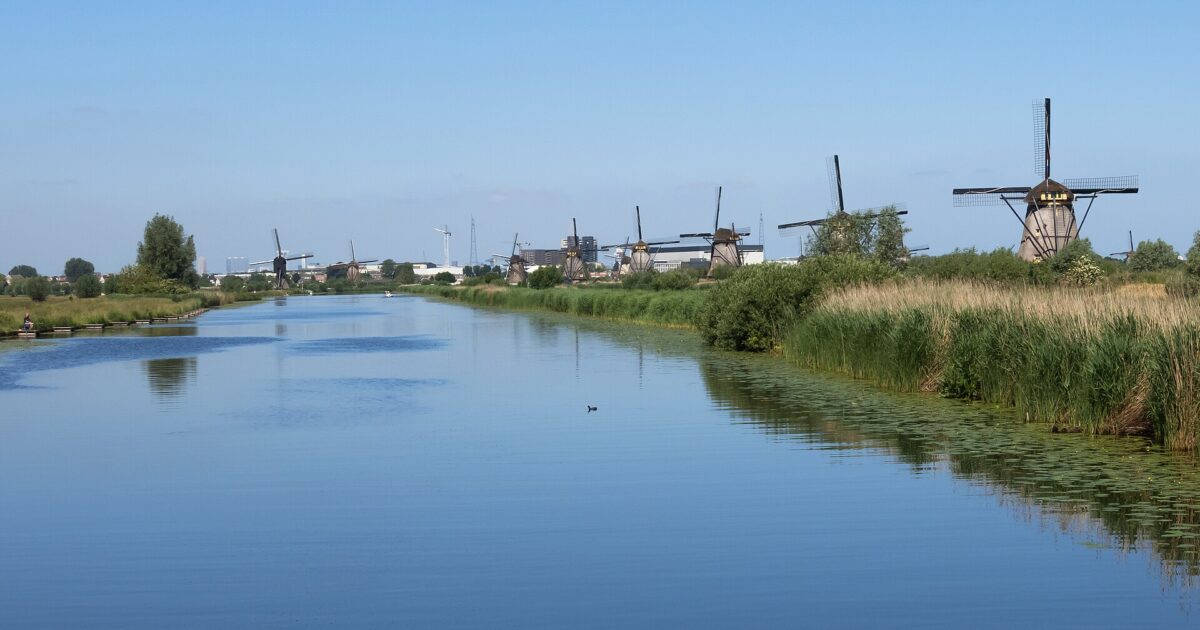
Nineteen eighteenth-century windmills standing in a row along two parallel canals, in a polder that would be under water without them. That is Kinderdijk, a UNESCO World Heritage Site since 1997, and it is the answer to the question most visitors to the Netherlands are actually asking when they go looking for windmills. This guide covers the Kinderdijk windmills — what a ticket costs, what it includes, how to get there from Amsterdam, and how it compares with the far more convenient alternative twenty minutes from the city.
Kinderdijk is a landscape, not a display. Zaanse Schans, the one everybody goes to, is a curated village of relocated buildings twenty minutes from Amsterdam that receives coach parties from ten in the morning. Kinderdijk is nineteen mills standing where they were built, in the working drainage system they were built for, with footpath routes from an hour’s walk to a full day and no gift-shop village. It takes about ninety minutes each way from Amsterdam, and it is much better. If you have a full day and any interest in why this country exists, go here. If you have a spare morning, go to Zaanse Schans and accept the trade.
| Detail | |
|---|---|
| Adult ticket | €21 — 10% off booking online |
| Child 4–12 | €9 — 10% off online |
| Child 0–3 | Free |
| Included | Museum mills, boat tour, Wisboom pumping station, De Fabriek film and exhibition, bird theatre, visitor centre |
| Where | Nederwaard 1b, 2961 AS Kinderdijk, near Rotterdam |
| From Amsterdam | About 1h 30m via Rotterdam, usually with a waterbus for the last leg |
| Open | Nearly all year; seasonal hours, roughly 09:00–17:30 with longer summer opening |
| Number of mills | 19, most built around 1738–1740 |
| Time to allow | 3–4 hours on site; a full day including travel |
| Best move | Take a bike. The site is spread out and cycling is how it is meant to be seen |
What you are actually looking at
This is the part that turns Kinderdijk from a photograph into something interesting, and it takes two minutes to explain.
The Alblasserwaard is a polder — reclaimed land, sitting below the level of the surrounding rivers. Water seeps in constantly and rain falls on it, and if nothing removes that water the whole area floods. From the medieval period onwards the solution was drainage by gravity into the rivers at low tide, but the land kept sinking as the peat dried and compacted, and by the eighteenth century gravity no longer did the job.
So in 1738 to 1740 they built sixteen of the site’s nineteen windmills in two groups — the Nederwaard and the Overwaard — arranged along two parallel canals. Each mill lifts water a metre or two from a lower reservoir into a higher one, and the mills work in sequence, passing water up the chain until it can be discharged into the river Lek. It is a mechanical staircase for water, powered by wind, and it kept a substantial piece of the Netherlands habitable for two hundred years.
The mills stopped being the primary system in 1868, when the steam-driven Wisboom pumping station took over, and they were kept as a backup — which is why they survive. Diesel and then electric pumps followed. The system is still running today; it is simply not the mills doing the work.
People live in several of the mills. They are not empty monuments and the millers who occupy them keep them turning. This is a working landscape that happens to be beautiful, rather than a beautiful landscape that has been made to look like it works — and once you understand the difference you will not confuse Kinderdijk with Zaanse Schans again.
Tickets and what they include
Adult entry is €21, children aged 4 to 12 are €9, and under-4s go free. Booking online gives an automatic 10% discount, which makes the online adult price a little under €19 — there is no reason not to.
What surprises people is how much the ticket covers. This is not a fee to walk along a path and look at windmills from outside. It includes:
- The museum mills — interiors you can climb through, furnished as they were lived in, with the machinery exposed. This is the part that justifies the price.
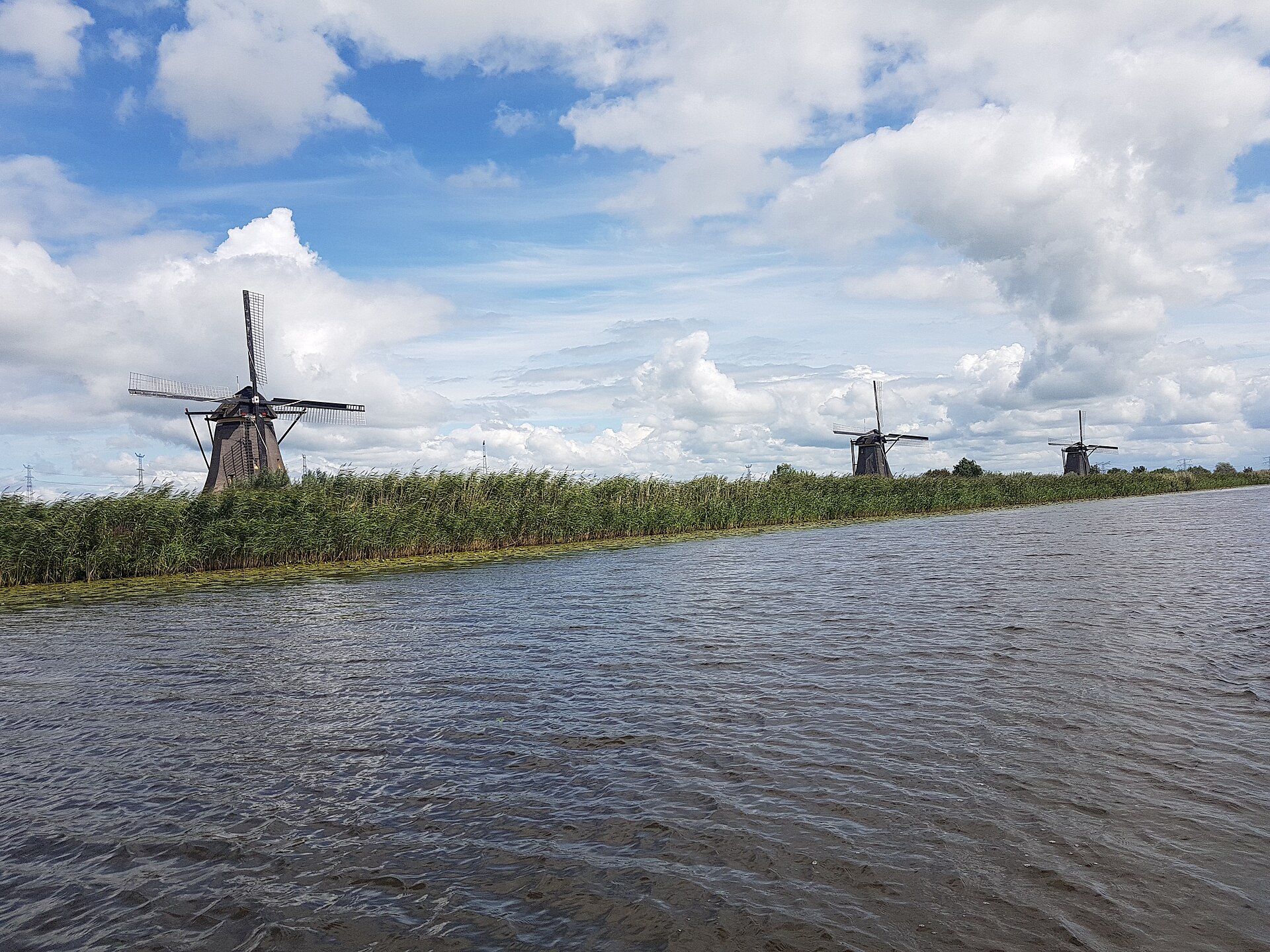
- The boat tour — included, not an extra. It runs the canals between the two rows and gives you the view the photographs are all taken from.
- The Wisboom pumping station — the 1868 steam pumping station that took over from the mills, now refurbished as a visitors’ centre with an exhibition.
- De Fabriek — the secondary pumping station, with a film and exhibition explaining the water system.
- The bird theatre and the visitor centre with its café.
Walking the outer dyke paths is free and you can see the mills from outside without paying anything at all. Plenty of people do this and it is a legitimate choice — but you lose the interiors and the boat, which are the two things that make the visit more than a photograph. At €19 online for four hours, we think the ticket is fair value.
Opening hours are seasonal and the site is open nearly all year. Roughly 09:00 to 17:30, longer in summer. Check the operator’s own opening-hours page before travelling rather than trusting a figure on any third-party site, this one included.
Getting there from Amsterdam
Kinderdijk is not near Amsterdam. It is near Rotterdam, which is 40 minutes from Amsterdam on the fast intercity, and then you have a second leg.
- Amsterdam Centraal to Rotterdam Centraal — about 40 minutes on the fastest intercity services, more on the slower ones. Fares are distance-based and fixed, so no advance booking is needed; tap in and out with OVpay. See our OV-chipkaart and OVpay guide.
- Rotterdam to Kinderdijk — the waterbus is the pleasant way, running down the Nieuwe Maas and the Noord to a stop at the site. It takes roughly half an hour and the approach by water is genuinely part of the experience. There are also bus connections via Ridderkerk.
- Total — allow about an hour and a half each way, and check the waterbus timetable both ways before you commit, particularly for the return.
Because you pass through Rotterdam anyway, the obvious move is to make a full day of it: Kinderdijk in the morning, Rotterdam in the afternoon. Rotterdam is the anti-Amsterdam — flattened in 1940, rebuilt without nostalgia, and now home to the Netherlands’ most prominent high-rise skyline. Our Rotterdam day trip guide covers what to prioritise with half a day.
If you are flying home from Rotterdam The Hague Airport, the geography works even better — see our page on Eindhoven and Rotterdam airports.
How to spend your time on site
The site runs roughly two kilometres along two parallel canals, and the operator suggests routes from a one-hour walk up to a full day. Three to four hours is the sweet spot.
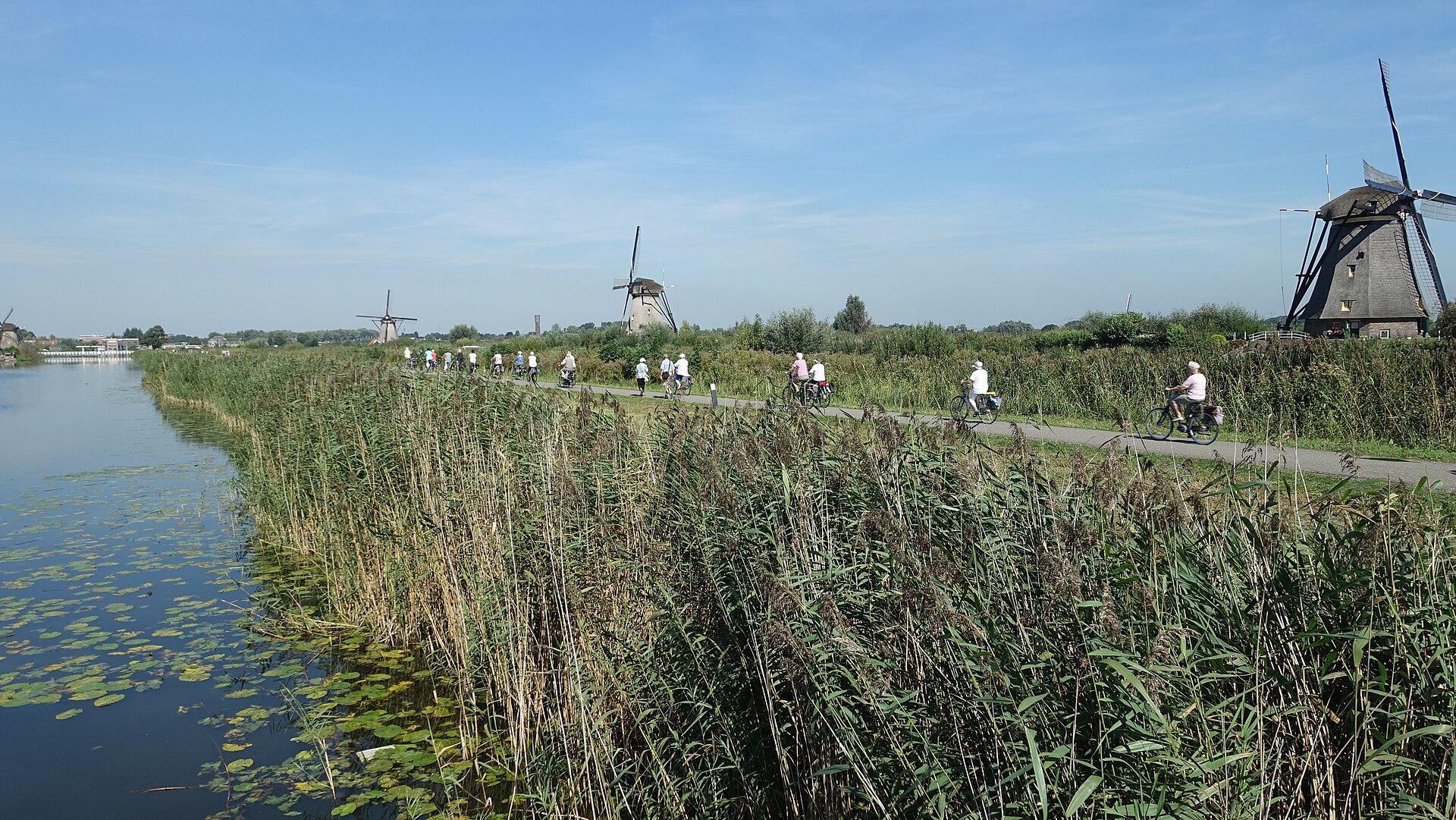
Take a bike if you possibly can. The dyke paths are flat, hard-surfaced and made for cycling, and covering the full length on foot eats an hour each way that you would rather spend inside the mills. OV-fiets hire is available at Dutch stations including Rotterdam, and there is bike hire near the site. A bike turns a slightly footsore afternoon into a genuinely good one.
A workable order:
- Wisboom pumping station and the visitor centre first, for the explanation. Fifteen minutes here makes everything afterwards make sense.
- The boat next, while you still have energy, for the view along the canals and the sense of scale.
- The museum mills — go inside at least two. The interiors are cramped, steep-staired and extraordinary: an entire family lived in the base of a working machine, and the millers’ quarters are furnished to show it.
- The far end of the site, which most day visitors never reach and which is consequently quiet.
- De Fabriek and the film on the way back if you have time.
A note on crowds. Kinderdijk gets busy — it is a UNESCO site — but it absorbs people far better than Zaanse Schans because it is spread along the polder rather than concentrated in one village. Even on a full day you can walk five minutes and be alone with a mill. Mornings are quieter; the coach and cruise arrivals cluster around late morning.
Kinderdijk or Zaanse Schans?
This is the real decision, so here it is plainly.
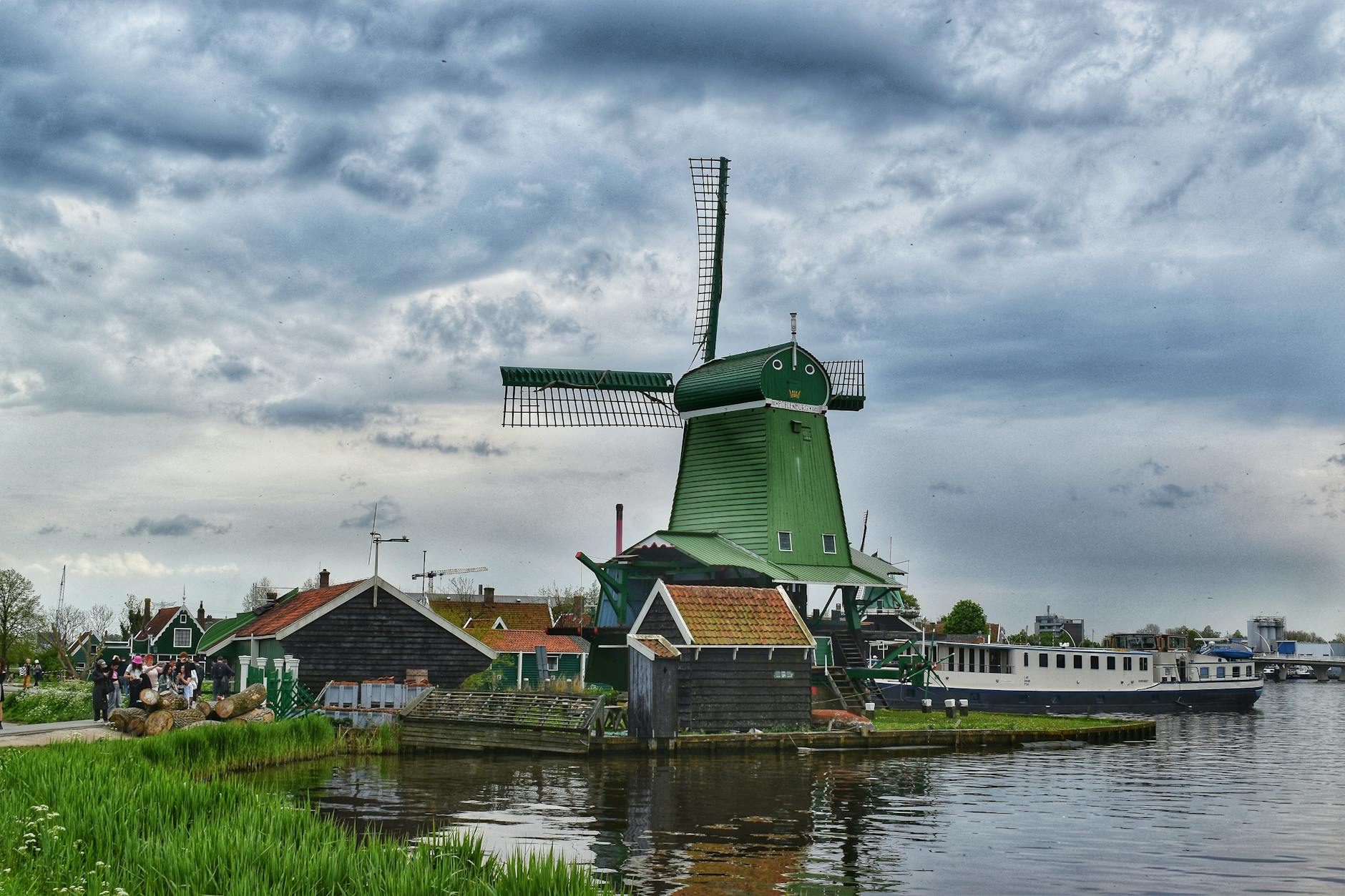
Choose Zaanse Schans if you have a morning rather than a day, you are travelling with small children or anyone who cannot walk far, or windmills are a box to tick rather than a genuine interest. It is twenty minutes from Amsterdam Centraal, several mills are open inside, there are craft workshops and a cheese shop, and you can be back in the city for lunch. The catch is the crowd: by 10:30 in summer the paths are shoulder to shoulder, and the village is a curated collection of buildings moved here from elsewhere rather than a place that grew. Our Zaanse Schans guide is blunt about the timing — before 09:30 it is lovely, after 11:00 it is a queue.
Choose Kinderdijk if you have a full day, you want to understand rather than photograph, and you are happy to walk or cycle for a few hours. Nineteen mills in their original positions in a working drainage system is a fundamentally different proposition from a heritage village, and the boat and interiors included in the ticket give you more to do.
Do not try to do both in one day. They are on opposite sides of Amsterdam and the day would be entirely spent on trains.
And if what you actually want is a windmill in a landscape without an entrance fee, the Netherlands has around a thousand surviving mills and a great many of them stand in ordinary countryside. Cycling out through Waterland north of Amsterdam will put you past several — our bike tours guide covers the routes, and our Volendam and Marken page covers that side of the water.
Life inside a windmill
The museum mills are the part of the ticket people underrate, so it is worth saying what is actually in them.
A Kinderdijk mill is not a tower with machinery in it. It is a house with machinery running through it. The miller and his family lived in the brick base — often eight, ten, twelve people in a round room a few metres across — while the drive shaft from the sails turned through the middle of their lives, day and night, whenever the wind blew. The stove was in the centre. There was no privacy of any kind.
The job was not a shift. A miller lived on site because the mill had to be attended whenever there was wind, which meant getting up at three in the morning to set sails and reef them again if the weather turned. Setting sails wrong in a gale could tear a mill apart. Millers used the position of the stopped sails to send messages visible across the flat land — a signal for a birth, a death, a celebration, or that the mill was resting briefly and would turn again shortly. That code was in general use across the country and it survives as a tradition.
Two of the mills at Kinderdijk are open as museums, furnished to show this. The interiors are cramped and the stairs are close to vertical, which is itself informative — you understand a good deal about eighteenth-century rural life from how difficult it is to get to the first floor carrying nothing at all.
It is also worth knowing that some of the mills here were still homes within living memory, and several are lived in now. The people who occupy them are not curators; they are residents with an unusual landlord and a legal obligation to keep the thing turning.
When to go
Late spring and early autumn are best: the reeds are up, the light is long, and the crowds are lighter than midsummer.
Summer is the busiest season, so check the waterbus timetable and opening hours for your date. Weekday mornings remain manageable.
Winter is bleak, flat and wind-scoured, and some visitors love it for exactly that. Fewer facilities run, the boat may not, and the light goes early. If a hard frost sets in and the canals freeze, this becomes one of the most photographed landscapes in Europe for about a week — but that is luck, not planning.
There is no season in which the mills all turn on demand. Sails are set when there is wind and a reason, and a still day means still mills. That is not a failure of the attraction; it is what a wind-powered machine does. Our month-by-month weather guide will tell you what to expect from the sky, which here is most of the view.
A short defence of taking the polder seriously
It is easy to file Kinderdijk under scenery and move on, so here is the case for the other reading.
Roughly a quarter of the Netherlands lies below sea level, and a much larger share would flood without continuous active management. That is not a historical curiosity; it is a permanent, ongoing engineering commitment funded by a tax that predates the state itself. The regional water authorities — the waterschappen — are among the oldest democratic institutions in the country, dating to the 13th century, because keeping the water out required collective decisions before anything else did.
Kinderdijk is where that is most legible. Nineteen machines, arranged in an order dictated by hydraulics rather than aesthetics, built by a community that would have drowned without them, maintained for nearly three centuries by institutions that still exist. The mills are beautiful, but the beauty is a by-product of a very long argument with the water.
Once you see that, other Dutch things change shape too. The Amsterdam canal ring stops being decorative and becomes drainage and defence — our page on the canal ring’s UNESCO story makes the same argument at city scale. The flatness of the countryside stops being a lack of hills and becomes a made surface. And the national temperament that everyone describes as pragmatic starts to look like the natural result of eight centuries of committee meetings about pumps.
Practical notes
- It is exposed. There is no shelter on a polder. Wind, sun and rain all arrive undiluted — take a layer and something waterproof whatever the forecast says.
- Mill interiors are steep. Near-vertical ladder stairs and low beams. Not suitable for everyone, and the paths outside are the accessible part of the site.
- Book online for the 10% discount and to skip the ticket queue.
- Check the waterbus return before you settle in, and look up the timetable for the last sailing.
- Cashless, as everywhere in the Netherlands.
- Bring water and a sandwich. There is a café at the visitor centre and essentially nothing else along the paths.
- People live here. Several mills are private homes. Stay on the paths and do not photograph through windows.
Keep Exploring
- The Netherlands Beyond Amsterdam
- Zaanse Schans Windmills
- Rotterdam Day Trip
- Day Trips from Amsterdam
- Delft Day Trip
- Volendam & Marken
- Amsterdam Bike Tours
- The Canal Ring’s UNESCO Story
- OV-chipkaart & OVpay Guide
- Alkmaar Cheese Market
- Weather Month by Month
- Amsterdam with Kids
Frequently Asked Questions
How much does it cost to visit Kinderdijk?
€21 for adults and €9 for children aged 4 to 12, with under-4s free. Booking online applies an automatic 10% discount. The ticket includes the museum mills, the boat tour, the Wisboom pumping station, the De Fabriek exhibition and film, the bird theatre and the visitor centre.
How do you get to Kinderdijk from Amsterdam?
Take an intercity from Amsterdam Centraal to Rotterdam Centraal — about 40 minutes on the fast services — then the waterbus down the river to the Kinderdijk stop, roughly half an hour. Allow about an hour and a half each way, and check the waterbus return times before you go.
How many windmills are there at Kinderdijk?
Nineteen, most of them built around 1738 to 1740 in two groups — the Nederwaard and the Overwaard — along two parallel drainage canals. They worked in sequence to lift water from the polder up to the river, and several are still lived in today.
Is Kinderdijk better than Zaanse Schans?
For a full day, yes. Kinderdijk is nineteen mills standing in the working drainage landscape they were built for, spread over two kilometres. Zaanse Schans is a curated heritage village of relocated buildings twenty minutes from Amsterdam — far more convenient, far more crowded, and a smaller experience.
Can you go inside the Kinderdijk windmills?
Yes. Museum mills are included in the ticket and are furnished as they were lived in, with the machinery visible. The stairs are near-vertical ladders with low beams, so they do not suit everyone; the dyke paths outside are the accessible part of the site.
How long do you need at Kinderdijk?
Three to four hours on site covers the visitor centre, the boat, two mill interiors and a good walk. Add about three hours of travel from Amsterdam and it is a full day — which is why pairing it with an afternoon in Rotterdam works so well.
Can you visit Kinderdijk for free?
You can walk the outer dyke paths and see the mills from outside without paying. You will miss the interiors, the boat tour and the pumping stations, which are the parts that turn a photograph into an explanation — but it is a legitimate option if you are short of money rather than time.
Do the Kinderdijk windmills turn?
When there is wind and reason to set the sails. They are working machines, not motorised displays, so a still day means still mills. The drainage system itself still operates, but electric pumps now do the work the mills once did.
Photo Credits
- Cyclists beside the Kinderdijk windmills: Kinderdijk – Windmühlen auf dem Overwaard-Polder by Franzfoto, CC BY-SA 4.0, via Wikimedia Commons.