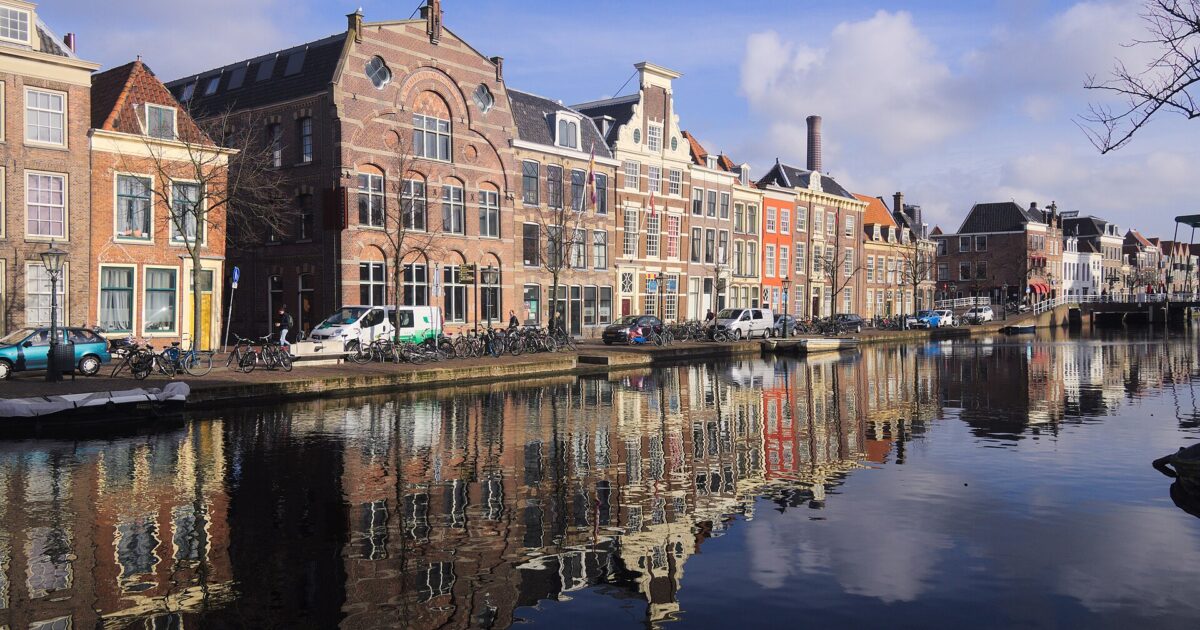
Leiden is thirty-five minutes from Amsterdam Centraal, has canals as pretty as the capital’s, holds the oldest university and the oldest botanical garden in the Netherlands, and produced Rembrandt. Almost nobody on a short Amsterdam trip goes. This guide covers the Leiden things to do that justify the journey, and is honest about the one thing people come looking for and cannot find.
Leiden is a student town first and a visitor destination a distant second, and that is the whole appeal. There is no queue outside anything. The cafés serve people who live here. The canals have residents’ boats on them rather than tour boats. What you give up is spectacle — there is no single unmissable building, no Anne Frank House equivalent, nothing that would make a stranger book a flight. What you get is a genuinely beautiful small Dutch city that is getting on with its own life, and a set of museums that are better than a place this size has any right to.
| Detail | |
|---|---|
| From Amsterdam | About 35 minutes by direct intercity |
| From Schiphol | A quick 15–20 minute train ride — one of the nearest historic cities to the airport |
| University founded | 1575 — the oldest in the Netherlands |
| Hortus Botanicus | Established 1590, the oldest botanical garden in the country |
| Naturalis | European Museum of the Year 2021 |
| Rijksmuseum van Oudheden | The national archaeology museum |
| De Valk | The city windmill, open inside |
| De Burcht | 11th-century keep ruin on a mound, free, city views |
| Rembrandt Route booklet | €6.95 from VVV Leiden |
| Time to allow | A full day; the museums alone could fill two |
The Rembrandt question, answered honestly
Let us deal with this first, because it is the reason a good many people come and it disappoints those who arrive unprepared.
Rembrandt van Rijn was born in Leiden in 1606, near Weddesteeg by the Rhine, the son of a miller. He lived and worked here until about 1631, when he moved to Amsterdam. This is genuinely his city.
But the birth house no longer exists. It was demolished long ago and only the site can be visited — a spot, marked, with a modern building on it. If you have come expecting a Rembrandt House Museum, that is in Amsterdam, on Jodenbreestraat, and it is excellent; see our Rembrandt House Museum guide.
What Leiden does have is better than a plaque. The Young Rembrandt Studio at Langebrug 89 is the seventeenth-century house where he trained under Jacob van Swanenburgh between 1606 and 1630 — the room where he learned to draw, paint and etch. It is small and unglamorous and it is the real thing.
The VVV tourist office sells a Rembrandt Route booklet for €6.95 that walks you through the relevant sites, and it is a good way to structure a morning if he is your reason for coming. Our page on Rembrandt in Amsterdam covers the other half of his life.
The museums, which are the real reason
Leiden has a museum density that makes no sense for a city of about 130,000 people, and it is a direct consequence of the university.
Naturalis Biodiversity Center
Named European Museum of the Year in 2021, and it earns it. A natural history collection of international significance in a purpose-built home, with dinosaur skeletons, a vast comparative collection, and displays that manage to be serious science and genuinely entertaining at the same time. If you are travelling with children this is the best museum day out in the Netherlands outside Amsterdam, and arguably including it. Check the current admission on its own site.
Rijksmuseum van Oudheden
The national museum of antiquities, in a monumental building near the centre, and the Dutch centre for archaeology. Egyptian, Greek, Roman and Near Eastern collections built up over two centuries, plus Dutch archaeology from prehistory onwards. There is an actual Egyptian temple — the Temple of Taffeh, gifted by Egypt in the 1970s — reassembled inside the entrance hall, which is a startling thing to walk into.
Hortus Botanicus
Established in 1590, the oldest botanical garden in the Netherlands and one of the oldest in the world. Carolus Clusius planted tulips here in the 1590s, and the Dutch tulip trade — and everything that followed from it, including the first recorded speculative bubble — traces back to this garden. The Clusius garden has been reconstructed as it was.
It is small by botanical garden standards and all the better for it: glasshouses, a Japanese garden, enormous old trees, and a quiet that is hard to find elsewhere in a Dutch city centre. If you have any interest in Dutch tulips, this is where the story starts.
Museum De Lakenhal
The city museum, in the seventeenth-century cloth hall, covering Leiden’s history and its art — including early Rembrandt and Jan Steen, who was also born here. The building alone is worth the visit.
Wereldmuseum Leiden (Museum Volkenkunde)
The national ethnography museum, founded in 1837 and now called Wereldmuseum Leiden. Like every museum of its type it is working through difficult questions about how its collection was assembled, and it does so more openly than most.
A note on cost: with this many good museums, a Museumkaart at €75 a year changes the arithmetic completely — three or four Leiden museums plus anything in Amsterdam clears it easily. Our city passes compared page runs the numbers.
Walking the city
Leiden’s old centre is compact, laced with canals, and takes about two hours to walk properly. Some fixed points:
- De Burcht — the ruin of an eleventh-century keep on an artificial mound in the middle of the city, at the point where the two branches of the Rhine meet. Free to climb, with views over the rooftops. Genuinely a thousand years old, and almost nobody is ever up there.
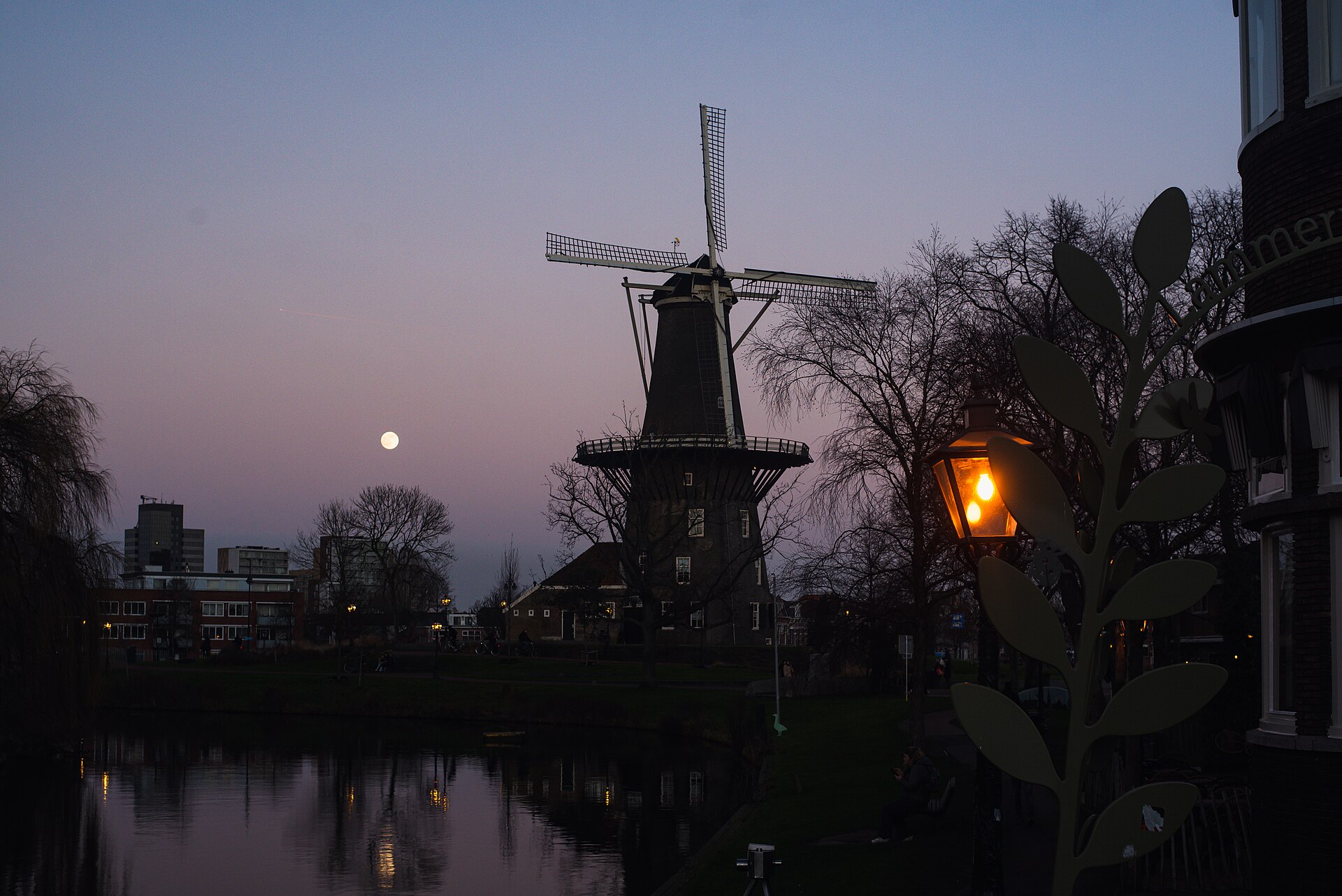
- De Valk — the city windmill, seven storeys, open inside as a museum with the milling machinery and the miller’s living quarters intact.
- Pieterskerk and Hooglandse Kerk — the two great churches, one of which holds a memorial to the Pilgrims.
- The Rapenburg — widely called the most beautiful canal in the Netherlands, and a fair claim. The university’s original building stands on it.
- The wall poems — over a hundred poems painted on building walls across the city, in dozens of languages, from Shakespeare to Neruda. Hunting them is a genuinely good way to explore.
- The Saturday and Wednesday markets on the Nieuwe Rijn, which are working markets rather than tourist ones.
The Pilgrims, and why Americans come here
A piece of history that surprises most European visitors and none of the American ones.
The English Separatists who would later be called the Pilgrims left England for religious freedom and settled in Leiden in 1609. They lived here for eleven years — working in the cloth trade, worshipping freely, and gradually worrying that their children were becoming Dutch. In 1620 a portion of the congregation left for the Mayflower voyage and Plymouth.
The Leiden American Pilgrim Museum, in one of the oldest houses in the city, covers this in a single small room with a curator who knows a great deal. There is a memorial in the Pieterskerk, where their pastor John Robinson is buried. It is a modest set of sites for a story of that weight, which is rather in keeping with the city.
The siege, and why the city is shaped as it is
Leiden’s defining event happened in 1574, and the city has not stopped talking about it since.
During the Eighty Years’ War against Spanish rule, Leiden was besieged for months and reduced to starvation — roughly a third of the population died. William of Orange’s answer was to break the dykes and flood the surrounding countryside, letting a fleet of shallow-draught boats sail across the drowned fields to relieve the city on 3 October 1574. The story is that the retreating Spanish left behind a cooking pot of stew, which is why hutspot — mashed potato, carrot and onion — is eaten on the anniversary to this day.
As a reward, William offered the city a choice between exemption from taxes and a university. Leiden chose the university, which was founded the following year, in 1575, and is the oldest in the Netherlands. Every museum on this page, the botanical garden, the ethnography collection and the entire character of the place descend from that decision.
The 3 October festival is still the biggest day in the Leiden calendar — a full civic celebration with a funfair, a procession, herring and white bread handed out, and the whole city on the street. It is one of the more genuinely local events in the Netherlands and worth planning around if your dates land near it. Our festivals and events calendar covers the national picture.
Getting there and around
Direct intercity trains run from Amsterdam Centraal in about thirty-five minutes. Fares are distance-based and fixed — no advance booking, no price to game — so tap in and out with OVpay and go when you like. Our OV-chipkaart and OVpay guide covers the mechanics.
One fact worth filing away: Leiden is only fifteen to twenty minutes from Schiphol, which makes it one of the nearest historic Dutch cities to the airport. If you have a long layover and a passport that lets you back through the border, Leiden is a more rewarding use of five hours than Amsterdam’s tourist core — you can be walking a canal forty minutes after clearing arrivals. Our Schiphol layover guide covers the mechanics and the border risk.

In the city, walk. The centre is under a kilometre across and the station is a five-minute walk from it. Canal boat tours run in season and are cheap by Amsterdam standards. OV-fiets hire at the station is available if you want to get out to the bulb fields, which start just north of the city.
Leiden also sits well as a base or a stop: Keukenhof is close, The Hague is fifteen minutes, Delft twenty-five. Our Keukenhof guide and Delft guide cover both.
A day in Leiden
- 09:30 — Train from Amsterdam. Out of the station and straight into the centre.
- 10:00 — De Burcht first, while the morning is quiet. Ten minutes up, ten minutes looking.
- 10:30 — Rijksmuseum van Oudheden or Naturalis, depending on whether you brought children. Two hours either way.
- 12:45 — Lunch on the Nieuwe Rijn or one of the smaller canals. Student prices, which is to say reasonable ones.
- 14:00 — Hortus Botanicus. An hour and a half, more if the weather is good.
- 15:30 — Walk the Rapenburg, find some wall poems, look at the Young Rembrandt Studio and the birth site if he is why you came.
- 17:00 — A drink on a canal terrace. Leiden’s café scene is its quiet strength.
- 18:30 — Train back, or stay for dinner and take a later one.
Eating and drinking
A university town of this size supports far more good, cheap places to eat than a tourist town does, and the difference is noticeable the moment you sit down. Prices run well below Amsterdam’s, portions are generous, and nobody is running a menu in six languages.
The streets around the Nieuwe Rijn and the Botermarkt hold most of it. There are decent terraces along the canals, a strong bakery culture, and the usual Dutch café staples done properly — our guide to must-try Dutch foods covers what to order. On 3 October the city celebrates the lifting of the Spanish siege of 1574 with a festival built around eating hutspot and herring, which is one of the more genuinely local celebrations in the country and takes over the whole city.
When to go
Leiden has no season that transforms it and none that ruins it, which makes the timing question easier than for most Dutch destinations.
Spring is the strongest argument. The bulb fields of the Bollenstreek start immediately north of the city, Keukenhof is a short bus ride, and Leiden makes a far more pleasant base for tulip season than Amsterdam does — closer, cheaper and quieter. Late March to mid-May.
Summer empties out. The students leave, the terraces fill with residents, and the city is at its most relaxed. Museums stay open; nothing much closes.
Early October brings the 3 October festival, which is either exactly what you want or exactly what you do not — the city is packed and joyful and accommodation is impossible.
Winter is the museum season, and with this many good ones that is a real proposition. A wet January day spent in Naturalis and the Rijksmuseum van Oudheden, with lunch between them, is a better use of bad weather than most things in Amsterdam. Our weather by month guide is realistic about how often bad weather arrives.
Is Leiden worth a day?
Yes if you have already done Amsterdam’s headline attractions and want a Dutch city that feels lived-in; you have any interest in archaeology, natural history or botany; you are travelling with children who would enjoy Naturalis; or you have a long Schiphol layover and want to use it well.
Consider Utrecht instead if you have exactly one day out and want the single most striking small Dutch city — the two-level canals with wharf cellars are unlike anything else in the country. Our Utrecht travel guide makes that case.
Consider Delft or Haarlem instead if you want maximum prettiness in minimum time. Both are smaller and denser.
Leiden’s argument is not that it beats those places on any single measure. It is that it has the museums of a much larger city, the canals of a much prettier one, and the atmosphere of a place that does not need you. For a certain kind of traveller that is the best combination on offer. Our pillar on the Netherlands beyond Amsterdam sets all of them side by side with times and fares.
Keep Exploring
- The Netherlands Beyond Amsterdam
- Utrecht Travel Guide
- Delft Day Trip
- Haarlem Day Trip
- The Hague & Scheveningen
- Keukenhof Gardens
- Rembrandt House Museum
- Rembrandt in Amsterdam
- Schiphol Layover Guide
- City Passes Compared
- OV-chipkaart & OVpay Guide
- The Dutch Golden Age
Frequently Asked Questions
How do you get from Amsterdam to Leiden?
Direct intercity trains take about thirty-five minutes from Amsterdam Centraal. NS fares are distance-based and fixed, so no advance booking is needed — tap in and out with OVpay. From Schiphol it is only fifteen to twenty minutes.
Can you visit Rembrandt’s birthplace in Leiden?
Only the site. Rembrandt was born near Weddesteeg by the Rhine in 1606, but the house itself no longer exists. The Young Rembrandt Studio at Langebrug 89 is the genuine seventeenth-century house where he trained under Jacob van Swanenburgh, and the VVV sells a Rembrandt Route booklet for €6.95.
What is Leiden famous for?
Being Rembrandt’s birthplace, the oldest university in the Netherlands (1575), the oldest Dutch botanical garden (1590), where Clusius grew some of the first tulips in the Netherlands, sheltering the Pilgrims from 1609 to 1620, and successfully withstanding a Spanish siege in 1574 — still celebrated every 3 October.
Is Leiden better than Utrecht or Delft?
Different. Utrecht has the most striking centre in the country thanks to its two-level canals with wharf cellars. Delft is the prettiest small town. Leiden has by far the best museums of the three and the most lived-in atmosphere. For a single day out, most people should pick Utrecht; for museums, Leiden.
Is Leiden good for a Schiphol layover?
Very. It is fifteen to twenty minutes by direct train, making it one of the nearest historic Dutch cities to the airport — you can be walking a canal within forty minutes of clearing arrivals. With five or more hours and a passport that lets you back through the border, it beats a rushed trip into central Amsterdam.
What museums are in Leiden?
Naturalis Biodiversity Center, European Museum of the Year 2021; the Rijksmuseum van Oudheden, the national archaeology museum with a reassembled Egyptian temple inside; Museum De Lakenhal for city history and early Rembrandt; Wereldmuseum Leiden (formerly Museum Volkenkunde) for ethnography; and the Hortus Botanicus.
How long do you need in Leiden?
A full day covers De Burcht, one big museum, the Hortus, a canal walk and a proper lunch. Two days lets you do Naturalis and the Rijksmuseum van Oudheden properly, which are both substantial, and see the city at a slower pace.
Why is the Hortus Botanicus in Leiden important?
It was established in 1590 and is the oldest botanical garden in the Netherlands. Carolus Clusius cultivated tulips here in the 1590s, which is where the entire Dutch tulip trade — and the speculative bubble that followed — began. The Clusius garden has been reconstructed as it was.