A short ride apart on the Intercity Direct, and about as different as two cities in one small country can be. The Amsterdam vs Rotterdam question is not really “which should I visit” — you can see both on the same trip without effort — but “which should I sleep in”, and that is a genuinely open question with money attached to the answer.
In one line: Amsterdam is the seventeenth century and Rotterdam is the twentieth. One kept its historic core; the other had its centre destroyed in May 1940 and rebuilt itself as a laboratory for modern architecture. Amsterdam is prettier, busier and more expensive. Rotterdam is cheaper, roomier, better for eating out, and considerably more interesting if buildings interest you. Most visitors should base in Amsterdam and day-trip to Rotterdam. A meaningful minority should do the opposite, and this page is mostly for them.
| Amsterdam | Rotterdam | |
|---|---|---|
| Character | Intact 17th-century canal city | Rebuilt post-1940 modern port city |
| Accommodation | Pricier, most of all in high season | Often cheaper, more space per euro |
| Getting between them | Intercity Direct from Amsterdam Zuid, plus a €3.20 supplement | |
| Best for | History, museums, canals, atmosphere | Architecture, food, space, value |
| Crowding | Severe in six central streets | Almost none |
| Museums | World-class and numerous | Good, not a reason to come |
| Walkability | Excellent, compact centre | Spread out; you will use the metro |
| Nearby | Haarlem, Zaanse Schans, Keukenhof | Kinderdijk, Delft, The Hague |

Why the two cities look nothing alike
On 14 May 1940 the centre of Rotterdam was bombed and largely destroyed. Amsterdam came through the occupation with its buildings intact — the horror there was human rather than architectural, and roughly three-quarters of the city’s Jewish population was murdered. The consequence for a visitor eighty-six years later is stark: Amsterdam has an unbroken seventeenth-century canal ring that is a UNESCO World Heritage Site, and Rotterdam has almost no old centre at all.
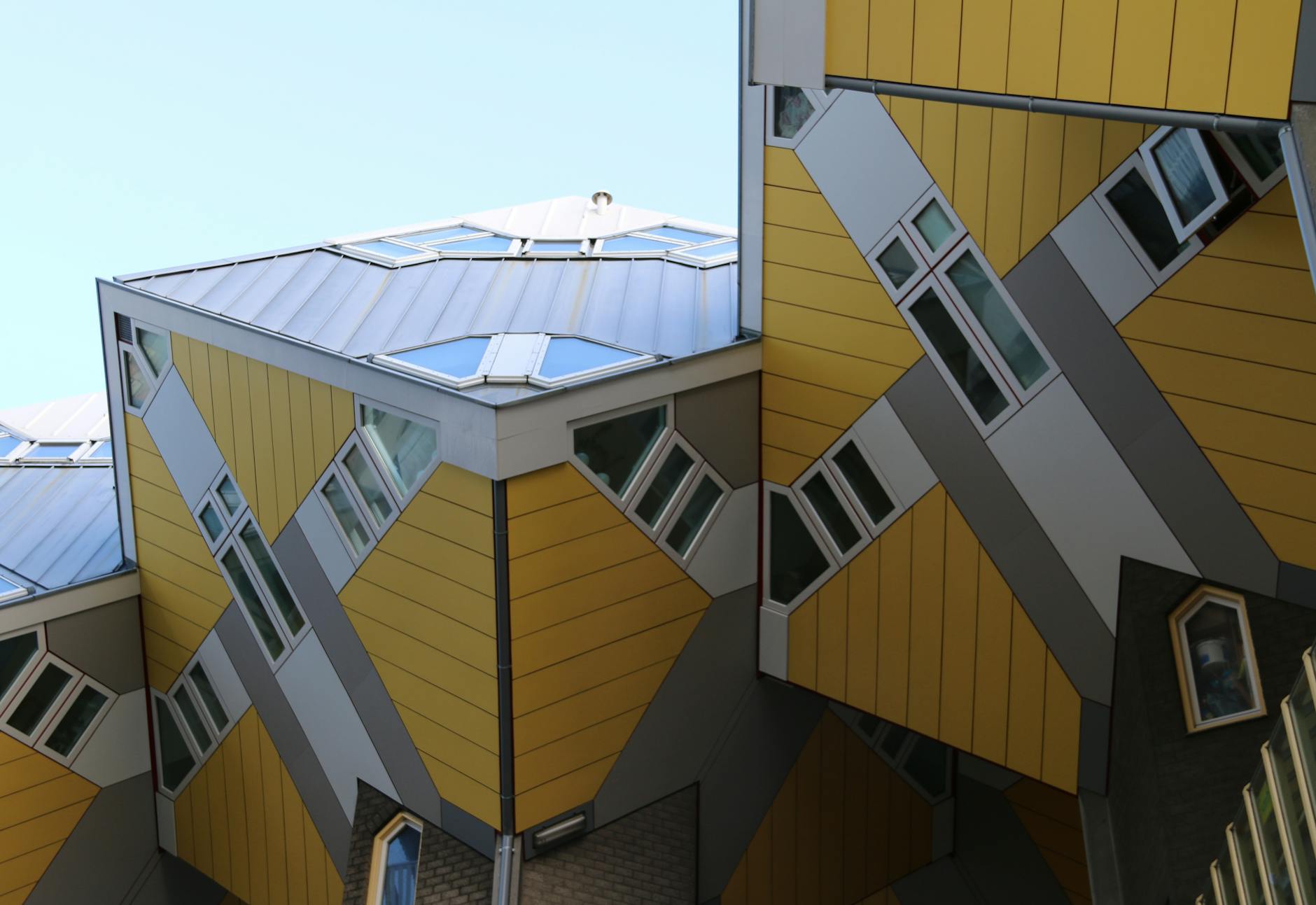
Rotterdam’s response was to stop trying to look old. It rebuilt as a deliberate experiment and has kept experimenting since — Piet Blom’s tilted cube houses, the vast arched Markthal with its painted ceiling, the Erasmus Bridge, the Depot Boijmans van Beuningen with its mirrored bowl. Europe’s largest port sits behind all of it, which is the reason the city exists and the reason it has money. It has the most dramatic skyline in the Netherlands, and the architecture of the last fifty years is the point rather than an intrusion.
Which of those you prefer is largely temperamental, and it is worth being honest with yourself about it before booking. Plenty of people find Rotterdam cold. Plenty find Amsterdam twee. Our Rotterdam day trip guide covers what to actually see there in a day, and our canal ring page covers what Amsterdam has instead.
The money question
This is why anyone seriously considers basing in Rotterdam. Amsterdam hotels are pricier, most of all in high season, and carry a tourist tax of 12.5% of the room price excluding VAT on top of the quoted rate. Rotterdam is often cheaper, and you often get more room for the money because the city was rebuilt at a modern scale rather than squeezed into merchant plots.
The offsetting cost is the commute. Intercity Direct no longer starts at Amsterdam Centraal; it leaves from Amsterdam Zuid and runs via Schiphol to Rotterdam Centraal on the high-speed line, with a €3.20 supplement each way on top of the ordinary fare — €1.92 if you buy the supplement at the Supplement Pole in off-peak hours. Doing that daily for a week is real money and real time, and it is why we do not recommend Rotterdam as a base for a trip whose content is mostly in Amsterdam.
Where Rotterdam does work as a base is a trip whose centre of gravity is the south: Kinderdijk’s nineteen UNESCO windmills, Delft, The Hague and its beach at Scheveningen are all much closer to Rotterdam than to Amsterdam. If half your list is down there, sleeping in Rotterdam is straightforwardly correct. Our Amsterdam cost guide runs the accommodation numbers in full.
For the closer alternatives — Haarlem, Utrecht and Zaandam, all under forty minutes — see our guide to staying outside Amsterdam.
Food: Rotterdam, more than people expect
This surprises visitors and it should not. Rotterdam is younger, more diverse, considerably less touristed and much cheaper to run a restaurant in, and the result is a food scene with less pressure on it to please people who will never come back. The Markthal alone — a residential arch over a covered market hall — does in one building what takes three neighbourhoods in Amsterdam. Fenix Food Factory in Katendrecht and the Witte de Withstraat give you the rest.
Amsterdam’s food is not bad, but we are consistent on this site about what it is: Dutch cuisine is hearty, sensible and unmemorable, and Amsterdam’s genuinely good eating is borrowed — Indonesian rijsttafel above all, which remains the one unmissable meal in the country and which Rotterdam also does well. Amsterdam’s disadvantage is simply that the central restaurants are priced and pitched for people passing through. Our food and drink guide and rijsttafel guide are honest about the distinction.

Museums and things to do: Amsterdam, comfortably
There is no serious argument here. Amsterdam has the Rijksmuseum (€25), the Van Gogh Museum (€25, entirely timed entry), the Stedelijk (€22.50) and the Anne Frank House (€16.50, sold only through annefrank.org) — plus the Rembrandt House, NEMO, ARTIS, Moco and STRAAT behind them. Rotterdam has the Boijmans collection and its architecture, and the architecture is the real attraction.
This is the single strongest reason most visitors should base in Amsterdam. If your days are going to be spent in museums, sleeping a train ride away from all of them is a false economy, and the €75 Museumkaart tilts it further — 500-plus Dutch museums, paid off after about three to four major museum visits, most of them in Amsterdam. Our museums guide and city passes compared page cover the options.
Rotterdam’s counter-argument is that it is not busy. Amsterdam’s crowding is severe and geographically tiny — essentially Damrak, the Dam and De Wallen — and while it is easy to walk out of, Rotterdam simply does not have the problem. If crowds are the thing that ruins a trip for you, that is worth weighing.
Getting around each of them
Amsterdam’s great practical advantage is that you can largely ignore its transport system. The centre is compact enough to walk, and if you only ride a few trams, a €10 GVB 24-hour ticket often fails to pay for itself against pay-as-you-go OVpay rides. It is also the best city in the world to cycle in, which converts the trip for anyone confident in traffic, though local cyclists are fast and unforgiving and rental bikes cause most of the minor collisions in the centre.
Rotterdam was rebuilt at a modern, wider scale, so it does not fold up the same way. The distances between the cube houses, Katendrecht, the Kop van Zuid and the Witte de Withstraat are real distances, and you will use the RET metro and trams to cover them. That is not a criticism — the network is quick and clean — but it does mean Rotterdam gives you fewer of those accidental discoveries that come from walking everywhere. It also makes Rotterdam easier to drive around, which matters if you are on a wider Dutch road trip, whereas central Amsterdam parking runs roughly €5–8 an hour and a large share of the street spaces are reserved for permit holders.
Arrivals differ too. Schiphol is a single terminal with a railway station directly beneath it and a 15–20 minute, roughly €6 train into Amsterdam Centraal. Rotterdam The Hague airport is a low-cost base 6 km from the city centre, with RET bus 33 linking it to Rotterdam Centraal in about twenty minutes for around €5.50, up to six times an hour. If your flight lands at Rotterdam rather than Schiphol, the case for basing in Rotterdam for at least the first night gets stronger on its own. Our Eindhoven and Rotterdam airports page covers both.
What each city puts within an hour of your hotel
This is the part people forget, and it often decides the question more cleanly than anything about the cities themselves. Where you sleep determines which day trips are cheap and easy, and the two cities face in opposite directions.
- From Amsterdam: Haarlem in about fifteen minutes; Zaanse Schans in about forty; Zandvoort’s beach in about thirty for around €6.90; Utrecht in about thirty-five for about €9–10; Volendam and Marken by bus; Keukenhof and the bulb fields between late March and mid-May; the Alkmaar cheese market on Fridays from late March to the end of September.
- From Rotterdam: Kinderdijk’s nineteen UNESCO windmills in about thirty minutes by WaterShuttle, against about an hour and a half from Amsterdam; Delft; The Hague and the beach at Scheveningen; and the whole southern half of the country within easy reach.
Kinderdijk is the clearest single example. From Amsterdam it is a committed day trip at about an hour and a half each way; from Rotterdam it is a morning. Adult entry is about €21, children 4–12 about €9, under-4s free, and the ticket covers the paths, one or two mill interiors, the pumping-station museums and the visitor centre. If windmills are high on your list and you want them without the Zaanse Schans crowds, that alone is an argument for a Rotterdam night or two. See our Kinderdijk guide and day trips from Amsterdam.
Which to base yourself in
- Base in Amsterdam if this is a first Dutch trip; if museums are the point; if you have three or four days; if you want to walk everywhere; if the canal ring is what you came for; if you are going north or west for day trips — Haarlem, Zaanse Schans, Keukenhof, Zandvoort, Volendam.
- Base in Rotterdam if the budget is genuinely tight and you are staying a week; if modern architecture is a real interest rather than a curiosity; if your day trips are southern — Kinderdijk, Delft, The Hague; if you are flying into Rotterdam The Hague, which sits 6 km from the centre; if crowds are a deal-breaker.
- Base in both if you have a week. Three or four nights in Amsterdam, then move south. Dutch rail fares are fixed and distance-based with no advance-purchase advantage, so you can decide the morning you travel and pay the same.
If the trip continues south into Belgium, our Benelux by train itinerary runs Amsterdam, Brussels and Bruges as one route.
The verdict
Base in Amsterdam and day-trip to Rotterdam. That is the right answer for most visitors, because Amsterdam holds the museums, the canal ring and the atmosphere, and Rotterdam is a short train ride away and works perfectly as a day out — the cube houses, the Markthal, the Erasmus Bridge and a proper lunch fill a day comfortably and you are back for dinner.
Reverse it only if the numbers demand it or the architecture genuinely excites you. And on a week-long trip, do not choose at all: move. Our seven-day Netherlands itinerary splits the nights between Amsterdam, Utrecht and Rotterdam, which costs about ninety minutes of total travel across the week and sees three genuinely different cities instead of one.
Keep Exploring
- Is Amsterdam Worth It?
- Rotterdam Day Trip from Amsterdam
- Netherlands 7-Day Itinerary
- The Netherlands by Train
- Kinderdijk Windmills
- Delft Day Trip
- The Hague & Scheveningen
- Utrecht Travel Guide
- Is Amsterdam Expensive?
- Eindhoven & Rotterdam Airports
- The Netherlands Beyond Amsterdam
- Where to Stay in Amsterdam
Frequently Asked Questions
Should I stay in Amsterdam or Rotterdam?
Amsterdam, for most visitors — that is where the museums, the canal ring and the atmosphere are, and Rotterdam is only a short train ride away as a day trip. Base in Rotterdam if the budget is tight over a longer stay, if modern architecture is a genuine interest, or if your day trips are southern.
How long is the train from Amsterdam to Rotterdam?
A short ride on Intercity Direct, which leaves from Amsterdam Zuid and runs via Schiphol on the high-speed line; the NS journey planner gives the day’s times. It carries a €3.20 supplement each way on top of the ordinary fare — €1.92 if bought at the Supplement Pole off-peak. Ordinary intercity services are slower but carry no supplement.
Is Rotterdam cheaper than Amsterdam?
Often, on accommodation and eating out. Amsterdam hotels are pricier and carry a 12.5% tourist tax (on the room price excluding VAT) on top; Rotterdam is often cheaper and gives you more space for the money. The offset is the daily commute if your sightseeing is in Amsterdam.
Is Rotterdam worth visiting?
Yes, for a day, and for longer if architecture interests you. The cube houses, the Markthal, the Erasmus Bridge and the Depot Boijmans van Beuningen make a full day, and the city is refreshingly uncrowded compared with central Amsterdam.
Why does Rotterdam look so modern?
Its centre was bombed and largely destroyed on 14 May 1940. Rather than reconstruct what had gone, the city rebuilt as a deliberate modern experiment and has kept experimenting since, which is why it has the most dramatic skyline in the Netherlands.
Can you day trip to Rotterdam from Amsterdam?
Easily. A short ride each way on Intercity Direct leaves a full day for the cube houses, the Markthal, a walk across the Erasmus Bridge and lunch, with time to get back for dinner in Amsterdam. Add Kinderdijk if you want a second stop.
Which city is better for food?
Rotterdam, more than people expect. It is younger, more diverse, less touristed and cheaper to run a restaurant in, and the Markthal alone covers a lot of ground. Amsterdam’s best meal remains an Indonesian rijsttafel, which Rotterdam also does well.
Is Rotterdam good for a first trip to the Netherlands?
Not as a base. A first Dutch trip should be built around Amsterdam’s museums and canal ring, with Rotterdam as a day out. On a second visit, or a full week, Rotterdam earns several nights of its own.