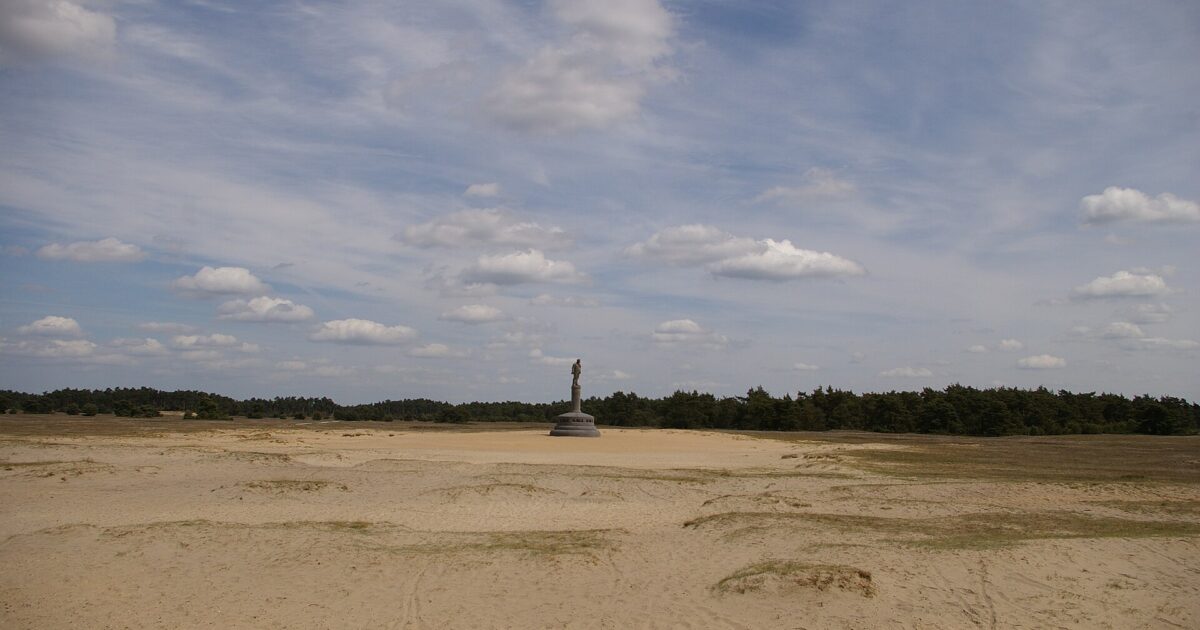
A couple of hours from Amsterdam there is a national park of heath, forest and open drifting sand, and inside it — reachable by a free white bicycle you pick up at the gate and ride through pine woods — sits the second-largest Van Gogh collection in the world. This is the strangest and, for a certain kind of visitor, the best day out in the Netherlands. This guide covers Hoge Veluwe and the Kröller-Müller: what the tickets actually cost, how the two-ticket system works, and how to spend the day.
This takes commitment. It is not a place you drop into, it requires a train and a bus and a bit of planning, and the ticketing is genuinely confusing until someone explains it. It is also one of the few places in the country where you can cycle through a landscape that looks nothing like the Netherlands and arrive at a world-class museum in the middle of it. If you have seen the Van Gogh Museum in Amsterdam and want more, or if you like the idea of art and landscape in the same day, nothing else here comes close.
| Ticket | Price |
|---|---|
| Combined day ticket, adult (museum + park) | €27.75 |
| Combined, youth 13–18 | €20.80 |
| Combined, child 6–12 | €6.95 |
| Park day ticket alone, adult | €13.85 |
| Museumkaart holders | Museum free — but you still pay the €13.85 park ticket |
| Students / CJP / Cultuurkaart / EYCA | €6.95 museum only — park ticket still required separately |
| White bicycles | Free, no separate ticket |
| Car or motorcycle inside the park | €9.80 |
| Parking at the entrance | €4.90 |
| Museum & sculpture garden hours | Tue–Sun and public holidays 10:00–17:00; daily 6 Jul–24 Aug; closed 1 Jan |
The two-ticket system, explained once
This is where people get caught, so here it is plainly.
The Kröller-Müller Museum sits inside De Hoge Veluwe National Park. The park and the museum are separate organisations with separate tickets. To see the art, you need both — a park ticket to get through the gate and a museum ticket to get through the door.
The simple answer for most visitors is the combined day ticket at €27.75 for an adult, which covers both and is what you should buy. Youth aged 13 to 18 pay €20.80 and children 6 to 12 pay €6.95.
The two situations that need care:
- Museumkaart holders. Your museum entry is free — but you still have to pay the park day ticket of €13.85 to get in. A Museumkaart does not get you into the park. This surprises a lot of Dutch visitors, let alone foreign ones.
- Students and CJP / Cultuurkaart / EYCA holders. You get the museum at €6.95, and you still need a park ticket bought separately at the park’s ticket office.
Book online. The operator says explicitly that it gives you priority at the park entrance on busy days, and on a sunny Sunday in August that is not a small thing.
The white bicycles
The single best thing about a day here, and it costs nothing.
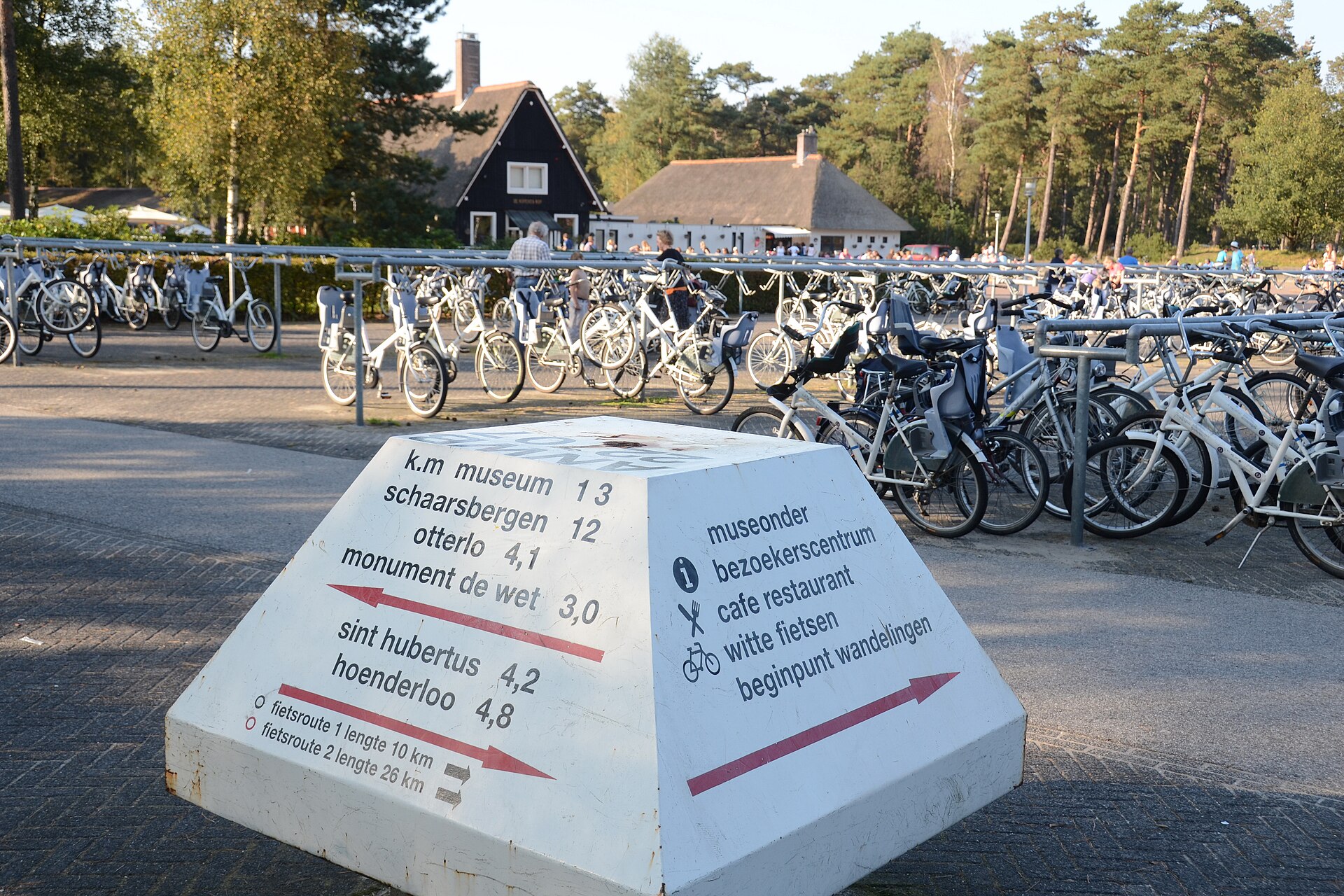
De Hoge Veluwe keeps around a thousand white bicycles at racks by the entrances and the visitor centre. You take one, ride it wherever you are going, leave it at a rack, and take another when you want to move on. There is no deposit, no booking, no separate bicycle ticket — it is included with park entry, and it has been running since the 1970s.
The bikes are single-speed, upright, robust and entirely unglamorous, which is exactly right for a flat sandy park. There are children’s bikes and bikes with child seats. They are not electric and they are not fast; the park is 54 square kilometres and the distances are real, so plan around a comfortable pace rather than a racing one.
If you are nervous about cycling, this is the gentlest possible place to try it — no traffic, no trams, no Amsterdam cyclists behind you ringing a bell. Our bike rental guide covers the city version, which is a great deal more demanding.
The Kröller-Müller Museum
Helene Kröller-Müller was one of the first collectors anywhere to recognise Van Gogh as a major artist, and she bought accordingly — starting in the years after 1907, when his reputation was still forming. By the time she and her husband gave the collection to the Dutch state in 1935, she had assembled nearly 90 paintings and many drawings.
That makes this the second-largest Van Gogh collection in the world, after the Van Gogh Museum in Amsterdam. The two are genuinely complementary rather than duplicative — the Amsterdam museum tells the biography and holds the family’s own retained works, while the Kröller-Müller was assembled by an outsider buying on judgement, so the selection is different and in places stranger. If you have done one, the other is not a repeat. Our Van Gogh Museum guide covers the Amsterdam side.
The rest of the collection is strong too: Seurat, Mondrian, Picasso, Léger and a substantial holding of early modernism. The building itself, by Henry van de Velde, is low, quiet and full of daylight — the opposite of a grand museum, and much better for looking at paintings.
The museum is open Tuesday to Sunday and public holidays, 10:00 to 17:00, closed on 1 January, and open every day from 6 July to 24 August.
The sculpture garden
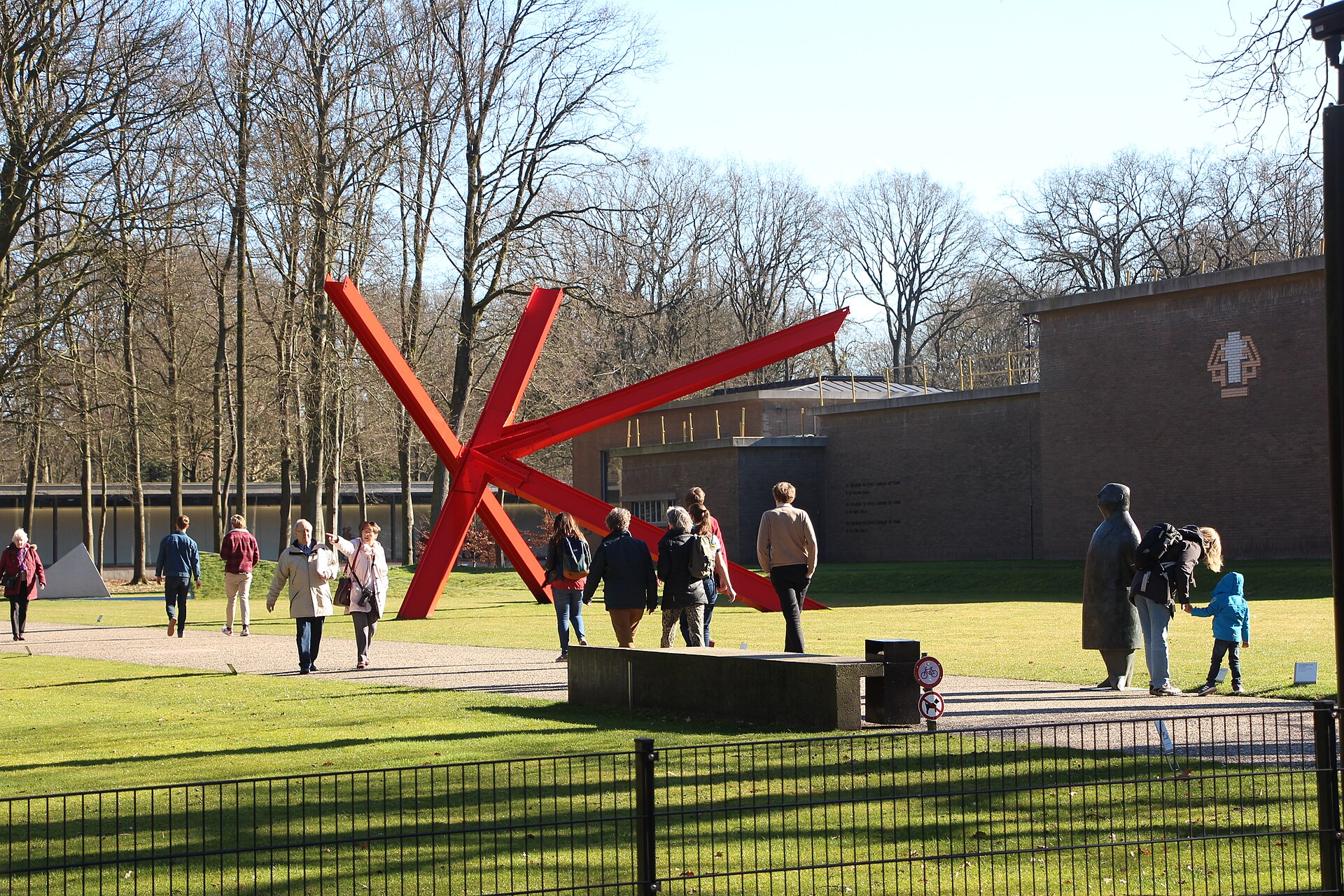
Behind the museum lies one of the largest sculpture gardens in Europe — around 25 hectares of woodland and lawn holding work by Rodin, Moore, Dubuffet, Serra, Oldenburg and many others, placed among the trees rather than lined up on plinths.
It is included in the museum ticket and it keeps the same hours. Allow at least an hour, and more if the weather is good; several of the works are meant to be walked through or into rather than looked at. Jean Dubuffet’s Jardin d’émail — a white enamelled landscape you climb up into — is the one everybody remembers.
Our honest view: the sculpture garden is the part people underestimate before they arrive and rave about afterwards. Do not treat it as an add-on to the paintings.
The park itself
De Hoge Veluwe is 54 square kilometres of heath, pine and deciduous woodland, and — most unusually — active drift sand, where wind moves open sand across a landscape with almost nothing growing on it. Standing in the middle of that, with a line of pines on the horizon and sand underfoot, you would struggle to place yourself in the Netherlands at all.
The heather flowers in August and early September, turning large areas purple, which is the park at its most photogenic. Autumn colour through October is the other peak.
Wildlife is a genuine draw. Red deer, roe deer, mouflon and wild boar all live here, and the park maintains observation hides — wildobservatieposten — where you can sit and wait. Dawn and dusk are the times; the middle of the day is not. The autumn rutting season in September and October is when the red deer are most active and most audible.
There is also the Museonder, an underground museum beneath the visitor centre devoted to what lives below the soil surface — roots, burrows, groundwater, geology. It is small, free with park entry, and a good deal more interesting than that description suggests, particularly with children.
And Jachthuis Sint Hubertus, the Kröller-Müllers’ hunting lodge, designed by Berlage from 1915 and completed around 1920, and visitable by guided tour. It is an extraordinary piece of Dutch design and the tours are worth booking ahead.
Getting there from Amsterdam
There is no station in the park. The route is train plus bus, and it takes about ninety minutes to two hours.
- Train from Amsterdam Centraal to Ede-Wageningen, Arnhem or Apeldoorn depending on which entrance you want. Ede-Wageningen serves the Otterlo entrance, which is the one nearest the museum.
- Bus from the station to the park entrance. Check krollermuller.nl and 9292.nl for the current bus connection to the entrance you want.
- Then a white bicycle from the entrance to wherever you are going. The signposts give distances in kilometres.
Check the bus timetable in both directions before you set out, and particularly the last service back. This is rural Gelderland and the frequency is not what you are used to in the Randstad.
Driving is straightforward if you have a car: parking at the entrance costs €4.90, and taking a car into the park itself is €9.80 — though the whole point is the bicycles, so park at the gate.
How to spend the day
- 08:30 — Leave Amsterdam. Train to Ede-Wageningen, then the bus.
- 10:30 — Through the gate. Take a white bicycle immediately; do not walk.
- 10:45 — Ride to the museum through pine woods; it is a short ride from the visitor centre. The ride is part of the experience.
- 11:00 — Kröller-Müller. Two hours minimum for the paintings.
- 13:00 — Lunch; check the museum and park websites for what is open on the day.
- 14:00 — The sculpture garden. Ninety minutes, more in good weather.
- 15:30 — Cycle out into the park proper. The drift sand and the De Wet monument are the landscape everyone photographs; the heath is best in late summer.
- 17:00 — Museonder if you have energy, then the bus.
- 19:30 — Back in Amsterdam.
If wildlife is your priority, invert this: arrive late, do the museum in the afternoon, and be at a hide at dusk. That requires accommodation nearby — Arnhem and Apeldoorn both work, and Arnhem has the Airborne Museum and the Openluchtmuseum if you are making two days of it.
Who Helene Kröller-Müller was
The collection makes a good deal more sense once you know where it came from.
Helene Müller was born in Germany in 1869 into a wealthy industrial family and married Anton Kröller, who ran the family shipping and mining business from Rotterdam. In 1906 she took an art appreciation course, which is a modest-sounding beginning for what followed: between about 1907 and 1939 she amassed a very large collection and became one of the most significant collectors in Europe.
What set her apart was conviction rather than money — plenty of people had money. She was one of the first collectors to recognise Van Gogh, at a time when his standing was still contested and the prices were low, and she kept buying while others hesitated. She bought Mondrian early. She bought Seurat. She was collecting living and recently dead artists at a point when the safe purchase was an old master.
The aim was a public museum. The couple bought the Veluwe estate — thousands of hectares of what was then poor hunting land — as the setting for it, commissioned Berlage to build the hunting lodge, and intended a grand museum building that the Depression eventually killed. What was built instead, Henry van de Velde’s low daylight-filled gallery, opened in 1938, and Helene served as its first director until her death a year later.
In 1935 the Kröller-Müllers gave the entire collection and the estate to the Dutch state, which is why the whole thing exists as a national park with a national museum inside it rather than as a private house full of paintings. It is one of the more consequential acts of philanthropy in Dutch cultural history, and almost nobody outside the country has heard of her. Our page on Amsterdam for art lovers covers where the rest of the national collection sits.
When to go
Late August and early September is the answer if you want the heather in flower — large stretches of the park turn purple and it is genuinely worth timing for.
October for autumn colour and the deer rut, which is the most dramatic wildlife event in the Dutch calendar.
Spring is quiet, green and pleasant, with the museum uncrowded.
Winter works better than you would expect — the museum is warm and empty, and a cold clear day on the heath is bleakly lovely. Watch the shorter opening and the 1 January closure, and note the museum is closed on Mondays outside the summer window.
Avoid a hot Sunday in the school holidays if you can. This is a favourite Dutch family day out and the entrances back up, which is exactly why the operator pushes online booking. Our month-by-month weather guide covers the wider picture.
Is it worth it?
Yes if you care about Van Gogh beyond the greatest hits; you like the idea of art and landscape in one day; you have four days or more in the Netherlands; or you have children who would rather cycle through a forest than stand in a gallery — this manages both.
No if you have three days and have not yet seen the Rijksmuseum and the Van Gogh Museum. Do those first; they are the reason people come to this country, and our Amsterdam museums guide covers them properly. The Kröller-Müller is a second-helping museum, and it is a superb one.
The comparison worth making is with the other long days out: Kinderdijk for engineering and landscape, Efteling for families, Maastricht for a different Netherlands entirely. Our pillar on the Netherlands beyond Amsterdam sets them side by side. Of all of them, this is the one that surprises people most.
Practical notes
- Book online for entrance priority on busy days.
- The museum closes Mondays outside 6 July to 24 August, and on 1 January.
- Museumkaart does not cover the park. Budget €13.85 on top.
- Take a bike, not a car. The white bicycles are free and the park is designed around them.
- Distances are real. 54 square kilometres. Look at the signposted kilometre figures before committing to a route.
- Bring water and layers. The open heath and drift sand have no shade and no shelter.
- Check the last bus before you settle into the sculpture garden.
- Cashless, as everywhere in the Netherlands.
Keep Exploring
- The Netherlands Beyond Amsterdam
- Van Gogh Museum Amsterdam
- Amsterdam Museums Guide
- Amsterdam for Art Lovers
- Kinderdijk Windmills
- Efteling Theme Park Guide
- Utrecht Travel Guide
- City Passes Compared
- Bike Rental in Amsterdam
- OV-chipkaart & OVpay Guide
- Day Trips from Amsterdam
- Amsterdam in Autumn
Frequently Asked Questions
How much does it cost to visit the Kröller-Müller Museum?
A combined day ticket covering both the museum and De Hoge Veluwe National Park costs €27.75 for adults, €20.80 for youth aged 13–18 and €6.95 for children aged 6–12. You need both a park and a museum ticket to see the art.
Does Museumkaart cover the Kröller-Müller?
It covers the museum but not the park. Museumkaart holders enter the museum free and still pay the €13.85 park day ticket to get through the gate. Students and CJP, Cultuurkaart or EYCA holders pay €6.95 for the museum and also need a separate park ticket.
Are the white bicycles at Hoge Veluwe really free?
Yes. Around a thousand white bikes sit at racks by the entrances and the visitor centre, included with park entry, with no deposit and no separate bicycle ticket. Take one, ride it, leave it at a rack. There are children’s bikes and bikes with child seats too.
How do you get to Hoge Veluwe from Amsterdam?
Train from Amsterdam Centraal to Ede-Wageningen, Arnhem or Apeldoorn, then a bus to the park entrance — about ninety minutes to two hours in total. Ede-Wageningen serves the Otterlo entrance, closest to the museum. Check the last bus back before you go.
How big is the Van Gogh collection at the Kröller-Müller?
Nearly 90 paintings and many drawings — the second-largest in the world after the Van Gogh Museum in Amsterdam. Helene Kröller-Müller was one of the first to recognise Van Gogh and began buying in the years after 1907, before his reputation was settled, so the selection differs from the Amsterdam holdings rather than duplicating them.
Is the sculpture garden worth seeing?
Very much so, and it is included in the museum ticket. Around 25 hectares of woodland and lawn holding Rodin, Moore, Dubuffet, Serra and Oldenburg among others. Allow at least an hour. Dubuffet’s walk-in Jardin d’émail is the piece everyone remembers.
When does the heather flower at Hoge Veluwe?
August and early September, when large areas of the park turn purple. October brings autumn colour and the red deer rut, which is the most dramatic wildlife event in the Dutch year. Both are worth timing a visit around.
Can you see wildlife at Hoge Veluwe?
Yes — red deer, roe deer, mouflon and wild boar live in the park, and there are observation hides where you can sit and wait. Dawn and dusk are the productive times, which means staying nearby rather than day-tripping from Amsterdam if wildlife is your priority.
Photo Credits
- Sculptures outside the Kröller-Müller Museum: 2019-02-24 Kröller-Müller Museum 02 by Ziko van Dijk, CC BY-SA 4.0, via Wikimedia Commons.