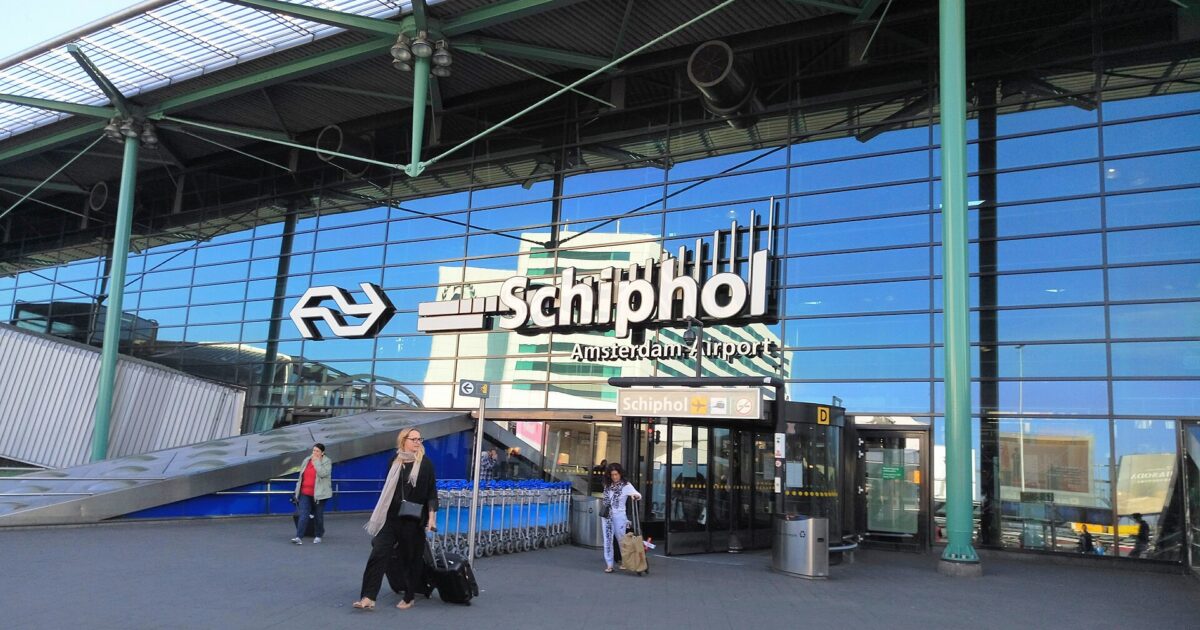
Almost every airport guide starts by telling you which terminal your flight leaves from. At Amsterdam Airport Schiphol that question has no answer, because there is only one terminal. What people mean when they ask about Schiphol terminals is really one of three different questions: which of the three departure halls you check in at, which pier your gate hangs off, and whether you cross a Schengen border on the way. This page answers all three, and then deals with the part that actually goes wrong for people — connecting from one flight to the next in a building that looks simple on a map and feels enormous underfoot.
Two things are true at once. Schiphol’s single-roof design is genuinely one of the better airport layouts in Europe, and for a straightforward Schengen-to-Schengen connection it is close to painless. But 2026 has been a bruising year here. The EU Entry/Exit System came in on 10 April, the airport moved to a new security organisation on 18 May, and the combination has produced passport queues that regularly run to two hours for non-EU passengers. The published minimum connecting times have not changed. Reality has. If you take one thing from this page, take that gap between the two numbers.
| What you need to know | The short version |
|---|---|
| Terminals | One. Never travel to “Terminal 2” — it does not exist. |
| Departure halls | Three (1, 2, 3), all connected landside on the same level as Schiphol Plaza |
| Check-in desks | Desks 1–8 in Departures 1 · 9–16 in Departures 2 · 17–32 in Departures 3 |
| Piers | B, C, D, E, F, G, H/M — all linked airside |
| Schengen piers | B, C and the upper level of D (gates D59–D87) |
| Non-Schengen piers | E, F, G, H/M and the lower level of D (gates D1–D57) |
| Published minimum connection | 40 min Schengen–Schengen · 50 min if non-Schengen is involved (KLM) |
| Realistic connection in 2026 | 2–2.5 hours if you arrive non-Schengen and depart Schengen |
| Longest airside walk | Roughly 25–30 minutes, far end of Pier G to far end of Pier B |
| Recommended arrival | 2 hours before a Schengen flight, 3 hours before non-Schengen |
| Pier A | Under construction, now due April 2027 |
One terminal, three halls: what that actually means
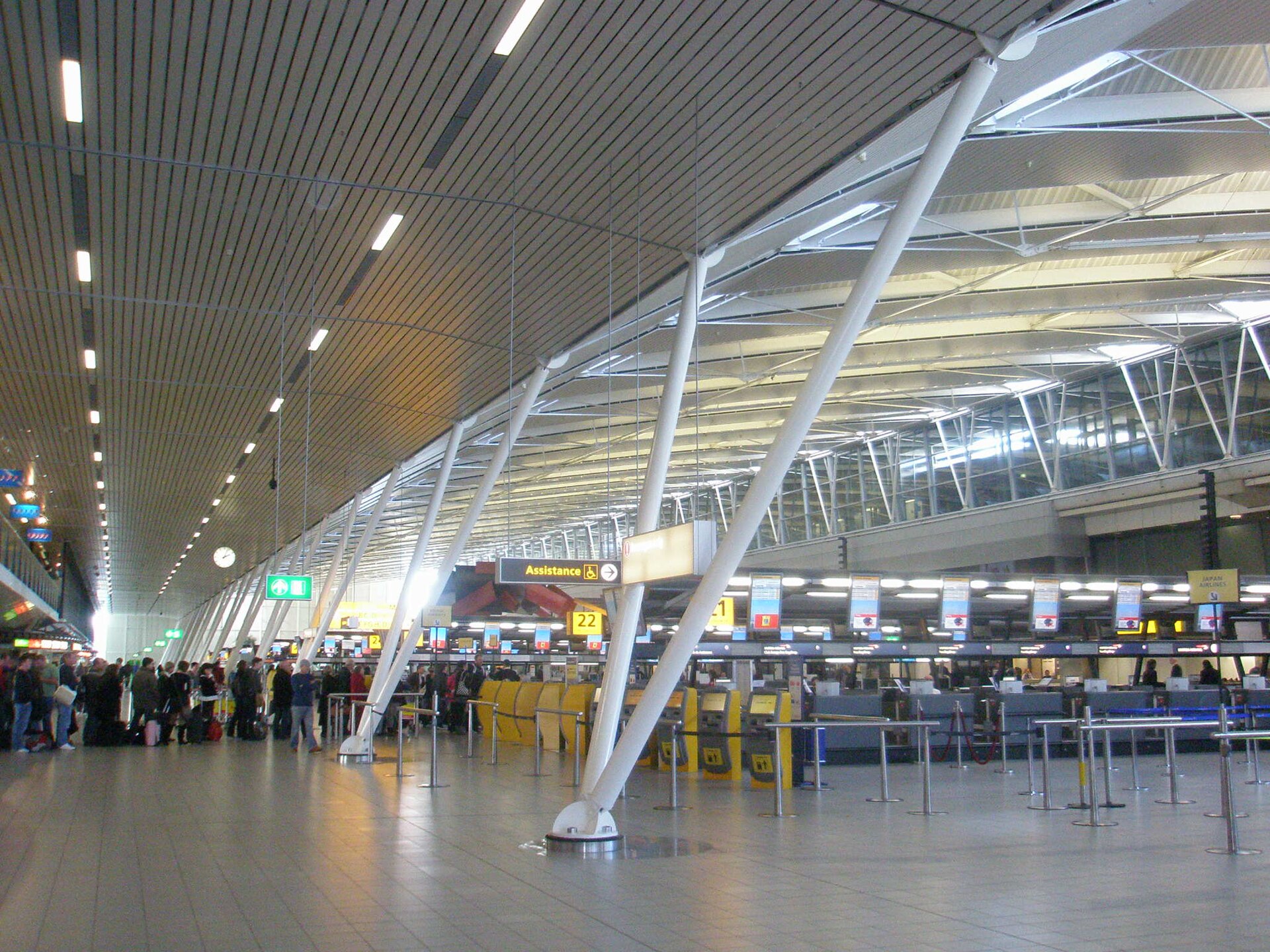
Schiphol is a single building. You walk in through one of three sets of doors, but there is no wall between them and no shuttle bus, no train and no transit system to get from one to another. Departures 1, 2 and 3 sit in a row along the same landside concourse, and walking from the far end of Departures 1 to the far end of Departures 3 takes about ten minutes at a normal pace with a bag. That is the whole story. If you have ever changed terminals at Heathrow or Charles de Gaulle, put that memory away — it does not apply here.
The halls are distinguished by their check-in desk numbers rather than by names. Desks 1 to 8 are in Departures 1, desks 9 to 16 in Departures 2, and desks 17 to 32 in Departures 3. Your boarding pass or your airline’s app tells you which desk row to head for, and the overhead displays throughout Schiphol Plaza will point you the rest of the way. Blue self-service kiosks belong to KLM and its SkyTeam partners and are scattered through all three halls; other carriers use their own.
In practice the hall matters less than people expect, because once you clear security you are in a single connected airside space. The hall determines where you queue for security and drop your hold bag — nothing more. This is why the airport’s own signage talks about piers and gates rather than terminals, and why it is worth learning the pier letters before you learn anything else about the building.
Schiphol Plaza, and why it changes how you plan
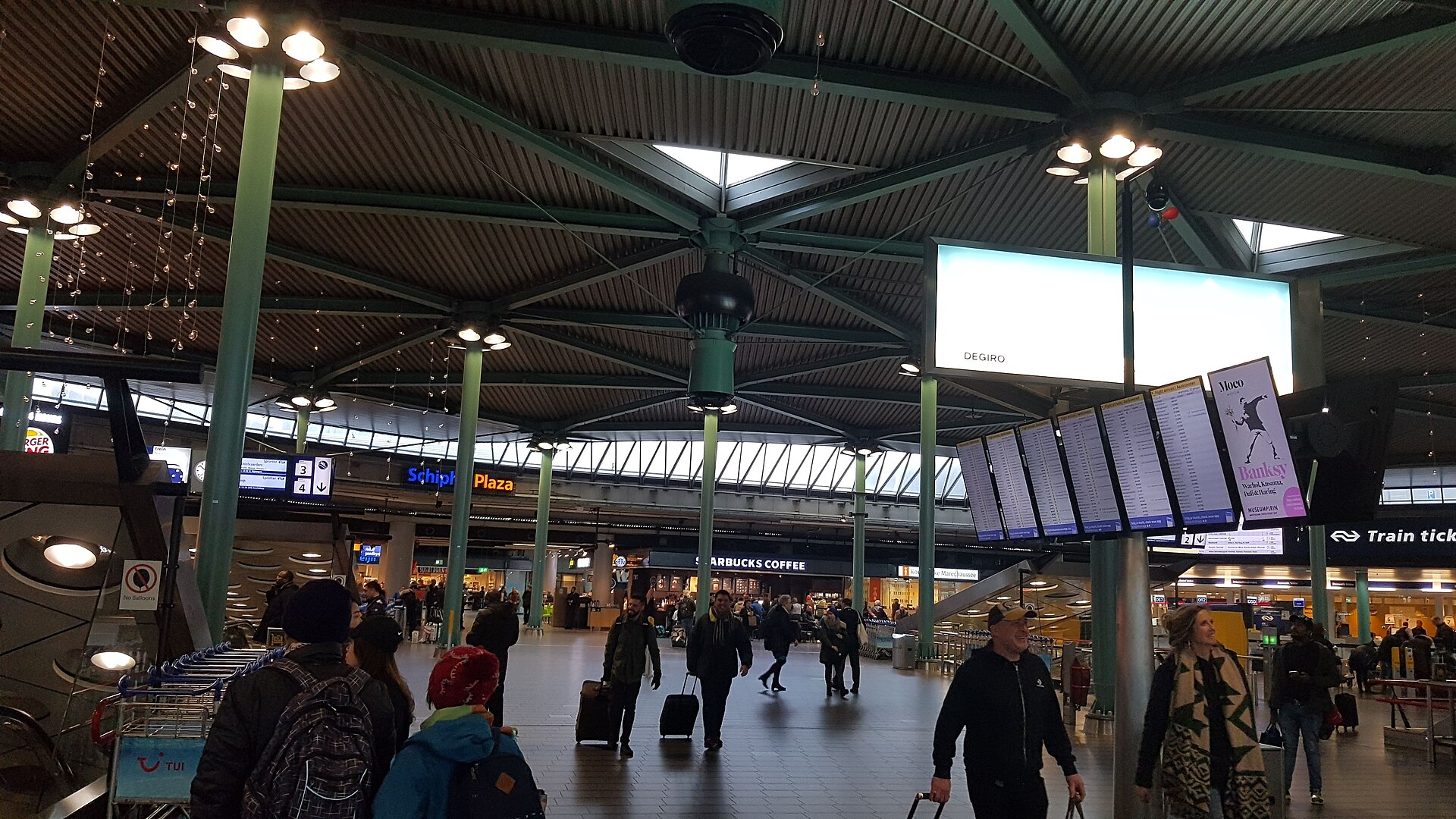
Everything landside funnels through Schiphol Plaza, the covered concourse that sits directly above the railway station. It has a full Albert Heijn supermarket, a proper bookshop, chemists, and a food court, and none of it requires a boarding pass. That matters for two reasons. First, you can meet someone, buy a sandwich for a fraction of airside prices, and use a bathroom without committing to security. Second, if your flight is delayed by hours, Plaza is a far more civilised place to sit than the gate areas — as long as you have not already gone through. Our complete Schiphol Airport guide covers the wider building; the transfer mechanics are what follow here.
Plaza is also where the trains are. The station sits one level below, and the journey into the city takes 15 to 20 minutes for roughly €6, several times an hour, with a reduced overnight service. If you are heading into town rather than connecting, our page on getting from Schiphol to Amsterdam compares every option including the 397 Airport Express and the taxi rate, which runs €50–65 and is almost never worth it.
The piers, decoded
Piers are the fingers of the building that hold the gates, and they are lettered B through M. Your gate number always starts with its pier letter, so gate F7 is on Pier F and gate C14 is on Pier C. There is no Pier A yet — it is under construction and has slipped repeatedly, now expected to open in April 2027.
The split that governs everything is Schengen versus non-Schengen. Schengen flights — the Netherlands to Spain, Italy, Germany, France and the rest of the border-free area — depart from piers B and C, and from the upper level of Pier D. Non-Schengen flights, which includes everything to the UK, the US, Asia, Africa and the Middle East, leave from piers E, F, G, H and M, and from the lower level of Pier D. Passport control sits at the boundary between the two zones, not at the gate.
Pier D is the one that confuses people
Pier D is the largest concourse at Schiphol and it straddles Departure Halls 1 and 2. Uniquely, it is stacked: the lower level handles non-Schengen departures at gates D1 to D57, while the upper level handles Schengen departures at gates D59 to D87. Same pier letter, two entirely different worlds, connected by escalators and a passport control point.
This trips up a specific kind of traveller — the one who reads “gate D” on the departure board, walks confidently to Pier D, and then discovers that the D gates they can see are all in the wrong hundred. Read the full gate number. D14 and D74 are a border crossing apart. Give yourself an extra fifteen minutes if you have a D gate and you are not certain which level you need.
Where the airlines sit
- KLM and SkyTeam long-haul — mostly piers D, E, F and G. Pier F in particular is the long-haul SkyTeam spine.
- KLM and SkyTeam European — piers B, C and the upper deck of D.
- Pier E — non-Schengen, Delta and KLM heavy, off Departure Hall 2.
- Pier F — non-Schengen, off Departure Hall 3, SkyTeam partners including Kenya Airways.
- Piers G, H and M — non-Schengen, and the furthest walk from the centre of the building. A good deal of the low-cost and UK traffic ends up here.
Do not treat this as gospel for your specific flight. Schiphol reassigns gates freely, sometimes late, and a pier that usually handles one alliance will take an aircraft from another when the stands are tight. Check the boards when you arrive rather than planning your morning around a pier letter you read online.
Connecting at Schiphol: the honest timings
KLM publishes a minimum connecting time of 40 minutes for Schengen-to-Schengen and 50 minutes where a non-Schengen flight is involved. Those are the numbers the booking systems use when they build an itinerary. Treat them as a legal floor, not a plan. KLM’s own chief executive said publicly in July 2026 that passengers were missing connections because of border control, which is an unusually blunt admission from an airline about its own hub.
Here is how the four combinations actually behave in 2026.
Schengen to Schengen — the easy one
You land at a B, C or upper-D gate and you depart from a B, C or upper-D gate. No passport control, no security rescreening in most cases, just a walk. Forty minutes is genuinely enough if your inbound is on time and your gates are not at opposite ends. An hour is comfortable. This is the connection Schiphol was designed for and it works.
Non-Schengen to non-Schengen — nearly as easy
Landing at E, F, G, H/M or lower-D and departing from the same zone also avoids the border. You stay airside throughout. The catch is distance rather than bureaucracy: arriving at the far end of Pier G and departing from Pier E is a real walk, and there may be a gate-level security screening depending on your destination — flights to the United States in particular run additional checks at the gate, which start well before boarding. Budget 90 minutes and you will be fine. Fifty will have you jogging.
Non-Schengen to Schengen — the problem case
This is where 2026 bites. You arrive from outside the Schengen area and you need to enter it to catch your onward flight, which means clearing passport control. Since the EU Entry/Exit System went live on 10 April 2026, non-EU travellers register biometrically rather than getting a stamp, and waits at Schiphol passport control have been reported at around two hours — roughly 50% longer than before EES. There are 161 self-service kiosks for pre-registration ahead of the border guard, and using them genuinely helps, but the guard is still the bottleneck.
If you hold a non-EU passport and your itinerary has you arriving non-Schengen and departing Schengen, 2 to 2.5 hours is the realistic figure. A 50-minute connection sold to you by a booking engine is not a connection, it is a lottery ticket. If you have already booked one, at least know where you stand: the airline owes you rebooking if you miss it on a single through-ticket, and nothing at all if you booked the two legs separately.
Schengen to non-Schengen — better, but not free
Exit checks are lighter than entry checks, and EES exit registration is quicker than the enrolment on the way in. Still, you are crossing a border, and there may be a queue. Ninety minutes is a sensible target.
Walking times you should actually budget
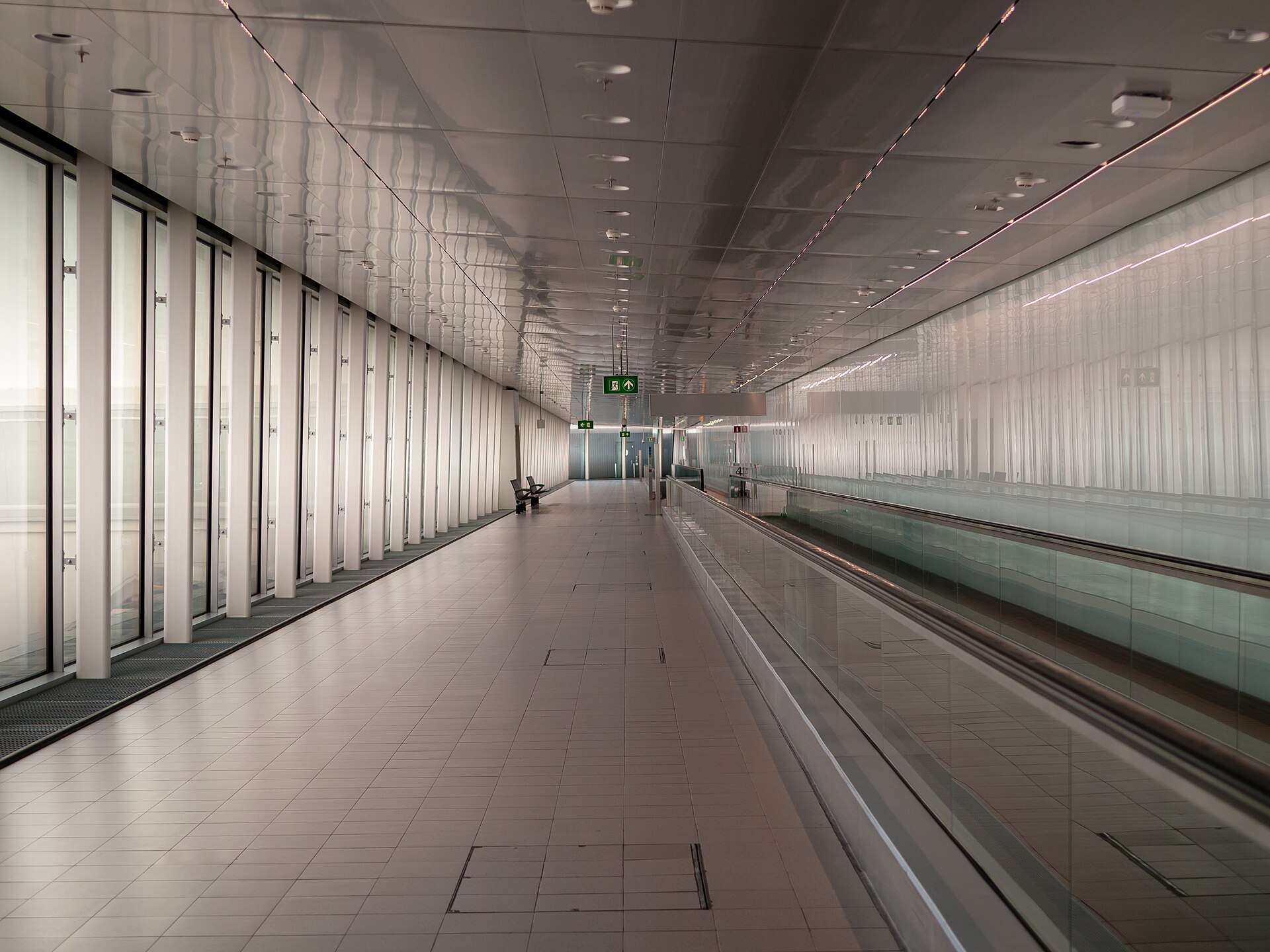
Because everything is connected airside, Schiphol distances are walking distances. There is no train, no bus, no automated people mover. Moving walkways cover the longest corridors and they help, but they do not remove the problem.
- Adjacent halls, gate to gate — 5 to 15 minutes.
- Central piers (D, E) to each other — 10 minutes or so.
- Pier G far end to Pier B far end — 25 to 30 minutes, and that is a brisk walk with hand luggage only.
- Pier D lower to Pier D upper — five minutes plus however long passport control takes, which is the actual variable.
Add time if you are travelling with small children, if you have reduced mobility, or if you are hauling a cabin bag that fights back. Schiphol has a good assistance service but it must be requested through your airline in advance — at least 48 hours is the usual requirement. Our Amsterdam accessibility guide covers what to expect on the ground once you are through.
Baggage on a connection
On a single ticket with a through-checked bag, your luggage is transferred for you and you do not see it again until your final destination. This is the normal case at Schiphol and it works reliably. You do not collect and re-check, and you do not clear customs in Amsterdam.
Two situations break that. If you booked two separate tickets — a long-haul into Amsterdam and a budget flight out, say — you almost certainly have to collect your bag, exit to the landside hall, check in again and go back through security. That turns a 90-minute connection into a three-hour one, and it is the single most common self-inflicted wound we see people describe. The second exception is where your final destination requires you to clear customs at your first point of entry into a country; that does not apply to onward flights out of Schiphol, but it does apply if Amsterdam is your destination.
If you find yourself stuck landside with hours to fill and a suitcase, the airport has staffed storage on Level −1 between Arrivals 1 and 2, open 24 hours, plus automated lockers landside and airside. Rates run from about €6–7 per item per day. The details are all in our guide to Schiphol luggage storage and lockers.
If you miss the connection
Go to your airline’s transfer desk. Every carrier operating a hub connection at Schiphol has one airside, and KLM’s are the most numerous. If you have not been issued a boarding pass for your onward flight — which happens when the two legs were not through-checked, or when the ticket was issued by a partner airline — the transfer desk or kiosk is also where you get it. Do not join the queue at the departure gate hoping to sort it out there; gate agents cannot reissue tickets.
On a single through-ticket, the airline rebooks you at no cost and, if the delay is long enough and the cause is within their control, owes you meals and a hotel under EU261. On separate tickets you own the problem entirely. This is worth reading before you book rather than after, and it is one of the few genuine arguments for travel insurance with missed-connection cover.
If the rebooking pushes you overnight, the airline’s hotel voucher usually sends you to one of the shuttle-belt properties in Hoofddorp or Badhoevedorp rather than the connected hotels. Our page on hotels near Schiphol Airport explains which ones you can actually walk to — the Sheraton is joined to Schiphol Plaza by a covered walkway, citizenM is about five minutes on foot — and which involve a bus at two in the morning.
If you are staying in the building rather than leaving it, our guide to sleeping at Schiphol covers the rest zones, the YOTELAIR pods and where the free showers are.
Departing from Schiphol: how early, really
The airport’s own advice is two hours before a Schengen departure and three hours before a non-Schengen one. In 2026 that advice is not padding. The move to a new security organisation on 18 May lengthened waits noticeably around the changeover, and industrial action disrupted individual days through the year.
The single most useful thing Schiphol has introduced is the free security time slot. Launched for Schengen departures in April 2026 and since extended to all international travellers, it lets you reserve a 15-minute window from three days before departure, either online or in the Schiphol app. You then use the lane marked “Reserved for time slots” and scan your QR code. It costs nothing and it is the closest thing to fast track that most passengers will ever get for free. Two limits worth understanding: it covers security only — not bag drop, and emphatically not passport control — and you must actually turn up inside your window.
Bag drop typically closes 40 to 60 minutes before departure, and earlier on some long-haul services. That deadline, not the gate closing time, is what strands people. Our detailed page on Schiphol security and how early to arrive goes through the time slots, the Privium membership option and the liquids rules — Schiphol went back to the 100ml standard in September 2024 and has kept it, though the CT scanners mean your liquids bag and laptop can stay inside your hand luggage at the checkpoint.
Filling the gap between flights
A long connection at Schiphol is one of the more tolerable ways to lose an afternoon. Airside there is a meditation and silence centre and an indoor park area with real plants and seating you can lie across. Landside, the Panorama Terrace is free, open to anyone, and has a retired KLM Fokker 100 parked on it — genuinely worth the walk if you have an hour and a child, or an hour and an interest in aircraft.
With five hours or more between flights and a passport that lets you back through the border, leaving the airport is realistic. The train to Amsterdam Centraal takes 15 to 20 minutes and you can be standing on a canal bridge 25 minutes after clearing arrivals. Our Schiphol layover guide sets out what is achievable in four, eight and twelve hours, and is honest about the point at which it stops being worth it. Below about five hours, and certainly with a non-EU passport in the EES era, stay in the building.
If you would rather buy comfort than walk to it, our guide to Schiphol lounges you can pay to enter compares the KLM Crown Lounges with Aspire No. 41 and the walk-up rates.
Hungry rather than tired? We have a separate page on where to eat at Schiphol Airport, including which side of security is cheaper.
Things that are not true about Schiphol
A few claims circulate widely enough to be worth correcting.
- “Terminal 2 is the international terminal.” There is no Terminal 2. If a booking confirmation or a taxi app says this, ignore it and go to the departure hall your desk number points to.
- “You can walk from any gate to any gate in ten minutes.” You cannot. Pier G to Pier B is half an hour.
- “Fifty minutes is enough for any connection.” It is the published minimum, not a recommendation, and in 2026 it is not enough for anything involving the Schengen border on a non-EU passport.
- “Schiphol has a library and a museum annex.” Both have been widely repeated in guides for years, but neither is something to plan around. Schiphol’s own site lists what is currently open.
Keep Exploring
- Schiphol Airport Complete Guide — the hub page for everything airport-related
- Schiphol Airport to Amsterdam: All Transfer Options
- Schiphol Security & Fast Track: How Early to Arrive
- Schiphol Layover Guide: 4, 8 or 12 Hours
- Schiphol Luggage Storage & Lockers Explained
- Hotels Near Schiphol Airport for Early Flights
- Amsterdam Visa Requirements & Entry Rules
- Amsterdam Packing List
- Getting Around Amsterdam
- First-Time Amsterdam Mistakes to Avoid
- Practical Amsterdam Information
- Amsterdam Trip Planning Guide
Frequently Asked Questions
How many terminals does Schiphol have?
One. Schiphol is a single-terminal airport with three departure halls under the same roof. There is no Terminal 1, 2 or 3 in the sense used at most large airports, and no transit system between halls because none is needed — you walk.
Do I need to go through passport control when connecting at Schiphol?
Only if you cross the Schengen border. Schengen-to-Schengen and non-Schengen-to-non-Schengen connections stay entirely airside with no border check. Any connection that moves between the two zones goes through passport control, which since April 2026 includes biometric EES registration for non-EU travellers.
What is the minimum connection time at Schiphol?
KLM publishes 40 minutes for Schengen-to-Schengen and 50 minutes where a non-Schengen flight is involved. In 2026 practice, allow 90 minutes for anything crossing the border on an EU passport and 2 to 2.5 hours on a non-EU passport arriving from outside Schengen.
Which pier will my flight leave from?
Your gate number tells you: the letter is the pier. Schengen flights use B, C and the upper level of D (gates D59–D87). Non-Schengen flights use E, F, G, H/M and the lower level of D (gates D1–D57). Gates are reassigned frequently, so check the boards rather than relying on a pier you looked up in advance.
Do I collect my luggage when connecting at Schiphol?
Not on a single through-ticket — your bag is transferred for you. You do collect it if you booked the two legs as separate tickets, which means exiting to landside, checking in again and repeating security. Allow at least three hours if that is your situation.
How far apart are the piers?
Gate to gate ranges from about two minutes to thirty. Adjacent halls take 5 to 15 minutes on foot. The longest realistic walk, from the far end of Pier G to the far end of Pier B, is 25 to 30 minutes even with the moving walkways.
Can I book a security time slot at Schiphol?
Yes, and it is free. Reserve a 15-minute window online or in the Schiphol app from three days before departure, then use the lane marked “Reserved for time slots”. It covers security only — not bag drop and not passport control.
Is Pier A open yet?
No. Pier A remains under construction and has slipped several times; it is currently expected to open in April 2027. Until then the piers in use are B through M.