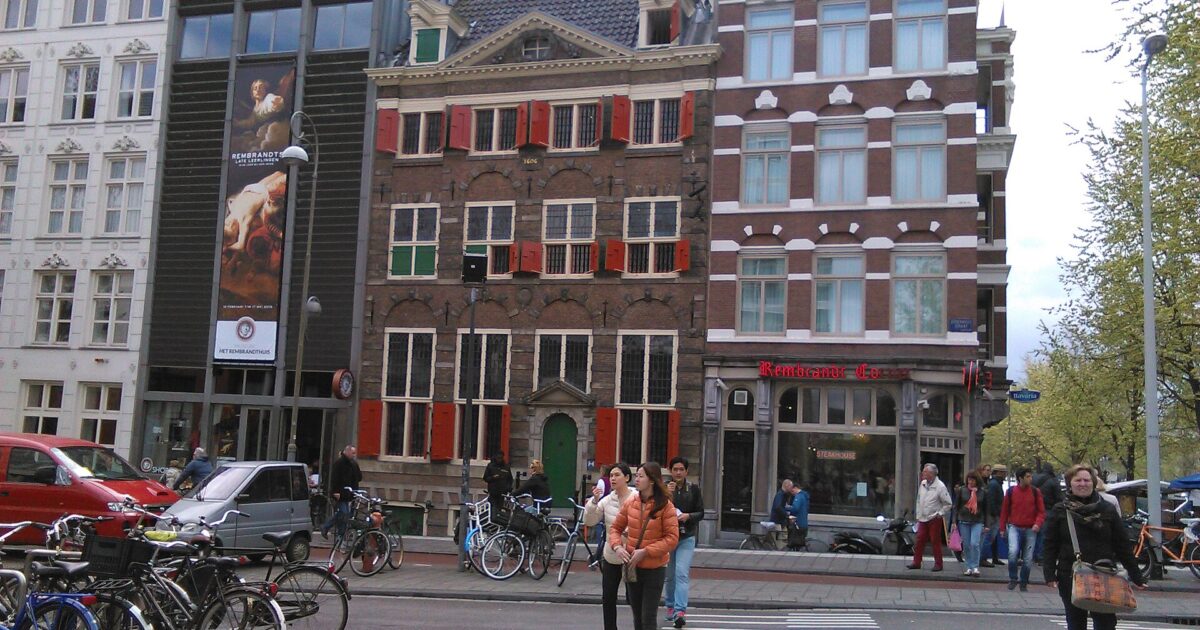
Jodenbreestraat 4 is a tall brick house with red shutters and 1606 carved on the front, and Rembrandt van Rijn bought it in 1639 for 13,000 guilders he did not have. He lived and worked here for twenty years, ran a studio full of pupils in the attic, filled the rooms with a collector’s hoard of shells, weapons, plaster casts and Roman busts, failed to pay for any of it, and was declared insolvent in 1656. The bailiffs made an inventory of every object in every room. That inventory is why the house you can visit today looks the way it does.
Know what you are buying: the Rembrandt House Museum Amsterdam is a small museum charging €23.50, and if you arrive expecting paintings you will be disappointed — the great canvases are in the Rijksmuseum, not here. What is here is the workplace: the studio with the north light, the pigments ground by hand, the etching press, the cabinet of curiosities reassembled object by object from a bankruptcy document. It is the best hour in Amsterdam for understanding how seventeenth-century pictures were physically made, and it is worth the money for that alone. It is not worth it as a substitute for seeing the paintings.
Rembrandt House Museum at a glance
Checked September 2026 against the museum’s own site.
| Detail | 2026 information |
|---|---|
| Adult ticket | €23.50 |
| Off-peak, 16:00–18:00 | €19.50 |
| Under 6 | Free |
| Multimedia tour | Included in every ticket |
| Opening hours | Daily 10:00–18:00 |
| Time needed | 1–1.5 hours |
| Address | Jodenbreestraat 4, beside Waterlooplein |
| From Centraal | About 15 minutes on foot |
| Demonstrations | Free etching and paint-making, several times daily |
| Museumkaart | Accepted |
| Booking | Walk up; the house is small but rarely sold out |
What you actually see, room by room
You move through the house from the ground floor upwards, following the layout the inventory records. The multimedia tour is included and is good; take it.
The entrance hall and living room
Seventeenth-century Amsterdam domestic life, with the box beds built into the walls that people slept in half sitting up. Rembrandt’s own bedroom, with the shutters, is smaller and darker than anyone expects. The furniture is not his — almost nothing in the house is — but every piece is documented in the inventory or the period.
The kunstkamer, or art room
The room in which he showed and sold work, and the one that explains the bankruptcy. Rembrandt was an obsessive collector: Roman portrait busts, Venetian glass, weapons and armour from three continents, corals, an armadillo, birds of paradise, plaster casts, shells arranged by species. It was partly a working library of visual reference and partly an addiction, and the reconstruction is remarkably complete because the bailiffs listed all of it.
The studio
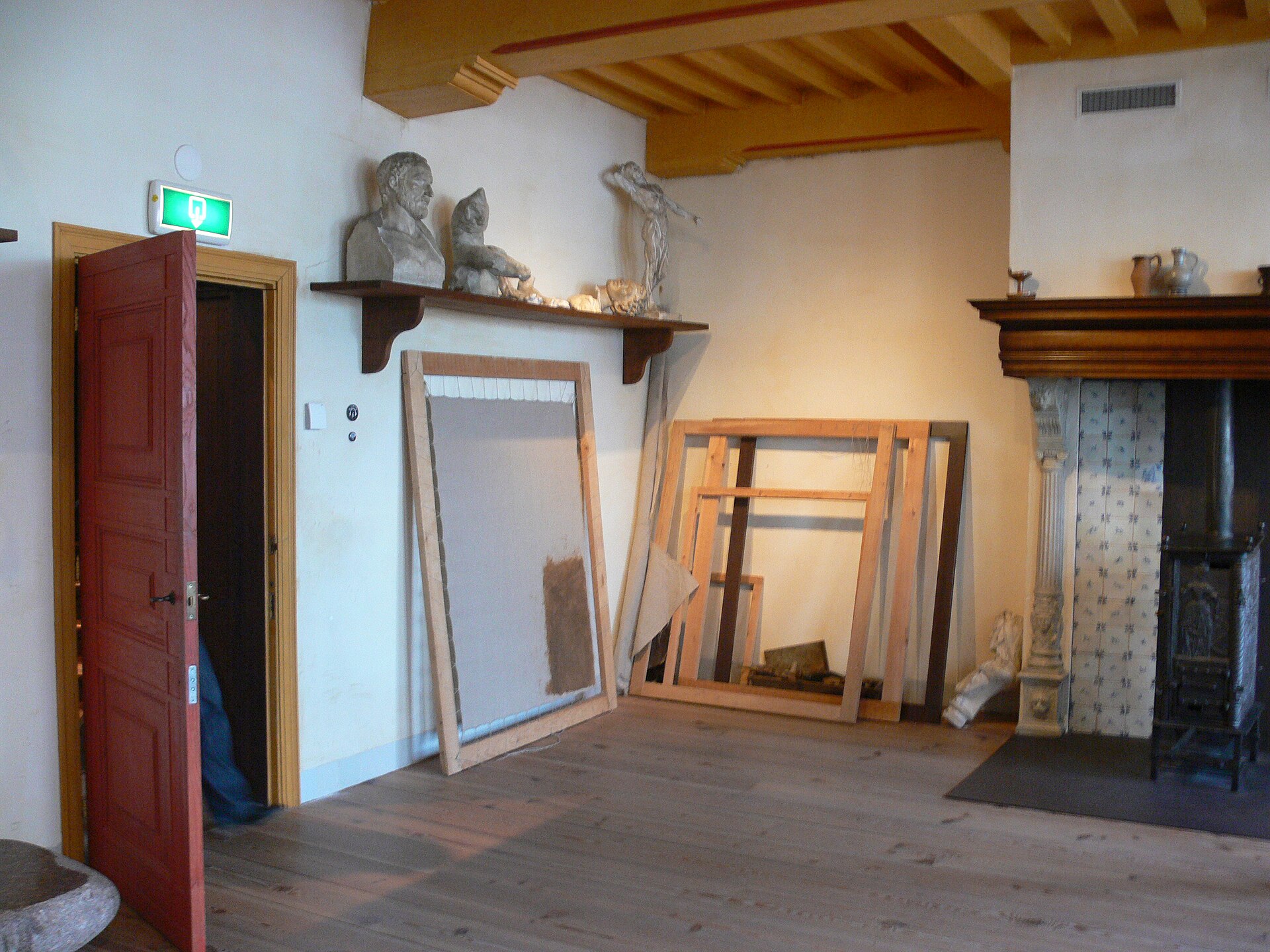
The main workroom, with tall north-facing windows because north light is even and does not move through the day. Easels, a grinding table, jars of pigment, a warming stove, the plaster casts he drew from. Staff give free demonstrations here of how the paint was actually made: lead white that was slowly poisoning everyone who handled it, the crushed cochineal insects that produced the reds, linseed oil, animal-skin glue, pig bladders used as paint tubes before paint tubes existed.
The pupils’ studio
Upstairs under the roof, partitioned into small cubicles so students could work without copying each other. Rembrandt ran one of the largest teaching studios in the Netherlands and the fees were a substantial part of his income.
The etching loft
The best room in the house. A working press, copper plates, acid baths, and a demonstration of the whole process from waxed plate to inked print. Everyone leaves with a print or postcard to take home, which is a small thing that visitors remember for years. Rembrandt’s etchings were how his reputation travelled across Europe in his lifetime, and the museum holds a substantial collection of them, shown in rotation because paper cannot take permanent light.

Is it worth €23.50?
This is the museum in this cluster where we have argued with ourselves most, so here is the case both ways.
Against. It is small — an hour, maybe ninety minutes — and €23.50 is within a euro or two of the Rijksmuseum, which is a hundred times the size and where the actual masterpieces hang. The furnishings are a reconstruction rather than survivals, which some visitors find deflating once they realise it. And the house was substantially rebuilt in the twentieth century, so what you walk through is a careful restoration rather than an untouched interior.
For. The demonstrations are the thing, and they are genuinely excellent. Watching a plate inked and pulled through a press, or a pigment ground and mixed, changes how you look at every seventeenth-century painting you see afterwards — and if you are going to the Rijksmuseum anyway, doing this first makes that visit measurably better. It is also quiet, which almost nothing else in this city is. And the kunstkamer is a genuinely strange and moving room: a reconstruction of one man’s compulsive accumulation, assembled from the legal document that took it all away from him.
Our verdict: go, and go before the Rijksmuseum rather than after. Take the €19.50 off-peak slot between 16:00 and 18:00 if you can, which is the same museum for four euros less. If your trip is two days long, this is the one to cut — but on three days or more it earns its hour.
Practical detail
- Take the 16:00–18:00 ticket. €19.50 rather than €23.50, and the house is at its quietest.
- Check the demonstration times at the desk when you arrive and plan the visit around them. Turning up in the etching loft between demonstrations halves the value of the ticket.
- The stairs are steep. This is a seventeenth-century canal house, and the upper floors involve narrow, near-vertical staircases. There is lift access to some floors, but this is not a fully accessible building — contact the museum first if that matters, and see our accessibility guide.
- The multimedia tour is included, so do not decline it at the desk. It is one of the better ones in the city.
- Booking is rarely necessary, though the house is small and can feel crowded when a group arrives. Mornings and the last two hours are the calmest.
- Children under six are free, and the etching demonstration works well from about eight upwards. The rest of the house does not.
- Temporary exhibitions occupy the modern wing next door and are included in the ticket; they usually focus on Rembrandt’s pupils, contemporaries or printmaking.
Where it sits, and what to combine it with
Jodenbreestraat 4, next to Waterlooplein and about fifteen minutes’ walk east from Centraal Station. Tram 14 stops on the doorstep; the metro to Waterlooplein is two minutes away. See the tram routes guide and public transport guide.
The street it stands on was the heart of Amsterdam’s Jewish quarter for three centuries, which is not incidental — Rembrandt chose to live here, drew his neighbours, and used them as models. The Portuguese Synagogue, the Jewish Museum and the Holocaust memorials are all within a few minutes’ walk, and our Jewish heritage guide covers the whole quarter properly. The Waterlooplein flea market is directly outside, covered in our flea markets and antiques guide.
The natural pairing is with the Rijksmuseum, in that order — the house in the morning, the paintings in the afternoon, with the technique fresh in your mind. Fifteen minutes further east is ARTIS, and ten minutes north-east is the NEMO waterfront, so this corner of the city can absorb a full day. Our attractions by area guide maps it.
For the man himself — the life, the paintings scattered across the city, Rembrandtplein, where the works hang and how to see them — our Rembrandt in Amsterdam guide is the place to start. This page is about the house.

Why the house looks the way it does
Almost every historic-house museum in Europe is a guess. This one is not, and the reason is the bankruptcy.
When Rembrandt applied for a cessio bonorum in 1656 — a form of insolvency that surrendered his goods to his creditors rather than sending him to prison — the Chamber of Insolvent Estates sent officials to list everything in the building, room by room, in order. Three hundred and sixty-three entries. The paintings by other artists, the antique busts, the shells and minerals, the armour, the pots and pans in the kitchen, the beds, which room each object stood in.
That document survived. When the house was restored and opened as a museum in 1911, and again when it was more thoroughly reconstructed and reopened in 1999, the inventory was the blueprint. Objects of the right type and period were acquired to match each entry and placed where the list says they stood. It is the reason the kunstkamer feels overloaded rather than tastefully arranged: it is overloaded because his was.
The sale raised far less than his debts. He left Jodenbreestraat in 1658 and spent his last eleven years in rented rooms in the Jordaan, still working, still taking commissions, and by most accounts painting better than ever. The house passed through other hands for two and a half centuries before the city bought it. For the wider seventeenth-century context, see our Dutch Golden Age guide and the culture and history guide.
The demonstrations, and how to time your visit around them
Everything we like about this museum happens in two rooms at set times, and a visitor who wanders in at the wrong moment sees a nice period interior and leaves puzzled about the price. So this is the practical core of the advice: ask at the desk for the day’s demonstration times before you climb a single staircase, and shape the hour around them.
The paint demonstration happens in the studio. A member of staff grinds pigment on a stone slab, mixes it with linseed oil and shows you what each colour actually was. Lead white, which was made by suspending lead over vinegar and which slowly poisoned the people who handled it. Bone black, made from charred bone. Carmine red from cochineal insects imported from the Americas. Ultramarine from lapis lazuli, which cost more by weight than gold and which is why so few seventeenth-century paintings have much blue in them.
You come out of that room understanding something specific: that the palette of a Dutch Golden Age painting was determined as much by supply chains and price as by taste. The browns and ochres everyone associates with Rembrandt were, among other things, the affordable colours.
The etching demonstration happens in the loft, and it is the better of the two. A copper plate is coated with wax, drawn into with a needle, bathed in acid so the exposed lines bite, inked, wiped, and pulled through the press against dampened paper under enormous pressure. The whole sequence takes about twenty minutes and the result comes off the press in front of you.
Rembrandt was one of the greatest etchers who has ever lived, and etching was how his reputation reached Italy, France and England while he was still alive — prints travelled, paintings did not. Seeing the process makes the etchings in the display cases legible in a way no wall text manages. Everyone leaves with a print or postcard.
How it compares with the other small museums
The Rembrandt House competes less with the big institutions than with Amsterdam’s other historic-house museums, and the comparison is genuinely close.
| House museum | Price | Time | What it does best |
|---|---|---|---|
| Rembrandt House | €23.50 / €19.50 late | 1–1.5 hrs | How pictures were made |
| Anne Frank House | €16.50 | 1.5 hrs | The single most affecting hour in the city |
| Museum Van Loon | Around €14 | 1 hr | A patrician canal house and its garden |
| Willet-Holthuysen | Around €15 | 1 hr | Nineteenth-century domestic grandeur |
| Our Lord in the Attic | Around €18 | 1–1.5 hrs | A hidden church in a merchant’s loft |
On price alone the Rembrandt House is the most expensive of these by some margin, which is the fairest criticism of it. What justifies the gap is the demonstrations, which none of the others offer, and the fact that this is the working premises of a specific and extraordinary person rather than a generic period interior. If you are choosing one canal house and you care about how things are made, take this one. If you want the emotional experience, take the Anne Frank House. Our museums guide covers the rest, and hidden gems has the ones almost nobody visits.
Fitting it into a day
This corner of Amsterdam — Waterlooplein, Jodenbreestraat, the Plantage, the eastern docks — is the least-visited good half of the centre, and the Rembrandt House is the best anchor for it.
The day we would build: start at Waterlooplein market when the stalls open, do the Rembrandt House at 10:00, walk five minutes to the Portuguese Synagogue and the Jewish Museum, eat somewhere on the Nieuwe Herengracht, then walk east through the Plantage to ARTIS or north to the waterfront and NEMO. That is a full day with no tram ride longer than four minutes and almost no crowds, which is not something you can say about the western half of the city.
Alternatively, take the €19.50 late ticket and use it as an end to a day that started on Museumplein — though in that direction the technique demonstration comes after the paintings rather than before, which is the weaker order. Our three-day itinerary and five-day itinerary both sequence the eastern side as a single day, which is how we would do it.
One more thing worth knowing: unlike almost every other significant Amsterdam attraction, this one needs no advance planning at all. If you are trying to build a trip around the fixed points — and the advance booking timeline explains which those are — the Rembrandt House is one of the pieces you can slot in wherever a gap appears.
Keep Exploring
- Amsterdam attractions and tickets: all prices and booking windows
- Rembrandt in Amsterdam: the life and where to see the work
- The Rijksmuseum guide
- The Jewish Cultural Quarter
- The Dutch Golden Age in Amsterdam
- The complete Amsterdam museums guide
- Amsterdam for art lovers
Frequently asked questions
How much is the Rembrandt House Museum Amsterdam?
€23.50 for adults, dropping to €19.50 for the off-peak slot between 16:00 and 18:00. Children under six are free, and the multimedia tour is included in every ticket.
Are there Rembrandt paintings in the house?
Not the famous ones. The museum holds a large collection of his etchings, shown in rotation, along with works by his pupils and contemporaries. The major paintings are in the Rijksmuseum.
How long does a visit take?
An hour to ninety minutes. It is a canal house, not an institution, and the demonstrations are what fill the time rather than the number of rooms.
Is the furniture actually Rembrandt’s?
No. Almost nothing in the house belonged to him — it was all sold in 1656. Every room is furnished with objects of the right type and period, placed according to the bailiffs’ inventory of that year.
Do you need to book in advance?
Rarely. The house is small enough to feel busy when a group arrives, but it does not sell out the way the Van Gogh Museum does. Booking online still guarantees your preferred time.
Are the demonstrations included?
Yes, both the etching demonstration and the paint-making demonstration are free with entry and run several times daily. Check the times at the desk on arrival — they are the best part of the visit.
Is the Rembrandt House accessible?
Partially. There is lift access to some floors, but the historic staircases are steep and narrow and the building cannot be made fully step-free. Contact the museum in advance if this is a concern.
Is it worth visiting if I am also doing the Rijksmuseum?
Yes, and the order matters: do the house first. Understanding how the paint and the plates were physically made changes what you see in the Gallery of Honour afterwards.
What time of day is quietest?
The first hour after opening at 10:00, and the last two hours from 16:00 — which is also when the ticket drops to €19.50, making late afternoon the obvious choice.
Is it suitable for children?
The etching and paint demonstrations work well from about eight upwards and children are usually gripped by them. The rest of the house is a period interior and will not hold a younger child for long.