This article contains advertising. Our booking links are routed through a partner that adds commission tracking automatically, so if you book through one we earn a commission from the provider, at no extra cost to you. It never affects what we recommend. Affiliate disclosure
The Rijksmuseum is the Netherlands’ national museum: 8,000 objects on display across 80 rooms, covering 800 years from medieval altarpieces to a Second World War fighter fuselage, in a building that took ten years and €375 million to renovate. This guide covers what it costs, how the timed-entry system works in practice, the route that gets you the best of it in three hours, and the parts most visitors walk straight past.
The practical facts first: Rijksmuseum tickets are €25, free under 19, and the timed-entry booking is real but far less brutal than the Van Gogh Museum‘s — three to seven days ahead is normally enough. The building is enormous, which means it absorbs crowds. Almost all the congestion in this museum happens in one room. If you understand that, you can have a genuinely calm visit on a busy Saturday, which is not true of anywhere else on Museumplein. What is also true, and less often said, is that most people see maybe eight percent of what is here and leave thinking they have done it.
Rijksmuseum tickets, hours and essentials
Checked September 2026 against the museum’s own site. Confirm hours in the week you travel, since exhibition changeovers and the occasional late opening shift them.
| Detail | 2026 information |
|---|---|
| Adult ticket | €25 |
| Under 19 | Free — still needs a booked start time |
| Opening hours | Daily 09:00–17:00, including public holidays |
| Shop and café | 09:00–18:00; ticket needed until 17:00 |
| Booking | A start time is required; buy online in advance |
| How far ahead | 3–7 days; longer over Christmas and Easter |
| Time needed | 2.5–4 hours; a full day is possible |
| Address | Museumstraat 1, entrance via the passage under the building |
| Payment | Card and digital only — no cash anywhere |
| Museumkaart | Accepted; reserve a free start time |
| I amsterdam City Card | Accepted |
| Gardens | Free, no ticket required |
Buying tickets, and how the timed entry works
Book a start time online through the museum’s own site, which is the cheapest option at a flat €25 with no booking fee. Your slot is a window for entering the building, not a tour: once you are inside you can stay until closing. That is the crucial difference from a timed exhibition ticket, and it means an early slot is unambiguously better value than a late one.
Three to seven days is normally plenty. Unlike the Van Gogh Museum, the Rijksmuseum is rarely truly sold out — what disappears first is the popular 10:00–12:00 band, not the day. In the fortnight around Christmas and over Easter it does tighten, and you should treat those weeks as you would treat the Van Gogh in August.
Both major passes work here. The I amsterdam City Card covers the Rijksmuseum, which is one of the strongest points in its favour, and a €75 Museumkaart covers it too. Either way you still reserve a start time using the card number, and either way you do not pay again. The full comparison sits in our Amsterdam attractions and tickets guide.
One thing not to buy: skip-the-line access. Timed entry has already removed the ticket queue, and the only line you will stand in is the security check, which everyone joins regardless of what they paid. Resellers such as Tiqets and GetYourGuide are legitimate and occasionally useful when the official site’s preferred slots have gone, but they add a margin for the same product.
When to go, and the one room to time carefully
The Rijksmuseum’s crowding is unusually predictable, because it is almost entirely about a single painting.
- 09:00 opening. Walk straight to the Gallery of Honour and turn left. You will have twenty minutes with the Vermeers before the first coach group reaches them.
- After 15:00. The second-best window. Groups leave, the light through the Great Hall windows is better, and the last ninety minutes are consistently the calmest of the day.
- 11:00–14:00 is the peak, and the Night Watch hall in that band is genuinely three or four deep.
- Weekdays over weekends, and February or November over anything in summer.
- Rain fills the museum within half an hour, so a wet forecast is a reason to take an early slot rather than a flexible one — see the weather by month guide.
The counter-intuitive move that works: go to the Night Watch last rather than first. Almost everyone does the opposite, so the hall empties noticeably in the final hour while the rest of the museum is still busy. You lose nothing by seeing it at 16:15 and you gain a much better look at it.
A three-hour route through the collection
Three hours is the honest sweet spot. Less and you are only doing the Gallery of Honour; more and museum fatigue takes over. This is the route we would give a friend on a first visit.
Start: the Gallery of Honour, floor 2
The long central corridor holding the seventeenth-century greatest hits: Vermeer’s The Milkmaid and Woman Reading a Letter, Frans Hals’s The Merry Drinker, Jan Steen’s chaotic households, Rembrandt’s The Jewish Bride and The Syndics. It ends at the Night Watch. Give it forty-five minutes.
The Milkmaid rewards standing closer than people do. Recent technical research at the museum found underdrawing and abandoned elements beneath the surface — a jug rack and a basket of fire, painted out — which is why the composition feels so unusually distilled. It is a small painting, about 45 by 41 centimetres, and it is better in person by a margin that is hard to explain.
The Night Watch
Rembrandt’s 1642 militia portrait, three and a half metres by four and a half, and the reason a large proportion of the room is holding a phone above their heads. It has been under an ongoing conservation and research project conducted in public, in the hall itself, using imaging technology developed for the purpose — so what you see may include a glass enclosure and visible equipment. That is not a disappointment; watching a national treasure being examined in the open is the most interesting thing happening in any Amsterdam museum.
Worth knowing: the painting was cut down in 1715 to fit a wall in the town hall, losing about sixty centimetres from the left side and two figures with it. The missing strips have since been reconstructed digitally and displayed alongside.
The rest of floor 2 — the Golden Age
The rooms flanking the Gallery of Honour are where the seventeenth century actually lives: doll’s houses that cost as much as real ones, Delftware, the astonishing silver, ship models, portraits of the merchants who funded all of it. This is the material context for the paintings and it is close to empty most of the day. Our Dutch Golden Age guide covers the history behind the room.
Floor 1 — the nineteenth and twentieth centuries
The Hague School, Breitner’s Amsterdam, four Van Goghs including a self-portrait, art nouveau, and the Second World War section. Small, sharply curated, and skipped by nearly everybody.
Floor 0 — special collections and the aeroplane
Ship models, weapons, magic lanterns, and a Second World War aircraft fuselage that lands very differently from the rest of the building. If you are visiting with children, start here rather than upstairs.
Floor 3 and the Asian Pavilion
Floor 3 is a single room covering the twentieth century, and takes ten minutes. The Asian Pavilion is a separate structure reached across the water in the gardens, holding a twelfth-century Shiva and a Japanese temple guardian — and it is reliably the quietest space in the entire museum. If you need twenty minutes of silence in the middle of a busy day, this is where to take them.

The building itself
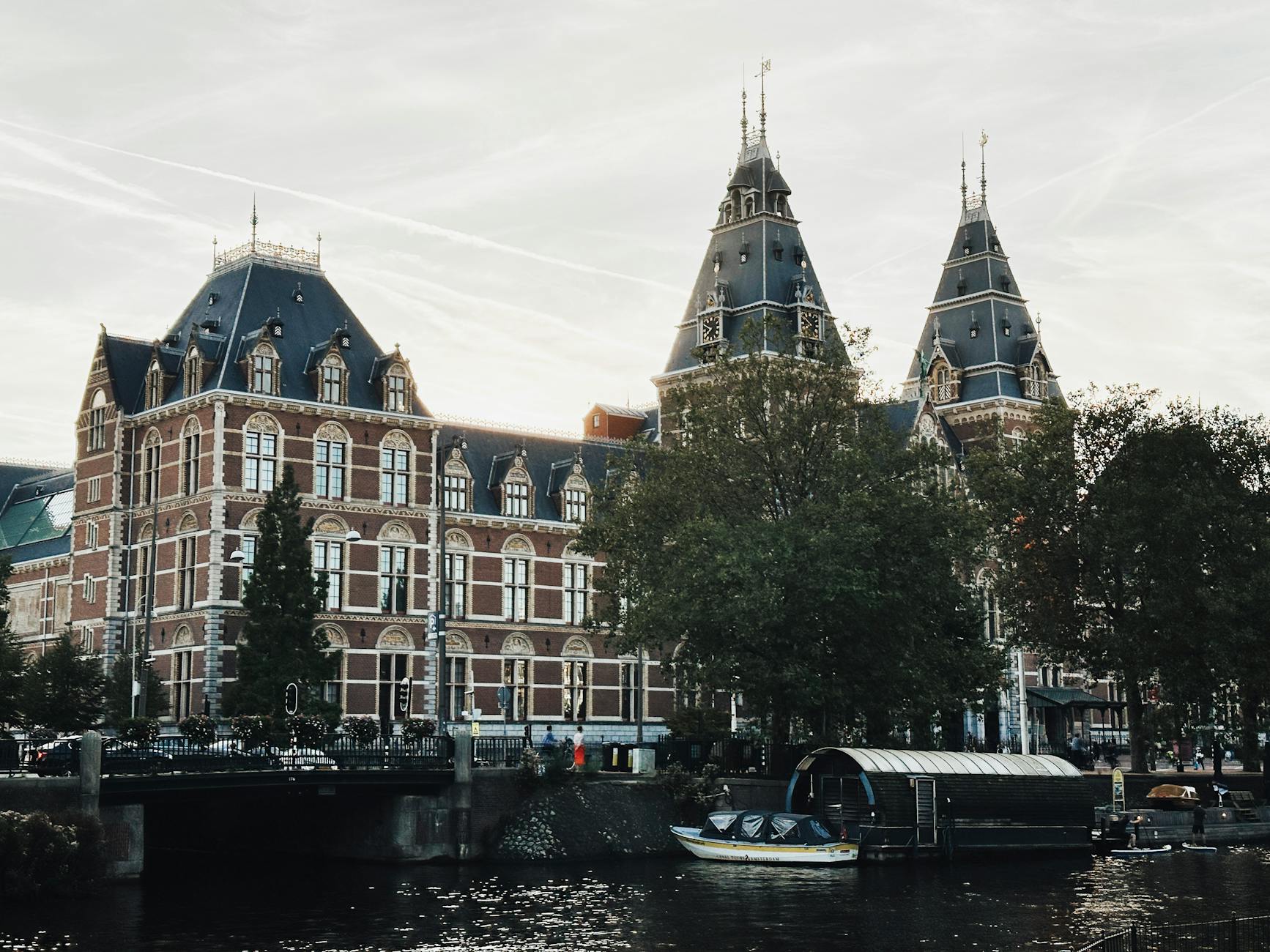
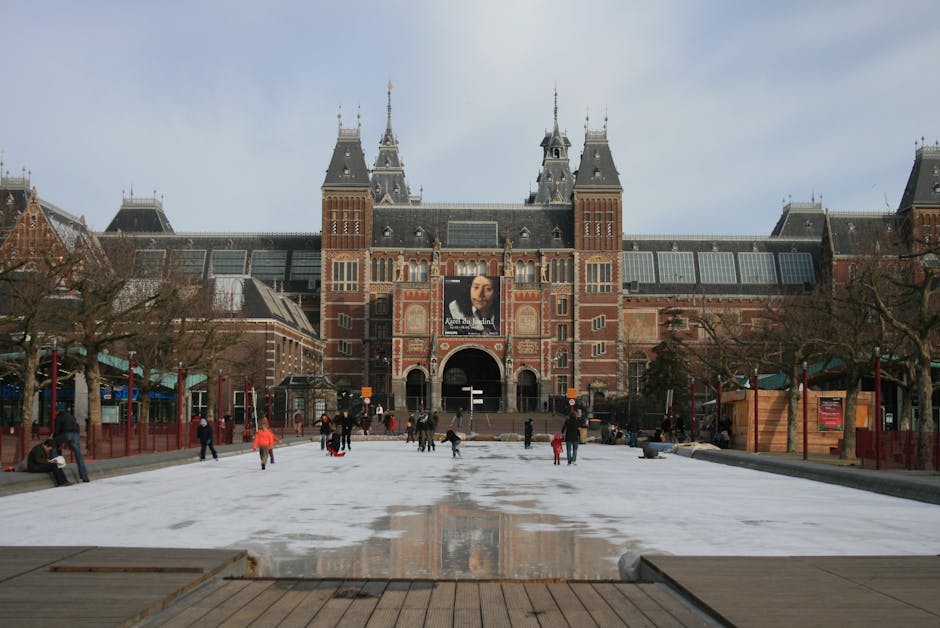
Pierre Cuypers finished the Rijksmuseum in 1885, and it was controversial immediately: too Gothic, too Catholic, too much like a cathedral for a Protestant nation’s national museum. King Willem III reportedly refused to set foot in it. Cuypers had his revenge in the details — the building is covered in decorative programme, tilework and stained glass that were painted over and boarded up during the twentieth century when taste turned against him.
The 2003–2013 renovation restored most of it. The Great Hall, with its stained glass and painted vaults, is now roughly what Cuypers intended, and it is worth ten minutes of looking upwards. The Spanish architects Cruz y Ortiz added the two glazed courtyards and the new entrance below the passage, which solved a century-old circulation problem elegantly.
That passage — the Museumstraat cycle tunnel running straight under the building — is a genuine Amsterdam curiosity. It is a public right of way, cyclists have used it since 1885, and the fight over whether to close it during the renovation ran for years and was won by the cyclists. There is usually a busker under the vault and the acoustics are extraordinary. Walk through it even if you are not going in. The architecture walking guide puts Cuypers in context; he also designed Centraal Station, which is why the two buildings look like siblings.
The gardens, which are free
The Rijksmuseum gardens on the south and west sides are open to anyone without a ticket. They hold fragments of demolished Dutch buildings — gateways, a bandstand, seventeenth-century stonework rescued during nineteenth-century demolitions — plus a formal garden and a summer sculpture exhibition. Almost nobody outside the museum’s own visitors knows they are free.
On a good day they are one of the better free things in this half of the city, and they pair naturally with Vondelpark a few minutes west. More in our guide to free things to do in Amsterdam.
Practical detail
- No cash. The entire museum is cashless — shop, café, everything. Card or phone.
- Bags. Free lockers in the entrance hall. Large rucksacks and suitcases are not admitted, so this is a bad final stop before a flight unless you have already stored your luggage.
- Photography is permitted without flash or tripod throughout the permanent collection.
- The app is free, works offline, and includes several curated routes including a one-hour highlights walk. It is better than the paid audio guides at most museums and costs nothing.
- Accessibility is good: lifts to all floors, step-free entry from the passage, wheelchairs available free at the entrance. The accessibility guide has the detail.
- Families: the museum runs a children’s trail and family routes, and under-19s are free, which makes an experimental hour cheap. Also see Amsterdam with kids.
- The café in the atrium is fine and busy; the restaurant is a proper restaurant with proper prices. There are better and cheaper options ten minutes away — see cheap eats.

Is the Rijksmuseum worth it?
This is the one museum in Amsterdam we would tell almost anyone to visit. At €25 for a building you can spend a full day in, with free entry for anyone under nineteen and a genuinely excellent free app, it is the best value of the major attractions — and unlike the Van Gogh Museum it never feels like a queue with pictures attached.
The case against is narrow but real. It is a general national museum, which means it does not have the single overwhelming focus that makes the Van Gogh Museum so effective. If you have limited time and one artist you care about, depth may beat breadth. And if you have a strong aversion to crowds, the Night Watch hall between 11:00 and 14:00 is exactly the thing you are trying to avoid — though as noted, it is the only room in the building where that is a problem.
The verdict we would give: if you visit one museum in Amsterdam, make it this one. If you visit two, add the Van Gogh. If you visit three, the third should not be another Museumplein giant — go east instead.
For the man rather than the masterpiece, our Rembrandt House Museum guide covers the studio on Jodenbreestraat.
And for the modern collection across the square, see the Stedelijk Museum guide.
Getting there and what else is close
Museumstraat 1, in the Museum Quarter. Trams 2 and 12 stop at Rijksmuseum; tram 7 and 19 stop at Spiegelgracht on the north side. From Centraal it is fifteen minutes by tram or a pleasant thirty-five-minute walk down through the canal ring. Fares and tapping are in the public transport guide, and route detail is in the tram routes guide.
Within five minutes’ walk: the Van Gogh Museum, the Stedelijk, the Moco and the Concertgebouw. Ten minutes east is the Spiegelkwartier, the antiques street, covered in our antiques and flea markets guide. Fifteen minutes south-east is De Pijp and the Albert Cuyp market, which is where to eat.
On a two- or three-day trip, the Rijksmuseum is a morning and should be paired with something outdoors rather than another gallery — our two-day itinerary and three-day itinerary both do exactly that. Booking order matters: fix the Anne Frank House first, then the Van Gogh Museum, then this, which is the most flexible of the three. The advance booking timeline sets out the whole sequence.
Fifteen things to find that are not the Night Watch
The museum’s own highlights list is short and predictable. This is the list we would actually hand someone, weighted towards objects that are better in person than in reproduction.
- The Milkmaid, Vermeer, c.1660 — smaller than you expect and worth two full minutes on its own.
- The Little Street, Vermeer — a specific house on a specific Delft street, since identified from tax records.
- The Jewish Bride, Rembrandt — Van Gogh said he would give ten years of his life to sit in front of it for a fortnight.
- The Merry Drinker, Frans Hals — brushwork done at speed, two centuries before anyone called that modern.
- Petronella Oortman’s doll’s house — a scale model of a canal house that cost roughly as much as a real one, furnished by the same craftsmen.
- The Delftware collection — including the violin, which is made of tin-glazed earthenware and is exactly as strange as that sounds.
- The Waterloo model room and the ship models on floor 0 — the most underrated hour in the building.
- The Hartog plate — a flattened pewter dish left on an Australian island in 1616 by a Dutch captain, and the oldest known European artefact from Australia.
- The Great Hall stained glass, restored to Cuypers’s scheme, best seen from the mezzanine.
- The library — a working art-history research library with a spiral staircase, visible from a balcony and open to researchers.
- Breitner’s Amsterdam paintings on floor 1 — the city in the 1890s, wet, grey and instantly recognisable.
- The Van Goghs on floor 1 — four of them, including a self-portrait, with none of the crowd from across the square.
- The Asian Pavilion Shiva — a twelfth-century bronze in a room designed so that no other object competes with it.
- The Second World War fuselage on floor 0 — unexpectedly affecting, and where children stop walking.
- The garden fragments outside — gateways and stonework saved from demolished Dutch buildings, free to walk among.
Visiting with children
Free entry up to and including eighteen makes this the cheapest serious museum in the city for a family, and the Rijksmuseum has thought harder about children than most European national collections. There is a family route with a printed trail, and the museum’s app carries a children’s tour designed to be followed by the child rather than read aloud by a parent.
The practical advice is to invert the adult route. Start on floor 0 with the ship models, the armour and the aeroplane, which hold attention immediately. Go up to the Gallery of Honour second, when there is still patience left, and treat the Night Watch as the finish rather than the opening. Ninety minutes is a realistic ceiling for under-tens; two and a half hours is achievable if you build in a stop at the café.
Buggies are fine throughout and lifts reach every floor. Baby-changing facilities are on the ground floor. Our broader Amsterdam with kids guide covers where this fits against the science museum and the zoo, and honestly, for a child under about seven, those two will win.
Temporary exhibitions
The Philips Wing hosts the major temporary shows, usually two or three a year, and these are the reason locals hold a Museumkaart. Some are included in standard admission and some carry a supplement, which is stated at the point of booking — check before you assume, since the blockbusters are the ones most likely to cost extra and most likely to sell out.
The museum’s 2023 Vermeer exhibition, which gathered 28 of the roughly 37 surviving paintings, is the benchmark and sold out entirely in advance. Nothing on that scale runs every year, but the pattern is worth knowing: when the Rijksmuseum announces a once-in-a-generation loan show, book it the week tickets open rather than the month you travel. Smaller photography and design exhibitions, by contrast, are usually walk-in even at the weekend.
Eight mistakes people make here
- Treating the start time as a tour slot. It is an entry window; you can stay until 17:00 regardless. An early slot is therefore strictly better value.
- Going to the Night Watch first. Everyone does, which is precisely why it is worst then. Go last.
- Doing only the Gallery of Honour. Ninety minutes in one corridor and out again means paying €25 to see about three percent of the museum.
- Buying an audio guide when the free app is better and works offline on your own phone.
- Adding the Van Gogh Museum on the same day. It is four minutes’ walk and a terrible idea; the second museum stops registering.
- Bringing luggage on a departure day. Suitcases are refused entry and the lockers will not take them.
- Missing the gardens, which are free and open to non-visitors.
- Assuming cash works. It does not, anywhere in the building, including the café.
More of the same across the whole city is in first-time Amsterdam mistakes.
Keep Exploring
- Amsterdam attractions and tickets: all prices and booking windows
- The complete Amsterdam museums guide
- Rembrandt in Amsterdam
- Amsterdam for art lovers
- Amsterdam culture and history
- The canal ring’s UNESCO story
- Things to do in Amsterdam
Frequently asked questions
How much are Rijksmuseum tickets?
€25 for adults and free for anyone under 19. Both the Museumkaart and the I amsterdam City Card cover entry, though all visitors still need to reserve a start time.
Do I need to book the Rijksmuseum in advance?
Yes, a start time is required, but three to seven days ahead is normally enough. The museum rarely sells out entirely — what goes first is the popular late-morning band, not the whole day.
How long does a visit take?
Two and a half to four hours for a proper look. Ninety minutes covers the Gallery of Honour and the Night Watch and nothing else. Your ticket is a start time rather than a time limit, so you can stay until closing.
Can you see the Night Watch right now?
Yes. The ongoing conservation research is deliberately carried out in public in the Gallery of Honour, so the painting remains on view, sometimes behind glass and alongside imaging equipment.
What time is the Rijksmuseum least busy?
The first hour after the 09:00 opening, and after 15:00. The peak is 11:00 to 14:00, and it is concentrated almost entirely in the Night Watch hall rather than spread through the building.
Is the Rijksmuseum free for children?
Entry is free up to and including age 18. They still need a booked start time. The museum runs family routes and a children’s trail, and the ground floor with its ship models and aeroplane works better for young children than the paintings upstairs.
Which is better, the Rijksmuseum or the Van Gogh Museum?
The Rijksmuseum for a single visit: it is bigger, better value, less crowded per square metre and covers 800 years. The Van Gogh Museum is the better second museum, and unbeatable if one artist is what you came for.
Are the Rijksmuseum gardens free?
Yes, entirely. The gardens, their architectural fragments and the summer sculpture display are open without a ticket, and they are one of the least-known free attractions in the Museum Quarter.
Is there a dress code or bag restriction?
No dress code. Bags larger than a small handbag go in the free lockers, and suitcases and large rucksacks are not admitted at all, so store luggage elsewhere if this is your departure day.
Can I cycle through the Rijksmuseum?
Through the Museumstraat passage beneath it, yes — it is a public cycle route and has been since the building opened in 1885. You cannot cycle into the museum itself, which people do ask.
Is the Rijksmuseum too big to see in one visit?
For the whole collection, yes — 8,000 objects across 80 rooms is more than a day. Nobody sees it all, and trying is the fastest route to museum fatigue. Pick two floors, do them properly, and accept that the rest is a reason to come back rather than a failure.
Where should I eat near the Rijksmuseum?
Not on Museumplein itself, where the prices assume a captive audience. Ten minutes east is the Spiegelkwartier with a handful of good cafes among the antique dealers, and fifteen minutes south-east puts you in De Pijp, which has the best eating in this half of the city at a fraction of the square’s prices.