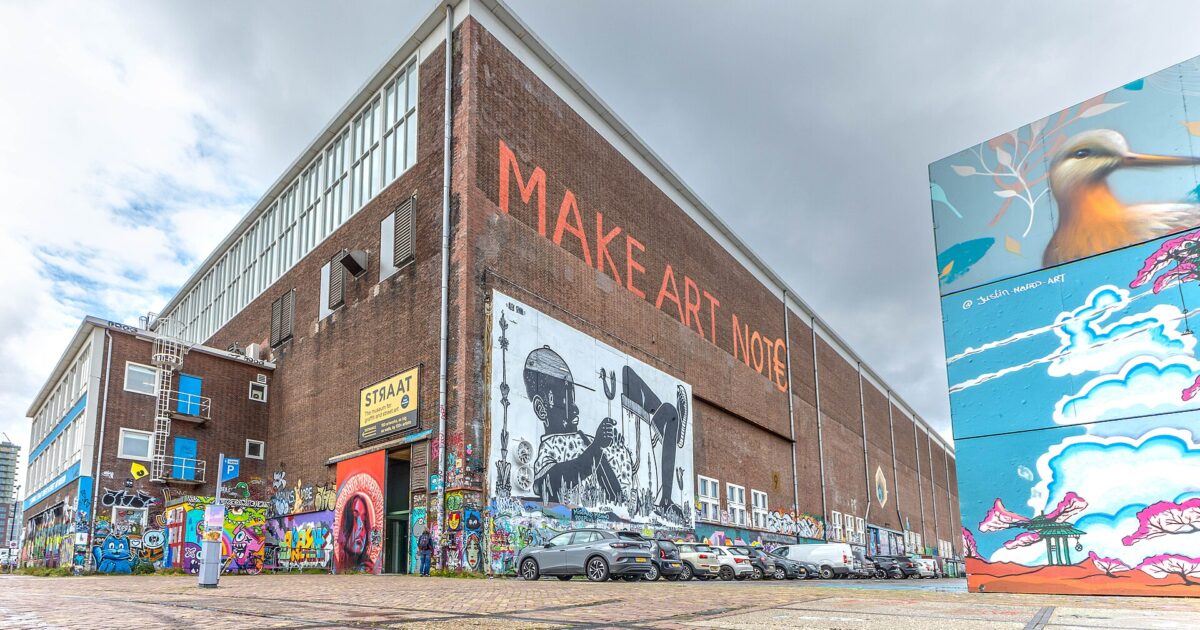
Fifteen minutes on a free ferry from the back of Centraal, on the north bank of the IJ, there is a shipbuilding shed the size of a cathedral with MAKE ART NOT € painted across the outside in three-metre letters. Inside are more than 180 enormous canvases by street artists from around the world, hung in a hall where ocean-going hulls were welded together until 1984. This is STRAAT, and the wharf it sits on — NDSM — is the most interesting square kilometre in Amsterdam that most visitors never reach.
STRAAT Museum Amsterdam costs €21.50, which is Rijksmuseum money for a museum that opened in 2020, and there is a real philosophical objection to the whole enterprise — street art taken off the street, put on canvas, and charged for. The museum knows this and does not hide from it. What tips the balance is the building and the scale. Nowhere else can you stand in front of forty wall-sized works by artists whose actual walls are scattered across five continents, in a space big enough that you can back up far enough to see them properly. And the surrounding wharf, which is free, is worth the ferry on its own even if you never buy a ticket.
STRAAT and NDSM at a glance
Checked September 2026 against the museum’s own site.
| Detail | 2026 information |
|---|---|
| Adult ticket | €21.50 |
| Students | €16.50 with valid ID |
| Children 0–12 | Free with a paying adult |
| Opening hours | Tue–Sun 10:00–17:00; Mon 12:00–17:00 |
| Late opening | First Friday of the month, until 21:00 |
| Address | NDSM-Plein 1, Amsterdam Noord |
| Getting there | Free NDSM ferry from behind Centraal, about 15 minutes |
| Time needed | 60–90 minutes inside; half a day for the wharf |
| Collection | Over 180 works, all made for the museum |
| I amsterdam City Card | Free entry |
| The wharf itself | Free, always open |
| IJ-Hallen flea market | €6.50, one weekend a month, 09:00–16:30 |
What STRAAT actually is
The museum occupies a former welding hall from the NDSM shipyard: roughly 8,000 square metres of brick, steel roof trusses and clerestory windows, with the original overhead crane rails still running the length of the ceiling. It opened in 2020, which makes it one of the newest museums in the city and by some distance the largest single room of art in it.
Every work in the collection was made for this building. Artists were flown in, given a canvas the size of a garage door or larger, and left to it. That is the key fact and the source of both the museum’s strength and the argument against it: nothing here was cut off a wall, and nothing was taken from anywhere. It is commissioned studio work by people whose reputations were built illegally outdoors.
The contradiction, stated plainly
Street art is site-specific, unauthorised, temporary and free. STRAAT is indoors, commissioned, permanent and €21.50. Purists find this insufferable and they are not wrong on the facts. The museum’s own answer, made explicitly in its wall texts, is that the alternative is worse: this work otherwise disappears under paint rollers and demolition, most of these artists have never been paid properly by an institution, and a canvas in a warehouse is at least an honest format rather than a chunk of chiselled-off brick sold at auction.
Our own view is that both things are true, and that the museum is far more interesting for admitting it. If you want the unauthorised version, it is directly outside the door and it is free — see the section below, and our galleries and street art guide for the rest of the city.
What it is like to walk around
Scale is the whole experience. Works are hung and suspended at different heights across a hall long enough that you lose the far end in haze, which means you get the distance to look at a five-metre piece properly — something you almost never get on an actual street, where you are pressed against a wall by a canal or a parked car. Photography is encouraged rather than tolerated, the lighting is designed for it, and the museum is refreshingly free of the hush that makes some visitors uncomfortable in art galleries.
Sixty minutes is enough to see it. Ninety is better if you read the artist cards, which are unusually good: each one gives you the artist’s city, their history and what they were trying to do, in plain language and without art-world vocabulary. Children are free up to twelve, and this is one of the few art museums in Amsterdam that genuinely holds them — the works are big, loud, figurative and immediate. Our Amsterdam with kids guide covers the rest of the northern options.
How to look at it
A hall this size is easy to walk through in a daze, and most visitors do. Three things sharpen it up considerably.
First, work from the far end backwards. The natural route pushes you along the length of the building and by the time you reach the last third your eye has given up; starting at the back and returning gives the second half of the collection the attention the first half got. Second, read where each artist is from before you look at the piece. The collection is genuinely international and the difference between a muralist trained on the walls of São Paulo and one who came up through New York subway lettering is visible once you know to look for it. Third, stand back further than feels necessary. These are wall paintings that happen to be on canvas, composed to be read from across a street, and at three metres you are looking at the wrong thing.
The building itself deserves a few minutes of the same attention. Look up at the crane rails, the riveted trusses and the height of the doors, all of which were sized for ship sections rather than paintings, and the museum’s choice of home stops being a decorating decision and becomes part of the argument.

The NDSM wharf: what you are standing on
NDSM stands for Nederlandsche Dok en Scheepsbouw Maatschappij, and this was one of Europe’s great shipyards. At its height thousands of people worked here building ocean-going vessels. It closed in 1984, the cranes stopped, and the site was left to rust on the wrong side of a river with no bridge.
What happened next is the interesting part. Squatters, artists, skaters and party organisers moved into the abandoned sheds through the 1990s, and rather than clearing them out, the city eventually recognised what it had and formalised it. NDSM became a designated creative district. The result today is genuinely strange: half-derelict industrial infrastructure, a permanent artists’ city built inside one of the sheds, a hotel in a crane, television production offices, festivals, and a museum — all on the same cracked concrete, with the rails still in the ground.
It is not pretty in the way the canal ring is pretty. It is windy, exposed, grey in bad weather, and half of it looks like a building site because half of it is one — residential towers are going up around the edges and the wharf’s character is visibly changing. Go now rather than in five years. Our Amsterdam Noord guide covers the wider district either side of the ferry.
The free street art outside
Almost every vertical surface on the wharf is painted, and this is the part nobody charges for. Work appears, gets painted over and reappears; some pieces have been there for years and some for a fortnight. The most famous is Eduardo Kobra’s enormous portrait of Anne Frank in his signature geometric colour, painted here in 2016 and visible from a long way off. Give yourself half an hour to walk the yard before or after the museum — it is the direct comparison the museum cannot provide, and it costs nothing, like a surprising amount of the city in our free things to do guide.
Eating and drinking on the wharf
This is where NDSM earns a whole afternoon rather than an hour.
- Pllek — built from stacked shipping containers with an artificial sand beach on the water, deckchairs facing the IJ and the city skyline behind the ships. The food is fine rather than remarkable; the setting on a clear evening is one of the best in Amsterdam.
- Noorderlicht — a greenhouse-ish cafe on the waterfront, scruffy, warm and much loved, with a wood stove for the eight months of the year when sitting outside is a lie.
- IJver — in the old shipyard canteen building, the most conventional restaurant option on the wharf and a good one when the wind is up.
All three are cheaper than the equivalent view in the centre, and none takes a reservation seriously on a sunny Saturday. Our restaurants by budget guide puts them in context.
IJ-Hallen, if your dates line up
One weekend a month, the sheds on the wharf host IJ-Hallen, the largest regular flea market in Europe: around 750 stalls outdoors in summer and roughly 500 indoors in winter, Saturday and Sunday from 09:00 to 16:30. Entry is about €6.50, with an early-bird ticket around €11 that gets you in from 06:00 with the dealers, and children under eleven free. It is genuinely enormous and genuinely cheap, and it is the single best reason to plan a Noord day around a particular weekend. Check the dates before you book anything — our flea markets guide has the wider circuit and our vintage shops guide covers the indoor alternative.
The crane hotel
The Faralda is a former shipyard crane on the water’s edge converted into a hotel with three suites, reached by an industrial lift, with a hot tub at the top of the jib. It is expensive and completely absurd and it is the most photographed object on the wharf. You do not need to stay in it to enjoy looking at it, though our boutique hotels guide has it alongside the more sensible options.

Getting there: the ferry is the good part
Walk through Centraal to the water at the back, go to the far left of the ferry piers, and take the NDSM ferry. It is free, it takes about fifteen minutes, it runs regularly through the day and less often late at night, and you can wheel a bike or a pushchair straight on. It is also, unambiguously, the best free thing in Amsterdam: you cross open water past working harbour traffic with the city behind you and the cranes ahead. Our free ferry guide covers all the routes and which pier is which.
Do not confuse the NDSM ferry with the Buiksloterweg ferry, which is the short two-minute crossing to A’DAM Lookout and the EYE. Different pier, different destination, and people get this wrong daily. Buses 391 and 394 towards Zaandam also serve NDSM if the ferry is out, and the whole area is straightforward by bike — see our bike rental guide, and note that bikes travel free on the ferry.
Time your return. The ferry thins out late in the evening, and the wharf is a long way from a taxi. Check the last sailing if you are staying for dinner, or read our night transport guide for the alternatives.

Five things to know before you go
- It is genuinely cold out there. NDSM is a flat concrete plain on open water with nothing between it and the North Sea. Whatever you were going to wear in the centre, add a layer — our packing list is not being dramatic about the wind.
- Monday opening is late. The museum does not open until 12:00 on Mondays, which catches out anyone who has planned a morning around it.
- There is very little shelter between things. The wharf is large and the gaps between the museum, the bars and the ferry are all outdoors. In driving rain this is a difficult half-day, and one of the better ones to move to a central museum instead.
- Bring a card, not cash. Amsterdam is close to cashless and the wharf is no exception; several places here take cards only. Our money and payments guide has the detail.
- Do not plan a tight evening afterwards. Between the ferry frequency and the walk at either end, getting from NDSM back to a restaurant reservation in the centre reliably takes forty minutes, not twenty.
Is STRAAT worth €21.50?
Yes, with one condition: go for the wharf, and treat the museum as the centrepiece of a half-day rather than a standalone errand. Judged as a ninety-minute museum visit that costs the same as the Rijksmuseum, it is a harder sell. Judged as the anchor of an afternoon that includes a free ferry crossing, a free open-air gallery, a beach bar in shipping containers and possibly Europe’s biggest flea market, €21.50 is easy money.
Skip it if you have two days in Amsterdam and have not yet seen the Rijksmuseum or the Van Gogh Museum — those come first, and the ferry is still free if you only want an hour on the north bank. Skip it too if the idea of paying for street art actively annoys you; walk the wharf instead, spend the money at Pllek, and you will have had a good day.
Go if you have four days or more, if you have teenagers, if the weather is decent, or if contemporary work interests you more than seventeenth-century painting. On the last count, the Moco Museum is the obvious comparison — smaller, more central, more Instagram-shaped, and half the room.
A half-day at NDSM
- 11:00 — ferry from Centraal. Stand outside on the deck; that is the point of it.
- 11:20 — walk the wharf. Find the Kobra Anne Frank mural, then wander the painted sheds.
- 12:00 — STRAAT, about ninety minutes with the artist cards.
- 13:30 — lunch at Noorderlicht or IJver, or Pllek if the sun is out.
- 15:00 — IJ-Hallen if it is that weekend, otherwise the studios and the crane.
- 16:30 — ferry back, or cycle east along the north bank towards the quieter waterfront.
This is a strong third or fourth day. It fits neatly into our five-day itinerary and is the sort of thing our hidden gems guide exists for.
Keep Exploring
- Amsterdam attractions and tickets: every price compared
- The Amsterdam Noord neighbourhood guide
- Galleries and street art across the city
- The free ferries to Noord
- Amsterdam flea markets and antique shops
- A’DAM Lookout, the other side of Noord
- Amsterdam for art lovers
- Hidden gems in Amsterdam
Frequently asked questions
How much is STRAAT Museum Amsterdam?
€21.50 for adults and €16.50 for students with ID. Children up to twelve go free with a paying adult, and the I amsterdam City Card covers entry.
How long do you need at STRAAT?
Sixty minutes to walk it, ninety if you read the artist cards, which are worth reading. Allow half a day for the museum plus the wharf around it.
How do you get to NDSM from Amsterdam Centraal?
The free NDSM ferry from the piers behind Centraal, on the far left as you face the water. It takes about fifteen minutes and carries bikes. Buses 391 and 394 towards Zaandam are the backup.
Is the street art at NDSM free?
Yes. The wharf is public and almost every surface on it is painted, including Eduardo Kobra’s large Anne Frank portrait. Only the museum charges, and you can have a good half-day here without buying a ticket.
Is STRAAT good for children?
Unusually good. Under-13s are free, the works are huge and immediate, photography is encouraged, and nobody minds noise. It is one of the easier art museums in the city to visit with a family.
When is the IJ-Hallen flea market?
One weekend a month, Saturday and Sunday from 09:00 to 16:30, in the sheds on the wharf. Entry is around €6.50, with an early-bird option about €11 from 06:00. Dates vary, so check before planning your day around it.
Can you see the works being made?
Sometimes. The museum rotates in new commissions and painting occasionally happens on site; the wharf outside is being repainted more or less continuously. Neither is scheduled for visitors, so treat it as a bonus.
Is NDSM worth visiting if I skip the museum?
Yes. The ferry, the murals, the shipyard ruins and the waterfront bars are all free or cheap, and the crossing alone is one of the best twenty minutes in Amsterdam.
Is it accessible?
The museum is a single large flat hall and is straightforward for wheelchairs and pushchairs, and the ferry is step-free. The wharf outside is cobbles, old rails and broken concrete in places, so plan the outdoor part carefully — see our accessibility guide.
What is the best time to go?
A dry weekday morning for the museum, or a clear late afternoon if the waterfront bars are the draw. The first Friday of the month, when STRAAT stays open until 21:00, is the best of both.
Is there anything else to do in Noord nearby?
A’DAM Lookout and the EYE Filmmuseum are both in Noord but at the other ferry, ten minutes east by bike along the bank. Do not try to walk between the two ferry landings unless you have time to spare.