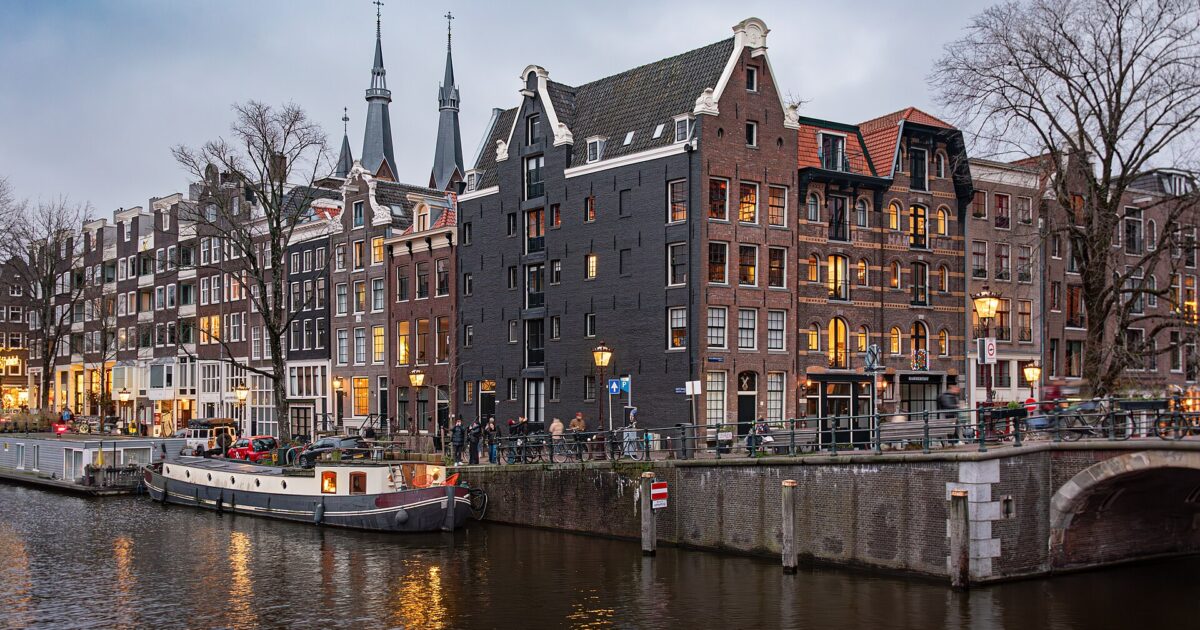
You can rent a small electric boat in Amsterdam, without a licence, without any experience, and take it out on the canals for two or three hours with your own food and your own music turned off. It costs less per person than a guided cruise if there are four or more of you, you choose where to go, and you can stop under a bridge and eat lunch. On a warm afternoon it is, without much competition, the best thing available in this city.
Before the romance, the arithmetic: boat rental Amsterdam is not the cheap option it looks like at first glance. Boats cost roughly €90 to €170 for a two- to four-hour block, not per person, so the arithmetic only works with a group; two people are better off on a guided cruise. There are real rules, several of them enforced with fines, and one of them — no amplified music — catches out almost every group that pictured a party on the water. And you are driving a boat you have never driven before, in a working waterway, past people’s homes. None of that is a reason not to do it. It is a reason to read this page first.
Boat rental at a glance
Prices checked September 2026 across several Amsterdam operators. Rates are per boat, not per person.
| Detail | 2026 information |
|---|---|
| Two hours | From about €90–100 per boat |
| Three hours | About €89–140 per boat |
| Four hours | About €170 per boat |
| By the hour | €50–90, usually with a two-hour minimum |
| City tax | €2.70 per person, mandatory, on top |
| Capacity | Typically 6–8 people |
| Licence | None needed for these boats |
| Minimum age to drive | 18, and sober |
| Speed limit | 6 km/h, fines from €95 |
| Music | Forbidden. Equipment can be confiscated. |
| Own food and drink | Allowed, and encouraged |
| Included | Boat, charging, safety gear, instructions, a map |
What you are actually renting
The standard Amsterdam rental boat is an electric sloop: an open, low, flat-bottomed boat with bench seating around the sides, a small outboard-style electric motor and a tiller. It seats six to eight comfortably. It is silent, which matters more than you expect — you hear the city, the bicycles on the bridges, the water against the hull.
No licence is required because these boats are slow and small. The person driving must be 18 or over and must stay sober enough to be responsible for the boat. Most operators include a canopy or cover for rain, cushions, a map marked with the routes, a phone number to call if something goes wrong, and ten minutes of instruction on the jetty. That instruction is genuinely all you need. Steering with a tiller is counter-intuitive for about four minutes and then obvious.
Some companies offer a skipper for an extra fee. If nobody in your group is comfortable driving, or if everybody wants to drink, that is money well spent and it turns the boat into a private cruise for a fraction of what a charter costs.

What it costs, honestly
Two hours from roughly €90 to €100, three hours from about €89 with the cheaper operators up to around €140, and four hours around €170. Add the mandatory city tax of €2.70 per person. Some operators quote by the hour at €50 to €90 with a two-hour minimum, which usually works out similar.
Now the comparison that matters. A standard guided canal cruise is €16 to €22 per person for an hour.
- Two people, three hours at €120: €60 each. A cruise would be €18. Do not rent.
- Four people, three hours at €120: €30 each for three hours, against €18 for one. Worth it.
- Six people, three hours at €140: €23 each. Cheaper per hour than the cruise, and it is your boat.
- Eight people, four hours at €170: €21 each. Comfortably the best value on the water in Amsterdam.
The rule of thumb is four. Below four, take a cruise. At four and above, rent, bring a picnic, and you will spend less than the group would have spent on one round of drinks on a terrace. Our trip cost breakdown puts it against everything else you will spend.
The rules, and they are enforced
Amsterdam’s canals are a residential neighbourhood that happens to be made of water. Roughly 2,500 households live on them. The city has tightened boating rules considerably in response to years of nuisance, and the enforcement is real.
- Six kilometres an hour. Walking pace. Fines start at €95. It also happens to be the speed at which the city is most enjoyable, so this is not a hardship.
- Keep right, and yield to bigger boats. Taller and commercial vessels have right of way, including the big tour boats, which cannot manoeuvre in a narrow canal. Get out of their way early rather than politely.
- No amplified music. This is the rule that surprises people. Speakers are forbidden on the canals and equipment can be confiscated. If your plan involved a playlist, change the plan.
- The driver stays under 0.5 per mille. Passengers can drink. The person on the tiller is legally a skipper and is treated as one.
- You cannot go on the IJ or into the open harbour in front of Centraal. That is commercial water with ferries and freight, and a rental sloop has no business there. It is also the most common serious mistake renters make.
- No confetti, fireworks or rice. Bachelor and hen parties, this means you — our stag and hen guide is blunt about what the city now tolerates.
- Take your rubbish with you. Cleaning fees start around €50.
- Do not photograph into houseboats, and keep your distance from them. People are at home. Amsterdammers famously leave their curtains open; that is not an invitation to a camera at two metres.
- Mooring is restricted near bridges and beside houseboats. Your operator will mark where you can tie up.
None of this is onerous. Almost all of it is a version of “you are in someone’s street, behave accordingly”, which is the theme of our whole Dutch etiquette guide.
Where to actually go
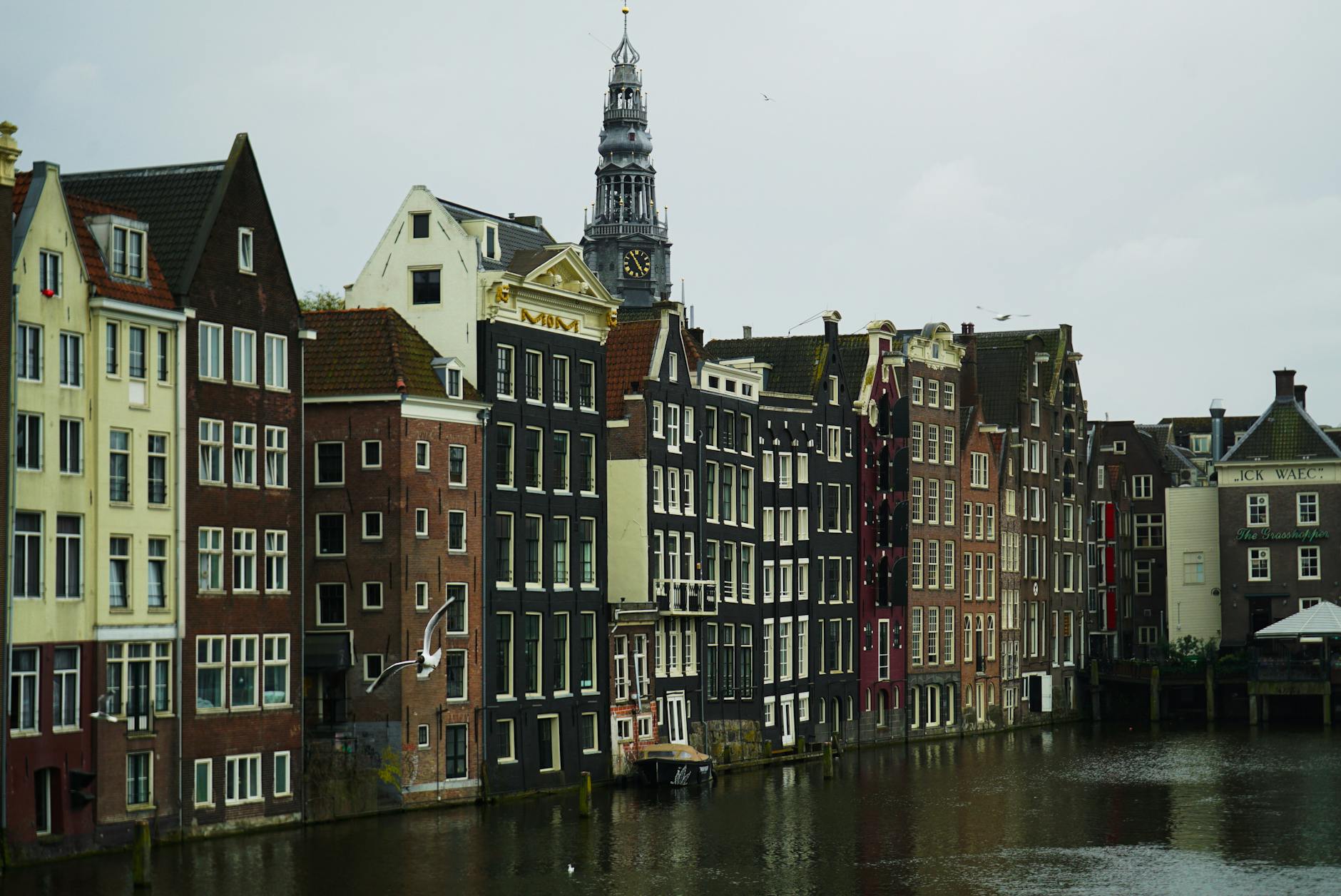
Your operator will hand you a marked map and tell you which stretches are one-way. Follow it. Beyond that, here is what is worth aiming at.
A two-hour loop
The classic ring: out along the Prinsengracht past the Westerkerk and the outside of the Anne Frank House, into the Brouwersgracht at the top — often called the prettiest canal in the city, and from the water you will see why — then back down the Herengracht or Keizersgracht through the grandest stretch of the canal ring. Two hours, no rushing, one stop.
Do not miss the seven-bridges view: pause where the Reguliersgracht meets the Herengracht and look down it. Seven bridge arches line up one behind another. It is the single best thing you can see from a boat in Amsterdam and it is invisible from the street.
A three- or four-hour route
Add the Amstel. Come out of the canal ring onto the river, which is wide, open and completely different in character, pass under the Magere Brug — the white wooden drawbridge — and turn back. Or go the other way into the narrow canals of the Jordaan, the Egelantiersgracht and Bloemgracht, where the big tour boats cannot follow and the whole thing feels like a village.
With four hours, add the eastern docks: past the maritime museum and NEMO‘s green hull, into the Oosterdok and the newer islands. Modern Amsterdam from the water, and almost empty of other boats.
What to avoid
The IJ and the harbour, which are forbidden. The Damrak and the busiest stretch beside Centraal on a summer afternoon, where the tour-boat traffic is heavy and a first-time skipper will have a stressful twenty minutes. And the narrowest canals at the peak hour on a Saturday, when the queueing under bridges takes the pleasure out of it.
Driving it: what nobody tells you on the jetty
- The tiller is backwards. Push left to go right. Everyone gets it wrong for the first minute; do your first minute on a wide canal, not a narrow one.
- Wind is your real enemy, not the current. The canals barely flow, but a flat-bottomed boat with high sides is pushed sideways by wind more than feels reasonable. Approach mooring and bridges with the wind in mind.
- Everything happens slowly. At 6 km/h you have time to correct anything. Panic is the only way to cause damage, and bumping a wall gently is a normal part of the day.
- Look up before every bridge. Some are lower than they look, especially with a canopy up, and heads need to be inside the boat.
- Reversing barely works. These boats steer poorly astern. Plan to loop round rather than back up.
- Watch for tour boats coming the other way. They are long, they need the middle of the canal, and their skippers deal with confused renters all day. Move over early and they will nod at you.
What to bring
Food and drink from a supermarket, which is the entire economic argument. A bottle opener, which everyone forgets. Layers, because it is colder on the water than on the quay and the wind funnels down the canals. Sunscreen, because there is no shade and Dutch sun is deceptive. A rubbish bag. And a coat with a hood — see our packing list, which is not being dramatic about the weather.
For the picnic itself: an Albert Heijn does the job for €10 a head. If you want to do it properly, buy cheese at a proper cheese shop from our Dutch cheese guide, bread from a bakery, and something from Albert Cuyp Market on the way.
Choosing an operator
A dozen companies rent boats in central Amsterdam and the listings look interchangeable. Five things actually differ, and only one of them is the headline price.
- Where the jetty is. This matters more than anything else. A base in the Jordaan or on the western canals puts you into the prettiest water within five minutes. A base out towards the eastern docks means half an hour of getting there and half an hour of getting back, which is a third of a two-hour rental spent in transit.
- Blocks or hours. Some price fixed two-, three- and four-hour blocks; others charge hourly with a minimum. Blocks are usually better value and hourly is more forgiving if you are unsure how long you want.
- Whether a skipper is available, and what it adds. Some operators offer one for a flat fee, which is the difference between a driving job and an afternoon off for everyone.
- The deposit and the damage terms. Read them. A gentle bump against a canal wall is normal and should not cost you; some operators are more relaxed about that than others.
- Canopy, heating and blankets. Trivial in July, decisive in April. If the boat has a proper cover you can rent in weather that would otherwise rule it out.
Book direct with the operator where you can. The resale platforms carry the same boats with a margin on top, and when the weather turns you want to be talking to the people with the boat rather than a support queue somewhere else.
Other ways onto the water
A self-drive sloop is not the only option, and one of the alternatives is free.
The IJ ferries. Free, all day, every day, across open water to Noord. Not a canal trip and not a substitute for one, but it is a proper boat ride at no cost and the crossing to NDSM takes fifteen minutes. Our free ferry guide has the routes.
Kayaks and canoes. Guided paddling trips run on the canals and are a genuinely different experience — you sit at water level, you can get down channels no motorboat fits into, and you work for it. Suited to a smaller group and to people who would rather be active than seated.
A boat with a skipper. Private charter of a small saloon boat costs more than a self-drive rental and much less than most people assume once it is split across a group. Worth pricing if your party includes someone who would find a low open boat difficult, or if it is a celebration and nobody wants the job.
When to book, and when not to bother
Summer weekends and any warm evening book out weeks ahead. This is the one activity in Amsterdam where availability, not price, is the constraint: the moment a good forecast appears, the boats go. Book as soon as your dates and the weather line up.
The best slot is late afternoon into early evening — the light is better, the canals are quieter than at midday, and you finish in time for dinner. Check whether your operator runs after dark, as many finish earlier than you would expect.
Do not bother in the following cases: if there are only two of you, if the forecast is genuinely wet rather than merely grey, if anyone in the group needs a stable step down into a boat that will not be provided, or between roughly November and March, when an open boat on a Dutch canal is an endurance exercise. Our weather by month guide will tell you what you are likely to get.
Is it worth it?
With four or more people and a decent forecast, it is the best thing you can do in Amsterdam, and we would put it above any museum on a sunny day. You get the city from the angle it was built to be seen from, at your own pace, with your own lunch, for around €25 a head. Nothing else on the tourist menu here comes close on that arithmetic.
With two people, take a guided cruise instead and spend the difference on dinner. With bad weather, do the same. And if nobody in the group wants the responsibility of the tiller, pay for a skipper rather than talking someone reluctant into it — a nervous driver spends three hours worrying instead of looking.
One more thing. Amsterdammers on the water are generally friendly, and other boats will wave. Wave back, keep the noise down, give way early, and you will have a better afternoon than any tour on our Amsterdam tours guide can sell you.
For the land equivalent — more ground covered, similar money — see our Amsterdam bike tours guide.
Keep Exploring
- Amsterdam tours and experiences: the full guide
- Amsterdam canal cruises compared
- Hop-on hop-off Amsterdam: bus vs boat
- The canal ring neighbourhood guide
- How the canal ring was built
- Staying on a houseboat
- Amsterdam in summer
- Free things to do in Amsterdam
Frequently asked questions
How much is boat rental in Amsterdam?
Roughly €90 to €100 for two hours, €89 to €140 for three and around €170 for four, per boat rather than per person, plus a mandatory city tax of €2.70 each. Boats usually take six to eight people.
Do you need a licence to rent a boat in Amsterdam?
No, not for the small electric sloops rented to visitors. The person driving must be at least 18 and sober, and the operator gives you about ten minutes of instruction before you leave the jetty.
Can you drink alcohol on a rental boat?
Passengers can. The driver is legally a skipper and must stay under the 0.5 per mille limit. If everyone wants to drink, hire a skipper with the boat.
Can you play music on the boat?
No. Amplified music is forbidden on Amsterdam’s canals and speakers can be confiscated. The canals are residential, and this rule is the one visitors most often do not expect.
How fast can you go?
Six kilometres an hour, which is walking pace, with fines starting around €95. The boats are not built to go faster and the city is better at that speed anyway.
Is it cheaper than a canal cruise?
Only with a group. Four people sharing a three-hour boat pay about €30 each for three hours against €18 for one hour on a cruise. Two people should take the cruise.
Can you go on the IJ or past Central Station?
No. The IJ and the open harbour in front of Centraal are closed to rental boats. That is busy commercial water with ferries and freight traffic.
Is it difficult to drive?
No. The tiller works backwards, which takes a minute to learn, and everything happens at walking pace so there is always time to correct. Wind pushes the boat around more than you expect; that is the only real skill.
Can you bring your own food and drink?
Yes, and you should — it is most of the value. Bring a bottle opener and a rubbish bag, because cleaning fees start around €50.
How far ahead should I book?
Weeks, for summer weekends and warm evenings. Availability rather than price is the constraint here, and boats disappear as soon as a good forecast appears.
Is it suitable for children?
Generally yes, with life jackets, which most operators provide on request — ask when booking. An open boat with small children needs one adult permanently not looking at the scenery.
What happens if something goes wrong?
You call the number the operator gives you and they come out. A flat battery, a rope round the propeller or a wrong turn are routine and they deal with them daily. Damage from speeding or misuse is a different matter and usually comes out of a deposit.