
Hop-on hop-off is one of the great travel products. In Rome, Berlin, London or Los Angeles, where the sights are spread across kilometres of city and the walk between two of them can eat an afternoon, a bus that loops all day and lets you get on and off is genuinely useful. It is sold just as hard in Amsterdam, where the entire historic centre is about two kilometres across, most of it is closed or actively hostile to large vehicles, and you can walk from the station to Dam Square in nine minutes.
So the honest verdict up front: for most visitors, hop-on hop-off Amsterdam is the one sightseeing product in this city we would tell you to skip. The bus version is the weaker of the two by a distance — you will regularly watch pedestrians overtake it. The boat version is better, because it uses the canals, which are the reason you came. But at €27.50 for 24 hours against €16 to €22 for a single one-hour cruise, you are paying a premium for a flexibility that a compact city does not need. There are real exceptions, and this page is mostly about identifying them properly rather than dismissing the whole thing.
The options at a glance
Prices checked September 2026. Operators change tiers and run online discounts, so treat these as the standard rate.
| Option | 24 hours | 48 hours | Verdict |
|---|---|---|---|
| Hop-on hop-off boat | €27.50 | €35 | The better of the two, if you must |
| Bus and boat combined | About €32.50 | About €42.50 | Only if you will genuinely use both |
| One standard canal cruise | €16–22 | — | What most people should buy instead |
| GVB day ticket | €10 | €16 | Real transport, goes where you live |
| Walking | Free | Free | Often the fastest option in the centre |
The problem: this city is too small for a sightseeing bus
Before comparing operators, it is worth being concrete about distance, because this is the whole argument and almost nobody does the sums before buying.
From Amsterdam Centraal, on foot: Dam Square and the Royal Palace in about nine minutes. The Anne Frank House in twenty. The Jordaan in fifteen. The Rijksmuseum and Museumplein in about thirty-five, and that is the far edge of the tourist centre. De Pijp is a little further again.
Those distances are the entire product. A bus that comes every twenty to thirty minutes, in traffic, with a wait at the stop, cannot beat a nine-minute walk to Dam. It cannot reliably beat a thirty-five-minute walk to Museumplein either, once you count the wait. And a tram will beat both: Centraal to Museumplein is about fifteen minutes on the tram, for a fare of a couple of euros, or €10 for a whole day of them.
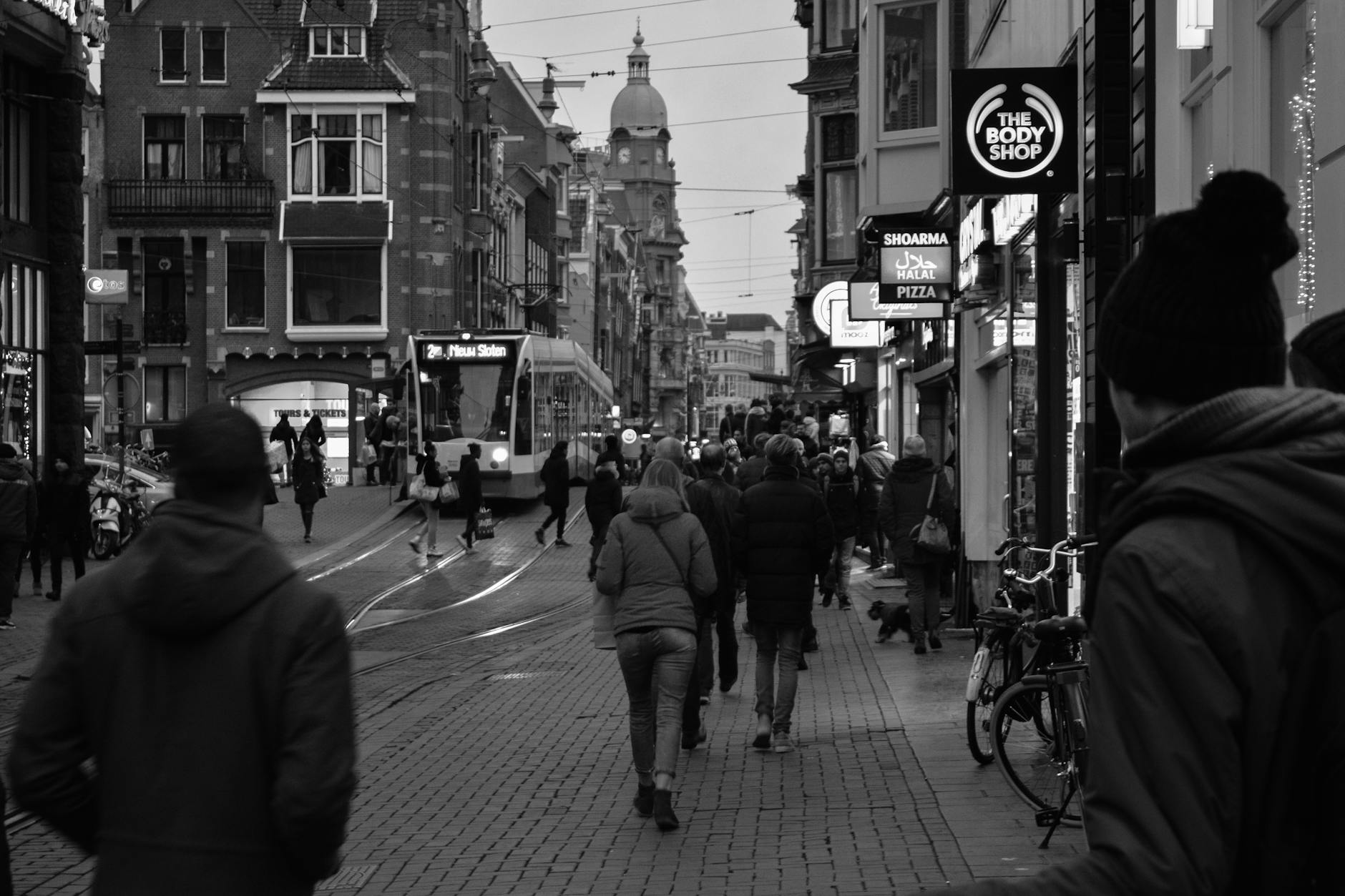
There is a second structural problem. Amsterdam’s centre is a medieval street plan crossed by canals, and the city has spent a decade pushing large vehicles out of it. Sightseeing buses therefore run on the ring of larger roads, which are the least interesting streets in the city. The bus does not go past the things you want to see; it goes past the roads near them. Our getting around guide and public transport guide cover what the network actually does well.
The bus, in detail
The main operator runs an open-top double-decker loop with recorded commentary in eighteen languages, all year except King’s Day on 27 April, in 24- and 48-hour tickets. Stops cover the obvious: Centraal, the museum quarter, the eastern docks and the main hotel clusters.
What it does well is orientation. If you have never been to Amsterdam and want the shape of the city delivered to you in ninety minutes without walking, one full loop does that, and the commentary is competent. Sitting on the top deck on a clear day is genuinely pleasant.
What it does badly is everything else. Frequency means a missed bus costs you twenty to thirty minutes. The route avoids the canal ring’s best streets because it cannot fit down them. In rain the top deck empties and the bottom deck is a windowed box. And the fundamental problem stands: you are queueing for a vehicle to take you somewhere you could walk to before the next one arrives.
The boat, in detail
Considerably better, because it does something walking cannot: it puts you on the water, which is where Amsterdam makes sense. Gable heights, bridge arches, houseboats, warehouse hoisting beams and the geometry of the canal ring are all legible from a boat and invisible from a pavement.
The hop-on hop-off canal service runs €27.50 for 24 hours and €35 for 48. The first boat leaves from the east side of Centraal at 09:15 and they run about every 25 minutes, with the last departure from Centraal at 19:00 in summer and 17:15 between 1 November and 20 March. Stops sit near the main museums and the Anne Frank House, and most operators now have an app showing where the boats actually are, which takes the worst of the guesswork out of waiting.
Two honest cautions. That 25-minute headway is the real cost: three hops in a day is realistically an hour of standing at jetties. And the winter timetable ends the service at 17:15, which is before dark in December — so if the appeal is lit bridges, this is not the product. A dedicated evening cruise is, and we compare those in our canal cruises compared guide.

What is actually at the stops
The stop list is the part of the marketing that does the heavy lifting, and it is worth translating. Both networks are built around the same handful of destinations, so here is what you get at each and whether the vehicle is the sensible way to reach it.
- Centraal Station. The hub for both, and the point at which almost everyone starts. It is also nine minutes’ walk from Dam and twenty from the Anne Frank House, which is the problem in one sentence.
- Museum quarter. The Rijksmuseum, Van Gogh Museum, Stedelijk and Moco, all within 200 metres of each other. This is the one genuinely useful stop, and the tram gets you there in fifteen minutes for a couple of euros.
- Anne Frank House / Westerkerk. Convenient in theory. In practice you need a timed ticket booked weeks ahead, so the boat stop is not what determines whether you get in.
- Heineken Experience / De Pijp. Real value if the Heineken Experience is on your list, since it is a genuine walk from the centre. Otherwise this is the stop for Albert Cuyp Market, which deserves an hour on foot rather than a hop.
- Eastern docks and NEMO. Modern architecture, the maritime museum and NEMO. A decent stop, and a part of the city most visitors skip.
- Leidseplein and Rembrandtplein. Nightlife squares that are unremarkable in daylight, which is when the services run.
Read that list honestly and the pattern is clear: two or three stops are genuinely useful, and all of them are reachable by tram for a fraction of the price. Our attractions by area guide groups them so you can walk between them properly.
Bus versus boat, head to head
| Bus | Boat | |
|---|---|---|
| 24-hour price | Around €25–30 | €27.50 |
| Frequency | Every 20–30 min | Every 25 min |
| Sees the canal ring | Barely | Yes, from the water |
| Beaten by walking | Often | No |
| In bad weather | Poor | Covered, fine |
| Runs after dark | No | Not in winter |
| Useful as transport | No, the tram is better | No, but it is scenic |
| Worth it as a one-off | Rarely | Sometimes |
If you have decided you want a hop-on hop-off ticket, take the boat. It is the same money, it shows you something you cannot see on foot, and it does not spend your afternoon in traffic. The bus is only the better choice if you are staying somewhere on its route that is genuinely awkward to reach otherwise, which is rare.
The combined ticket
Around €32.50 for 24 hours and €42.50 for 48, letting you switch freely between the bus and the boat. As an upsell it is well designed: five euros more than the boat alone for a whole second network.
The problem is time, not money. Twenty-four hours is one day, and one day in central Amsterdam has room for perhaps two museums, a meal and a wander. Fitting a bus loop and a boat loop into that leaves you having seen a great deal of transport and not much of the city. The 48-hour version at €42.50 makes more sense arithmetically, but by then you are €42.50 into a product designed to move you around a place you could cross on foot in half an hour.
Buy the combined ticket only if you already know you want the boat and you are staying somewhere the bus genuinely helps. Otherwise it is €15 more than the single cruise most people actually want.
When hop-on hop-off is the right call
There are five situations where we would recommend it without hesitation, and they are all real.
- Limited mobility. This is the strongest case by far. If walking two kilometres over cobbles and humpback bridges is not realistic, a bus with a fixed loop and guaranteed seating changes the trip completely. Check step-free boarding with the operator first, and read our accessibility guide.
- A single-day stopover. Cruise passengers, long layovers and one-night stops. When you have six hours and no bearings, a fixed loop removes every decision and guarantees you see the outline of the city.
- Older travellers who want to pace themselves. The ability to sit down between sights, in the dry, is worth real money on a long day. Our guide for older travellers covers the wider pacing question.
- Persistent rain. Amsterdam gets rain in every month. A covered boat that keeps moving is a decent way to spend a wet afternoon, and better than a wet walking tour.
- Young children who will not walk. Boats hold their attention, and the hopping means you can leave at any point without an argument. See our Amsterdam with kids guide.
If none of those describes you, the case is thin.
What to buy instead
Set against a €27.50 hop-on hop-off ticket, here is what the same money or less does in Amsterdam.
- €16–22: one standard canal cruise. You get the water, the bridges and the commentary, and you keep the rest of your day. This is the swap most visitors should make.
- Around €30: an evening cruise, which is better than any daytime version — lit bridges, smaller boats, open curtains along the canals.
- €10: a GVB day ticket. Real public transport, going where you actually want to go, every few minutes, including the free ferries. Our tram routes guide makes it easy.
- €10–15 in tips: a free walking tour, two and a half hours, which will teach you more about the city than any recorded loop.
- Free: the IJ ferries to Noord, which are a proper boat trip across open water at no cost at all, and the best-value thing in Amsterdam by some margin.
Which walks are worth joining, free and paid, is in our best walking tours in Amsterdam guide.
And if there are four of you, driving your own boat costs less per head and is a far better afternoon — see our Amsterdam boat rental guide.

A worked day: what 24 hours really buys
The brochure version of a hop-on hop-off day has you gliding between six attractions. Here is the version with the waiting in it, using a 25-minute headway and a realistic pace.
- 09:15 — first boat from Centraal. Full loop for orientation, about 75 minutes with the commentary.
- 10:30 — hop off at the museum quarter. Rijksmuseum, two hours if you are efficient.
- 12:45 — back to the jetty. Average wait, twelve minutes. Call it 13:00 on the water.
- 13:20 — hop off for lunch. An hour, because you have been standing since nine.
- 14:40 — jetty again, another twelve-minute wait, another twenty minutes on the boat.
- 15:30 — one more attraction, ninety minutes.
- 17:00 — last useful boat back, or walk, which will probably be quicker.
That is a full, busy day, and it contains two museums, a lunch and roughly two and a quarter hours on or beside a boat — of which around forty minutes is standing at jetties. It is not a bad day. But you could have had the identical day with one €18 canal cruise in the morning and a €10 tram ticket, and been €15 better off with more control over the timings.
The second 24 hours, on a 48-hour ticket, is where the maths gets worse still. By day two you know the city, you have found your bearings, and you will almost certainly walk. Look at our two-day itinerary and ask honestly which parts of it a loop would have improved.
If you are buying one, do it properly
- Buy online, not at a kiosk. Street and hotel prices are the highest, and online rates are frequently lower.
- Start it in the morning. These tickets run on hours from first use. Activating at 14:00 wastes half of what you paid for.
- Check the winter timetable. The boat’s last departure from Centraal drops to 17:15 between 1 November and 20 March, and the whole thing stops on King’s Day.
- Use the tracking app. Most operators have one, and knowing a boat is eleven minutes away rather than unknown minutes away materially improves the experience.
- Do not buy from someone on the pavement. Sellers around Damrak and Centraal charge full price at best. Our scams guide covers the rest of it.
- Check what your pass already includes. The Holland Pass bundles one hop-on hop-off bus ticket or a canal cruise, so do not buy it twice — our city passes compared has the detail.
Comparing operators without getting lost
Several companies sell versions of this in Amsterdam, the listings look nearly identical, and the resale sites multiply them into what looks like dozens of different products. Four things actually differentiate them, and none of them is the headline price.
Headway. Every twenty minutes and every thirty minutes are very different products over a day. Two extra minutes of advertised frequency is worth more than two euros off the ticket.
Where it leaves from. Boats depart from different sides of Centraal and from different jetties along the canals. If your hotel is fifteen minutes from the nearest jetty, the whole proposition weakens. Check the map before the price.
Whether there is a live app. Knowing a boat is nine minutes away rather than somewhere unknown changes the day considerably, and not every operator provides it.
Cancellation terms. Free cancellation up to 24 hours ahead is standard on the platforms and is worth insisting on. Amsterdam’s weather can turn a planned open-top loop into a bad afternoon, and our weather by month guide is realistic about how often that happens.
One caution on resale listings: a large number of what look like separate tours are the same operator’s ticket sold through different brands at different margins. If two listings share the same route map and the same stop list, they are the same boat. Buy the cheapest one with decent cancellation terms, or buy direct.
The verdict
Hop-on hop-off works in cities where distance is the problem. In Amsterdam distance is not the problem; the city is small, flat and beautiful to cross on foot, and the parts a bus can reach are the least interesting parts. The boat version escapes the worst of that by using the canals, but it charges a €10 premium over a single cruise for a flexibility most people use twice.
Buy it if you have a mobility reason, a stopover with no time to plan, or a small child who will not walk. Otherwise: one canal cruise, a day ticket for the tram if the weather turns, and your own two feet. You will see more, spend less, and enjoy it more — which is the same conclusion we reach across our whole Amsterdam tours guide.
Keep Exploring
- Amsterdam tours and experiences: the full guide
- Amsterdam canal cruises compared
- Public transport for visitors
- The Amsterdam tram routes guide
- The free ferries to Noord
- Amsterdam city passes compared
- Amsterdam attractions grouped by area
- First-time mistakes to avoid
Frequently asked questions
Is hop on hop off Amsterdam worth it?
For most visitors, no. The centre is about two kilometres across and walking or the tram beats the bus regularly. It is worth it for limited mobility, a single-day stopover, persistent rain or young children who will not walk.
How much does hop-on hop-off cost in Amsterdam?
The canal boat is €27.50 for 24 hours and €35 for 48. A combined bus and boat ticket runs about €32.50 and €42.50. A single one-hour canal cruise, by comparison, is €16 to €22.
Bus or boat — which is better?
The boat, clearly. It uses the canals, which are the reason to be in Amsterdam, it is unaffected by traffic, and it is covered in bad weather. The bus runs on the ring roads and is regularly slower than walking.
How often do the boats run?
About every 25 minutes. The first leaves the east side of Centraal at 09:15, with the last departure from Centraal at 19:00, dropping to 17:15 between 1 November and 20 March.
Does the hop-on hop-off boat run at night?
No. It stops in the early evening and finishes at 17:15 in winter. For lit bridges and the Light Festival you want a dedicated evening cruise instead.
Is a canal cruise better than the hop-on hop-off boat?
For most people, yes. One hour, €16 to €22, and you keep the rest of your day rather than building it around a 25-minute headway. The hopping is only useful if you would genuinely get on and off three or more times.
Can I use hop-on hop-off as transport?
You can, but it is bad at it. A GVB day ticket is €10, runs every few minutes, covers trams, buses, metro and ferries, and goes to where you are actually staying.
Do the buses run all year?
Yes, all year except King’s Day on 27 April, when the centre closes to traffic entirely. Winter timetables are shorter, particularly on the boats.
Is it wheelchair accessible?
Some vehicles and jetties are and some are not, and this is the case where it matters most. Contact the operator directly and confirm both boarding and the specific stops you need before buying.
Where do I board?
Both bus and boat services centre on Amsterdam Centraal, with the boats leaving from the east side of the station. Other stops sit near the museum quarter and the main hotel clusters.
Is it included in any city pass?
The Holland Pass includes one hop-on hop-off bus ticket or a canal cruise as an alternative. Other passes vary and change their lists annually, so check before buying separately.
Are the different operators actually different?
Less than the listings suggest. Many apparently separate tours are the same operator’s ticket resold under different brands. Compare the route map, the headway, the departure jetty and the cancellation terms rather than the name.
Is it worth it for a cruise ship stopover?
This is one of the better cases. With six hours, no bearings and a fixed return time, a loop removes every decision and guarantees you see the shape of the city. Take the boat rather than the bus, and start it the moment you are ashore.
Should I get 24 or 48 hours?
If you are buying at all, 48 hours is the better arithmetic — but ask first whether you want to spend two days of a short trip riding a loop. Most people who buy 48 hours use it properly on one day and barely on the second.