This article contains advertising. Our booking links are routed through a partner that adds commission tracking automatically, so if you book through one we earn a commission from the provider, at no extra cost to you. It never affects what we recommend. Affiliate disclosure
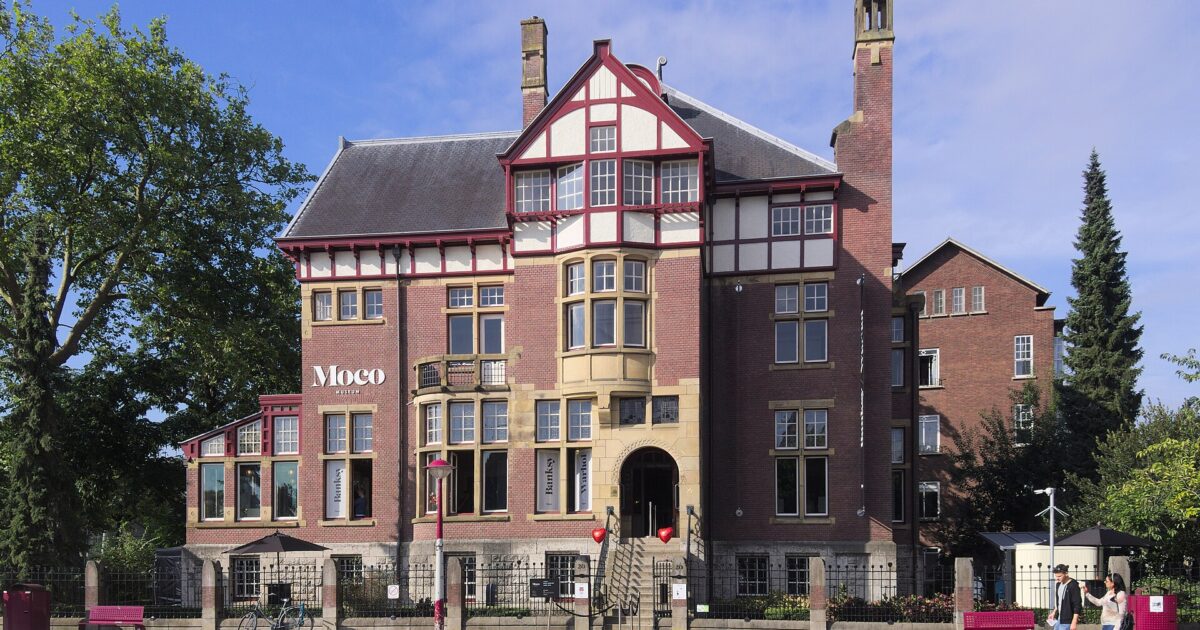
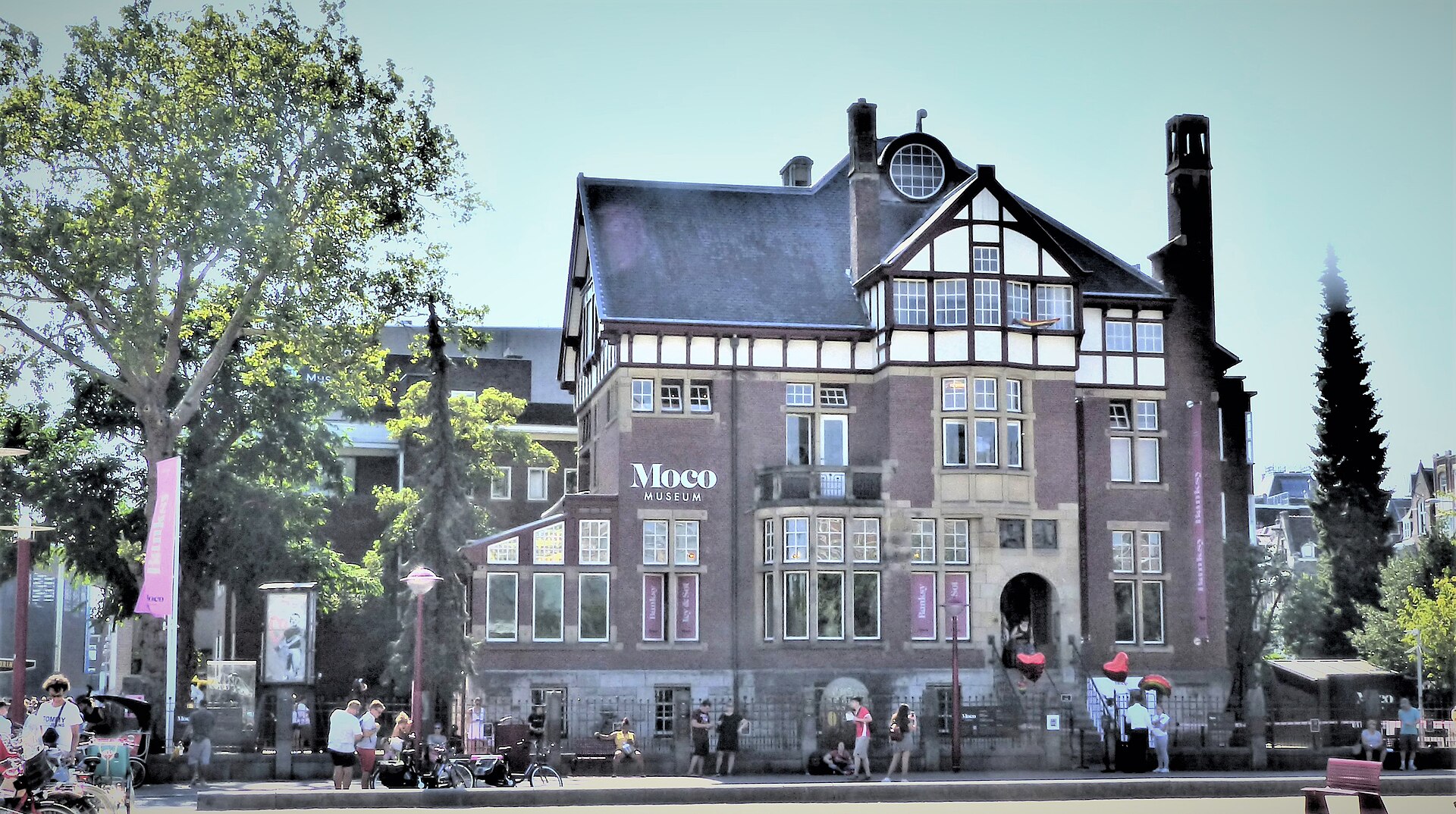
The Moco Museum occupies Villa Alsberg, a red-brick townhouse of 1904 on the Honthorststraat corner of Museumplein, wedged between the Rijksmuseum and the Van Gogh Museum. Inside are Banksy, Basquiat, Warhol, Kusama, Haring and a basement of immersive digital work by Studio Irma. It is privately owned, it is the newest museum on the square, and it is the one that most divides opinion.
The numbers first: Moco Museum Amsterdam tickets start at €17.95 online and rise towards €22 for the middle of a busy day, with up to €5 off the earliest and latest slots, and the visit takes about an hour. That makes it the cheapest and quickest of the four Museumplein museums, which is precisely the right way to think about it. It is not a rival to the Rijksmuseum and does not try to be. It is an hour of very well-lit, very photogenic contemporary work in a beautiful house, and if you go in expecting a scholarly institution you will come out annoyed. Go in expecting what it actually is and it is good value.
Moco Museum at a glance
Checked September 2026 against the museum’s own site.
| Detail | 2026 information |
|---|---|
| Adult ticket | €17.95–€21.95 online, demand-priced by day and slot |
| Discount | Up to €5 off for an early or late time slot |
| Opening hours | Daily 09:00–20:00 |
| Duration | About 60 minutes |
| Address | Honthorststraat 20, on Museumplein |
| Booking | Timed slots; 2–3 days ahead in high season |
| Museumkaart | Not accepted — it is a private museum |
| I amsterdam City Card | Check current terms before relying on it |
| Photography | Encouraged throughout |
| Other locations | Barcelona and London |
What is inside
The collection is split across three broad strands, spread over four floors of a house that was never designed to be a museum — which is part of the charm and all of the constraint. Rooms are small, staircases are original, and you move through at a decent clip.
Banksy
The reason most people come. Moco holds one of the larger private groupings of Banksy work anywhere, including screenprints, canvases and pieces removed from walls. Girl with Balloon, Laugh Now, Kissing Coppers and Beanfield have all been shown here, though what is on display rotates and the museum does not always publish a definitive list in advance.
A note worth making, because nobody else makes it: Banksy has publicly stated that he has no involvement in exhibitions of his work that he has not organised himself, and this includes commercial shows of privately owned pieces. That does not make the work fake — provenance here is not in dispute — but it does mean you are seeing a collector’s assembly rather than an artist’s exhibition. Whether that matters to you is a fair question to settle before buying a ticket.
Modern masters
Basquiat, Warhol, Haring, Hirst, Kusama, Ai Weiwei and Yves Klein, hung a handful of works at a time in the upper rooms. It is a greatest-hits approach rather than a curated argument, and it works better than it sounds because the domestic scale of the rooms puts you unusually close to the pictures. A Basquiat in a former dining room is a genuinely different experience from a Basquiat in a white cube.
Digital and immersive art
The basement holds Studio Irma’s installations — mirrored rooms, projections, walk-through light environments — plus rotating digital work and, at times, NFT-linked pieces. This is the most Instagram-driven part of the museum and the museum is entirely unembarrassed about that. Children and teenagers tend to like this floor more than anything upstairs.
The garden
A small sculpture garden at the front, visible from the square, usually holding a large statement piece. You can see it from the pavement without a ticket, which a surprising number of people do not realise.
Is Moco worth it?
Our verdict: yes, if you book an early or late slot and treat it as an hour rather than an afternoon. At €17.95, and less again in an early slot, it is comfortably the cheapest ticket on Museumplein. At €22 in the middle of a Saturday, for sixty minutes in crowded rooms, it is a much thinner proposition — and since the museum itself discounts the quiet slots, taking one is simply the correct move.
Go if
- You want contemporary work and the Stedelijk‘s more austere approach is not what you are after.
- You are travelling with teenagers. This is the single most reliable Amsterdam museum for a fifteen-year-old, and it is not close.
- You have an hour to fill between a Museumplein booking and dinner. Nothing else on the square fits into an hour.
- It is late. Open until 20:00 daily, it is the only major Museumplein museum that works as an evening plan.
Skip it if
- You hold a Museumkaart and are counting on it. Moco is private and does not accept it, so this is the one museum on the square you pay for twice.
- You want depth. Sixty minutes and a few works per artist is not a serious survey of anyone.
- Crowds in small rooms bother you. Villa Alsberg’s staircases and landings are narrow, and a busy afternoon is genuinely tight.
- You would rather see street art in the street. Which is free, outdoors, and covered in our galleries and street art guide — the NDSM wharf in Amsterdam Noord is the real thing at no cost.
Getting the cheapest ticket
Moco prices dynamically, which is unusual on Museumplein and works in your favour if you pay attention.
- Book the 09:00–10:00 or the 18:30–19:30 slots. The museum’s own site advertises up to €5 off for these, which is a quarter of the peak price for the same museum with fewer people in it.
- Buy direct. The museum’s site is the cheapest; resellers add a margin on a ticket that is not scarce.
- Book two or three days ahead in summer. It is not the Van Gogh Museum — you will rarely be locked out — but the cheap slots go first.
- Do not buy a combination ticket pairing Moco with a cruise unless you have priced both separately. See our attractions and tickets guide for how those bundles usually work out.
One structural point: because the Museumkaart does not cover Moco and the I amsterdam City Card‘s coverage of it has varied, this is a museum where you should check the current terms rather than assume. Both cards’ exclusions are the thing that quietly erodes their value.
The building, which is half the visit
Villa Alsberg was built in 1904 to a design by Eduard Cuypers — nephew of Pierre Cuypers, who built the Rijksmuseum across the square and Centraal Station at the other end of town. It is a private house in the Dutch neo-Renaissance manner, all red brick, half-timbering, bay windows and a corner chimney, and it stands out sharply against the institutional bulk of its neighbours.
Living with the building is the museum’s defining constraint. Rooms are domestic. Ceilings are ordinary height. The staircase is a staircase, not a circulation system. That is why the visit is an hour and why the crowd flow is imperfect — but it is also why the work feels closer and more personal here than it does in a purpose-built gallery. Our architecture walking guide puts the Cuypers family in context, and the Museum Quarter guide covers the streets of villas behind it, most of which are now consulates and law firms.
Practical detail
- Timed entry, but relaxed — arriving fifteen minutes either side of your slot is normally fine.
- Photography is actively encouraged. Several rooms are designed as photographs. If that is not your thing, this is a museum to skip rather than endure.
- Accessibility is the weak point. It is a 1904 townhouse with original staircases; step-free access does not reach every floor. Contact the museum before travelling if this matters, and see our accessibility guide for the venues that do it well.
- No large bags, and the cloakroom is small.
- Cashless, like everything else on Museumplein.
- The shop sells prints and merchandise at prices that assume you have just had a good time.
Where it fits on Museumplein
Honthorststraat 20, one minute from the Van Gogh Museum and three from the Rijksmuseum. Trams 2 and 12 stop at Van Baerlestraat; the tram routes guide and public transport guide have fares and stops.
The pairing we would recommend is a morning at the Rijksmuseum or the Van Gogh Museum, an afternoon outdoors, and Moco at 18:30 on the way to dinner. That sequence gets you three very different things and never asks you to look at two major collections back to back — the mistake that ruins more Amsterdam museum days than crowding does.
If contemporary art is the reason you are here, our Stedelijk Museum guide covers the serious version of the same territory across the square.
Afterwards: Vondelpark is two minutes west, De Pijp is fifteen minutes east for dinner, and the Nine Streets are a twenty-minute walk north if you would rather shop. Our art lovers’ guide maps the wider circuit, and hidden gems covers the small galleries most people never find.
Moco against the rest of Museumplein
Four museums stand within four minutes of each other and they are routinely presented as interchangeable. They are not. This is the comparison we would give someone choosing between them with limited time and money.
| Museum | Price | Time | Best for |
|---|---|---|---|
| Rijksmuseum | €25 | 2.5–4 hrs | Breadth, one visit only, families |
| Van Gogh Museum | €25 | 2–3 hrs | Depth on one artist |
| Stedelijk | €22.50 | 2 hrs | Serious modern and contemporary |
| Moco | From €17.95 | 1 hr | Teenagers, an evening, a short gap |
Read down the time column and the point becomes obvious. Moco is the only one of the four that fits into an hour, and it is the only one open at 19:00. Those two facts, rather than the collection, are why it works — it slots into a day the others cannot. Trying to do Moco and the Van Gogh Museum on the same morning is possible; doing the Rijksmuseum and the Stedelijk on the same day is a slog. The full costing across every Amsterdam attraction is in our attractions and tickets guide, and the museums guide covers the rest of the city.
The artists you are most likely to see
Displays rotate, so treat this as the shape of the collection rather than a guarantee. What is consistent is the emphasis: recognisable late-twentieth-century and contemporary names, shown a few works at a time.
- Banksy — the largest single presence, spread over more than one room.
- Jean-Michel Basquiat — usually a small group, and the pieces that most reward the domestic scale of the house.
- Andy Warhol — prints rather than the famous canvases, which is worth knowing before you build a visit around him.
- Keith Haring — consistently on show and consistently popular with younger visitors.
- Yayoi Kusama — the museum has shown infinity-room-style work, though the Stedelijk’s Kusama retrospective from 11 September 2026 to 17 January 2027 is the serious version this winter.
- Damien Hirst, Ai Weiwei, Yves Klein, KAWS, Daniel Arsham — rotating, generally one or two works each.
- Studio Irma — the resident digital artist, and the whole of the basement.
If a specific artist is your reason for going, check the museum’s exhibitions page in the week you travel rather than relying on a list like this one. Rotation here is faster than at a public institution, because nothing is on permanent display by statute.
A short history of the museum
Moco opened in April 2016, founded by the Dutch gallerists Lionel and Kim Logchies, with an inaugural pairing of Banksy and Warhol. It was, and remains, a private museum: no state funding, no acquisitions committee, no obligation to a permanent collection. That model explains almost everything about the visit — the fast rotation, the commercial tone, the ticket pricing that moves by the hour, and the absence from the Museumkaart scheme.
It also explains the criticism. Established museums in the Netherlands have been sniffy about Moco from the start, and the objections are not unreasonable: little scholarship, no catalogue tradition, an exhibition programme shaped by what the founders can borrow or buy. Against that, Moco has brought a large and genuinely new audience onto Museumplein, and it stays open until 20:00 in a district where everything else shuts at five. Both things are true.
The museum has since opened in Barcelona and London. Ticketing is per city, and the collections differ — a Banksy you saw in Amsterdam will not necessarily be in London, and vice versa.
Making an evening of it
Because Moco runs to 20:00, it is the only Museumplein museum that can anchor an evening rather than a day, and that is how we would use it. A 18:30 slot puts you out at half past seven, in a part of the city that is quiet after dark and ten minutes from three very different dinners.
Walk east into De Pijp for the widest choice at the fairest prices — our restaurants by budget guide concentrates there. Walk north into the canal ring for the prettiest twenty-minute walk in the city with the bridges lit. Or stay in Oud-Zuid if you want the quiet, expensive version of an Amsterdam evening. A concert at the Concertgebouw, four minutes away, is the natural pairing if anything is on — see the culture and history guide.
For couples, this sequence — an hour of art, a walk along the Singelgracht, dinner in De Pijp — is one of the better evenings the city offers without booking anything difficult. Our romantic Amsterdam guide has more in the same vein, and the two-day itinerary shows where an evening museum slot buys you back a whole afternoon.
Keep Exploring
- Amsterdam attractions and tickets: all prices and booking windows
- The complete Amsterdam museums guide
- Galleries and street art
- The Museum Quarter and Oud-Zuid
- Amsterdam for art lovers
- Things to do in Amsterdam
- Amsterdam Noord and the NDSM wharf
Frequently asked questions
How much are Moco Museum Amsterdam tickets?
€17.95 to €21.95 online, demand-priced by day and time slot, with up to €5 off the earliest and latest entries. The museum discounts quiet slots by up to €5, so the cheapest ticket is also the least crowded visit.
How long does a Moco visit take?
About sixty minutes. It is a townhouse with four modest floors, not a large institution, and an hour covers it comfortably.
Is Moco included in the Museumkaart?
No. Moco is a privately owned museum and does not accept the Museumkaart, which makes it the one museum on Museumplein you pay for separately if you hold the card.
Are the Banksy works real?
The provenance of the pieces is not in dispute. What is worth knowing is that Banksy does not endorse or participate in exhibitions of privately owned work, so this is a collector’s display rather than an artist-organised show.
Is Moco good for children?
For teenagers, it is the best museum on Museumplein by a wide margin. For younger children, the digital basement works and the upper floors largely do not.
Can you take photos in the Moco Museum?
Yes, throughout, and it is actively encouraged. Several installations are built specifically to be photographed, which is either the appeal or the objection depending on your temperament.
What is the best time to visit Moco?
The first hour after the 09:00 opening or the last ninety minutes before the 20:00 close. Both are cheaper and noticeably quieter than the 12:00 to 16:00 block.
Moco or the Stedelijk?
The Stedelijk for a proper survey of modern and contemporary art over two hours. Moco for an hour of recognisable names in a beautiful house, at a lower price, later in the day. They are not really competing for the same visit.
Is there a Moco Museum in other cities?
Yes — Barcelona and London. The collections differ, and a ticket for one does not carry over to another.