
The Stedelijk is the city’s museum of modern and contemporary art, and the third of the four institutions on Museumplein. Its collection runs from 1880 to now: Malevich, Mondrian and De Stijl, Chagall, Matisse’s The Parakeet and the Mermaid, the CoBrA painters, Warhol, Judd, and a design collection strong enough that most cities would build a separate museum around it. Entry is €22.50, free for anyone under nineteen.
The Stedelijk Museum Amsterdam is the museum that visitors skip and that people who live here rate most highly, and both positions are defensible. It has no single object that everyone has heard of — no Night Watch, no Sunflowers — so it loses the argument on any list of ten things to see. What it has instead is the best-argued permanent collection in the Netherlands and an exhibition programme that is genuinely international. If you have two museums in you, this is a real contender for the second, and it is almost always the quietest of the four on the square.
Stedelijk Museum at a glance
Checked September 2026 against the museum’s own site.
| Detail | 2026 information |
|---|---|
| Adult ticket | €22.50 |
| Students | €12.50 |
| Under 19 | Free |
| Kusama retrospective | €32.50, 11 Sep 2026 – 17 Jan 2027 |
| Opening hours | Daily 10:00–18:00, 365 days a year |
| Last entry | 17:45; tickets are valid all day |
| Time needed | 2 hours; 3 with a major exhibition |
| Address | Museumplein 10, entrance under the white canopy |
| Museumkaart | Accepted |
| I amsterdam City Card | Accepted |
| Booking | Day before, or walk up outside blockbusters |
Tickets, and the one thing to check before booking
€22.50 for adults, €12.50 for students, and free for everyone under nineteen — which makes it, like the Rijksmuseum and the Van Gogh Museum, unexpectedly cheap for a family. Both the Museumkaart and the I amsterdam City Card cover it in full, which is worth knowing because the Van Gogh Museum next door does not accept the City Card at all.
The thing to check: whether a blockbuster exhibition is running, because those carry a supplement. The Yayoi Kusama retrospective from 11 September 2026 to 17 January 2027 takes the ticket to €32.50, which is the most expensive standard museum admission in the city. Whether that is justified depends on whether you came for Kusama; the permanent collection is included either way, but you cannot buy a cheaper ticket that excludes the exhibition during that period. Our attractions and tickets guide compares the four Museumplein prices side by side.
A useful detail most museums do not offer: your ticket is valid all day rather than for a slot, so you can go in at eleven, leave for lunch and come back. Very few Amsterdam museums allow that, and on a long Museumplein day it is genuinely useful.
Booking a day ahead is enough outside blockbuster periods, and walking up on a weekday morning is normally fine. During a major exhibition, treat it like the Van Gogh Museum and book a week out.
What is in the collection
Roughly 90,000 objects, of which a rotating selection is on show. The permanent presentation is hung thematically and chronologically across the old building’s upper floors, and it is unusually well argued — you are being walked through an actual case about how modern art developed, not shown a series of trophies.
The Malevich holding
Since 1958 the Stedelijk has held the largest collection of Kazimir Malevich’s work in the West, acquired in circumstances that were complicated at the time and have been legally contested since. It is the single most important thing in the building. Seeing the progression from figurative peasant scenes through Cubo-Futurism to pure Suprematist geometry, in one room, is the sort of thing you can do in perhaps three museums on earth.
De Stijl and Mondrian
The Stedelijk did more than any institution to establish De Stijl internationally — the 1951 survey curated by the director Willem Sandberg travelled to MoMA in New York and effectively created the movement’s global reputation. Mondrian, Van Doesburg, Rietveld’s furniture including the red-blue chair. This is a Dutch movement told properly on home ground.
CoBrA
Karel Appel, Constant, Corneille and the rest of the post-war group formed in a Paris cafe in 1948 by artists from Copenhagen, Brussels and Amsterdam. Loud, childlike, deliberately crude, and completely unlike anything else on Museumplein. Appel’s Questioning Children caused a genuine scandal when it was installed in Amsterdam’s city hall.
The international twentieth century
Matisse’s enormous cut-out The Parakeet and the Mermaid, Chagall, Picasso, Warhol, Lichtenstein, Judd, Newman’s Cathedra, Bruce Nauman. The strength here is depth in particular decades rather than a complete survey.
Design and applied art
The part visitors do not expect and often like best. Posters, furniture, industrial design, typography, Amsterdam School interiors, Gerrit Rietveld, Dutch graphic design from Sandberg onwards. If you have any interest in how things are made and why they look as they do, allow an extra half-hour.
The Bathtub
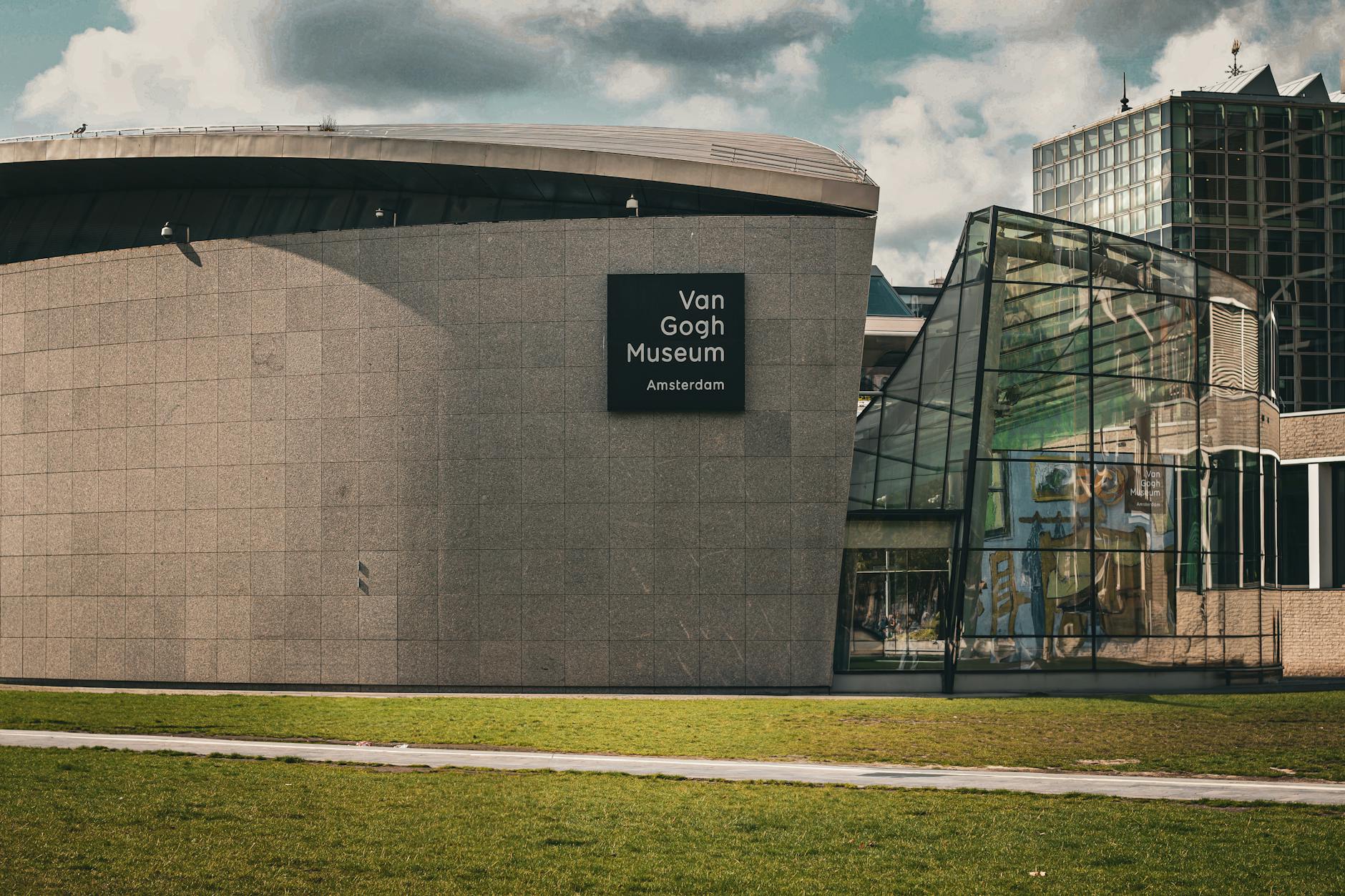
The original 1895 building by A. W. Weissman is a red-brick neo-Renaissance pile facing the square. Bolted onto its front since 2012 is a vast smooth white shape by Benthem Crouwel Architects, cantilevered out over the entrance, which Amsterdam named de Badkuip — the Bathtub — almost immediately and has called it ever since.
It is made of 185 seamless composite panels in aramid and carbon fibre, the same material family used in boat hulls and body armour, and there is not a visible joint anywhere on it. Technically it is remarkable. Aesthetically, Amsterdam is still arguing, and the argument has settled into affection rather than agreement — which is roughly what happened with the Pompidou in Paris.
Practically, the extension solved a real problem: the entrance now faces Museumplein rather than a side street, and the underground exhibition hall beneath it gives the museum the large column-free space that a contemporary programme needs. Our architecture walking guide covers it alongside Cuypers’s Rijksmuseum and Rietveld’s Van Gogh Museum, which makes Museumplein an unusually good crash course in a century and a half of Dutch building.
Is the Stedelijk worth it?
Our verdict: yes as a second or third museum, and no as your only one.
Go if
- You have three or more days and have already done one of the big two.
- You care about design as much as painting. Nothing else in Amsterdam covers it this well.
- You want to avoid crowds. Outside blockbusters this is reliably the quietest building on Museumplein, and on a busy Saturday that is worth a great deal.
- You are travelling with under-19s, who enter free, which makes an experimental hour cost nothing extra.
- You have already seen the Van Gogh Museum and want to know what happened next.
Skip it if
- You have two days. The Rijksmuseum and the Anne Frank House have stronger claims on a short trip.
- Modern art actively irritates you. This is not a museum that will convert you, and there is a good deal of conceptual work in the contemporary galleries.
- You want an hour. The Stedelijk needs two to make sense; for an hour on Museumplein, Moco is the better use of the time.
For the opposite end of Dutch art history, our Rembrandt House Museum guide covers the seventeenth-century studio across town.
When to go
- Weekday mornings from 10:00 are the quietest, and during a blockbuster they are the only genuinely calm hours.
- Late afternoon from about 16:00 works well, since the ticket is valid all day and the building empties before 18:00.
- Any day of the year — the museum opens 365 days, which makes it the reliable answer on public holidays when smaller museums close.
- Rainy days fill it, like everywhere else on the square. See the weather by month guide.
- Museum Night in early November, when the Stedelijk is one of the more inventive participants and the crowd is overwhelmingly Dutch.
Practical detail
- Tickets are valid all day, not for a timed slot, so you can leave and return.
- Free lockers in the entrance hall; large luggage is not admitted.
- Photography without flash is generally permitted in the permanent collection; temporary exhibitions vary and are signed.
- Accessibility is very good — step-free from the square, lifts throughout, wheelchairs available. See our accessibility guide.
- The cafe under the Bathtub canopy is open to non-visitors and is a decent place to sit on the square.
- The bookshop is the best art bookshop in Amsterdam, and it is outside the ticket barrier.
- Guided tours run in English at set times; the free app carries collection highlights.
Where it sits, and what to pair it with
Museumplein 10, in the Museum Quarter. Trams 2 and 12 stop at Van Baerlestraat, a minute away; the tram routes guide and public transport guide have fares and stops.
The obvious pairing is the Van Gogh Museum one minute away, and chronologically it works — Van Gogh dies in 1890, the Stedelijk’s collection starts around 1880, and the handover is almost seamless. Two big museums in a day is a lot, though, so if you do it, take the Van Gogh at 09:00 and the Stedelijk after 15:00 with a long lunch between.
The better pairing, for our money, is the Stedelijk in the morning and something entirely non-museum in the afternoon: Vondelpark two minutes west, the Nine Streets twenty minutes north, or the galleries and antique dealers of the Spiegelkwartier ten minutes east, which are covered in our galleries and street art guide.
For eating, walk fifteen minutes south-east to De Pijp rather than paying Museumplein prices — see restaurants by budget. The wider art circuit is mapped in our art lovers’ guide, and the museums guide covers everything beyond the square.
A two-hour route through the building
The Stedelijk’s layout confuses people, because the collection lives in the old 1895 building upstairs while the temporary exhibitions are in the underground hall beneath the new white extension. Arriving through the Bathtub, your instinct is to go down. Do not, at least not first.
Go up to the permanent collection and take it in order. The first rooms handle the late nineteenth century and the transition out of Impressionism, which reads directly on from the Van Gogh Museum if you did that yesterday. Then the Russian avant-garde and the Malevich holding, which is the heart of the museum. Then De Stijl, then the Bauhaus and functionalist design, then the post-war rooms with CoBrA and the Americans, then the contemporary galleries.
That takes about ninety minutes at a reasonable pace. Then go down to whatever temporary exhibition is running, which is where the last half-hour goes. Doing it the other way round means you meet the collection tired, and the collection is the better half.
One practical note that follows from the all-day ticket: if the museum is busy when you arrive, do the upstairs collection, go out for lunch, and come back for the exhibition at four when the building has emptied. Very few Amsterdam museums permit that and it is the single best use of the Stedelijk’s ticketing policy.
Ten works worth finding
Displays rotate, so treat this as a shape rather than a checklist — but these are the pieces that make the collection what it is.
- Malevich, Suprematism and the Suprematist series — the largest holding in the West, and better understood here than anywhere.
- Matisse, The Parakeet and the Mermaid — a vast late cut-out made when the artist could no longer stand at an easel. It fills a wall.
- Mondrian, Composition in Red, Black, Blue, Yellow and Grey — and the rooms around it that show how he got there.
- Rietveld’s red-blue chair — famously uncomfortable, and one of the most influential objects of the twentieth century.
- Karel Appel, Questioning Children — the CoBrA work that scandalised Amsterdam’s city hall in 1949.
- Barnett Newman, Cathedra — an enormous blue field, attacked and painstakingly restored, and a room-sized argument about what painting can be.
- Chagall, The Fiddler — the picture that gave the musical its title.
- Donald Judd and the minimalists — a genuinely strong group, well spaced.
- The Sandberg posters and typography — the museum’s own graphic identity from the 1950s, and a founding document of Dutch design.
- Whatever is in the underground hall — the temporary programme is the reason locals buy the Museumkaart.
Willem Sandberg, and why this museum matters
The Stedelijk’s reputation was built by one director. Willem Sandberg ran it from 1945 to 1963, having spent the war in the resistance forging identity documents — work that got a number of people out of the Netherlands and got several of his collaborators killed.
He came out of that and rebuilt the museum on a deliberate principle: modern art belonged to everyone and the building should feel open rather than reverent. He painted the interiors white, took the carpets out, hung work low, opened a cafe, designed the catalogues himself in torn-paper typography that is still copied, and put on exhibitions of Malevich, De Stijl and CoBrA when those were minority tastes rather than canonical.
The 1951 De Stijl survey that travelled to MoMA is the clearest example: a Dutch movement that had largely been forgotten at home was made internationally significant from this building. It is why the Stedelijk sits in a different category from a regional modern-art museum, and why the permanent collection has the coherence it does — most of it was assembled by people making an argument rather than filling gaps.
Sandberg’s other legacy is the openness. The bookshop and cafe outside the barrier, the all-day ticket, the free entry under nineteen — these are continuous with a policy set eighty years ago. The wider story of the city in that period is in our wartime history guide and the Amsterdam history timeline.
Fitting the Stedelijk into a trip
On a two-day trip, leave it out. The two-day itinerary is already tight and this is the fourth-most-urgent museum on one square.
On three days it becomes a real option, and the slot that works is a morning after a day of walking — see the three-day itinerary. On five days or a week it is close to essential, because by then you have seen the seventeenth century twice and the twentieth is what is missing; the five-day and one-week itineraries both make room for it.
Because it opens every day of the year, it is also the reliable answer on the awkward dates — Christmas Day, New Year’s Day, the Monday when smaller museums shut. On King’s Day it technically opens, though the city outside is a better use of the afternoon. In winter, when everything indoors is competing for the same visitors, it is the one that stays comfortable.
Keep Exploring
- Amsterdam attractions and tickets: all prices and booking windows
- The complete Amsterdam museums guide
- Amsterdam for art lovers
- The Museum Quarter and Oud-Zuid
- The Moco Museum guide
- Galleries and street art
- Amsterdam culture and history
Frequently asked questions
How much is the Stedelijk Museum Amsterdam?
€22.50 for adults, €12.50 for students, and free for anyone under nineteen. During the Kusama retrospective from 11 September 2026 to 17 January 2027, admission rises to €32.50.
What are the opening hours?
Daily from 10:00 to 18:00, 365 days a year including public holidays, with last entry at 17:45. Tickets are valid all day rather than for a timed slot.
How long do you need at the Stedelijk?
Two hours for the permanent collection at a decent pace, three if a major temporary exhibition is running. It is a considerably smaller building than the Rijksmuseum.
Is the Stedelijk covered by the Museumkaart?
Yes, and by the I amsterdam City Card too. It is one of the few Museumplein institutions covered by both, which is a point in its favour if you hold either card.
Is the Stedelijk better than the Van Gogh Museum?
Different rather than better. The Van Gogh Museum is depth on one artist and is the stronger single visit; the Stedelijk is broader, quieter and more rewarding if you already know what came before. As a second museum, the Stedelijk usually wins.
What is the most famous work in the Stedelijk?
There is no single headline piece, which is precisely the museum’s problem on a top-ten list. The Malevich holding is the most important thing in the building, and Matisse’s The Parakeet and the Mermaid is the largest single work most visitors remember.
Why is it called the Bathtub?
The 2012 extension by Benthem Crouwel is a vast smooth white form cantilevered over the entrance, made from 185 seamless composite panels. Amsterdam named it de Badkuip almost immediately and the name stuck.
Is the Stedelijk good for children?
Under-19s are free, which makes it worth trying, and the design collection and CoBrA rooms hold children better than the conceptual galleries. For under-tens, NEMO or the zoo will do far more.
Do you need to book in advance?
A day ahead is enough outside blockbuster exhibitions, and walking up on a weekday morning is usually fine. During a major show, book a week out.
Can you visit the shop or cafe without a ticket?
Yes. Both sit outside the ticket barrier, and the bookshop is the best art bookshop in the city — worth a stop even if you are not going in.