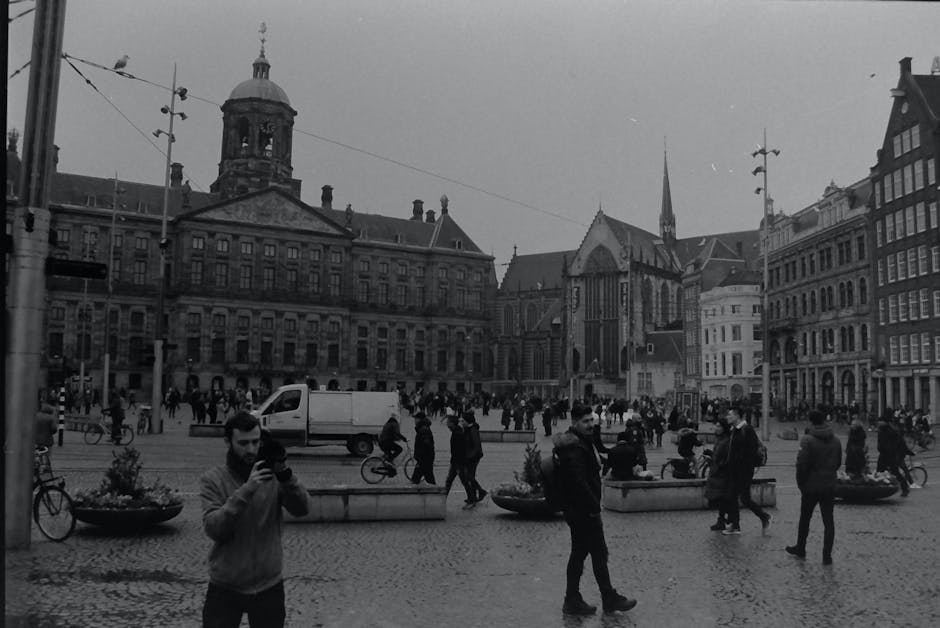
The enormous sandstone block on the west side of Dam Square was never built to be a palace. It went up between 1648 and 1665 as Amsterdam’s city hall, at the exact moment the city was the richest port on earth, and it was designed to say so to anyone arriving by ship. Jacob van Campen gave it a classical front with no grand entrance at all — seven small doors, so that no single citizen could be received more importantly than another. The whole thing stands on 13,659 wooden piles driven into the marsh, a number Dutch schoolchildren still learn. It only became a royal residence in 1808, when Louis Napoleon Bonaparte decided a king needed a palace and simply took the town hall.
Royal Palace Amsterdam tickets cost €13.50, which makes this the best-value historic interior in the city centre and one of the most consistently overlooked. Tens of thousands of people photograph the outside of this building every week and walk straight past the door. Inside is the Citizens’ Hall, a room the size of a church with the known world inlaid in marble across its floor, the largest collection of Empire furniture anywhere, and a marble courtroom where death sentences were read out to a crowd standing where the tourists now stand. The catch is that it closes without much notice for state occasions, so you have to check the calendar before you go. Dam Square itself, we should say plainly, is the least pleasant square in Amsterdam — and the palace on it is one of the best hours you can buy.
Royal Palace Amsterdam at a glance
Checked September 2026 against the palace’s own site.
| Detail | 2026 information |
|---|---|
| Adult ticket | €13.50 |
| Students | €9 |
| Ages 17 and under | Free |
| Audio tour | Included in every ticket |
| Museumkaart | Accepted, free entry |
| ICOM card | Free entry |
| Opening hours | Daily 10:00–18:00 when open |
| Open days per year | Roughly 230 — check the online calendar |
| Time needed | 60–90 minutes |
| Address | Nieuwezijds Voorburgwal 147, on Dam Square |
| From Centraal | 8–10 minutes on foot down Damrak |
| Guided tours | Groups of 10+, €105 weekdays / €135 weekends |
What the building actually is
Understanding this building means forgetting the word palace for twenty minutes. In 1648 the Republic had just won its eighty-year war with Spain, Amsterdam’s merchant fleet dominated world trade, and the old medieval town hall was a fire-damaged embarrassment. The city commissioned a building that would put Amsterdam alongside Rome, and paid for it with the proceeds of an empire that ran on colonial trade and, uncomfortably, on slavery — something the palace’s own audio tour now addresses directly rather than skirting.
For 160 years it was where the city was governed: aldermen, bankruptcy commissioners, the Bank of Amsterdam in the cellars, marriage registrations, and criminal justice. Then in 1808 Louis Napoleon, installed as King of Holland by his brother, moved in, ordered the city government out and shipped in furniture from Paris. He lasted two years. When he fled in 1810 the furniture stayed, which is why the palace holds what is generally reckoned to be the largest and most complete collection of Empire-style furniture in the world — a French emperor’s taste, marooned in a Calvinist town hall.
The Dutch State owns it today and the King uses it for state occasions: New Year receptions, incoming ambassadors, the Erasmus Prize, state banquets for visiting heads of state. Nobody lives here. Between those events, it is open to you for €13.50.
The Citizens’ Hall
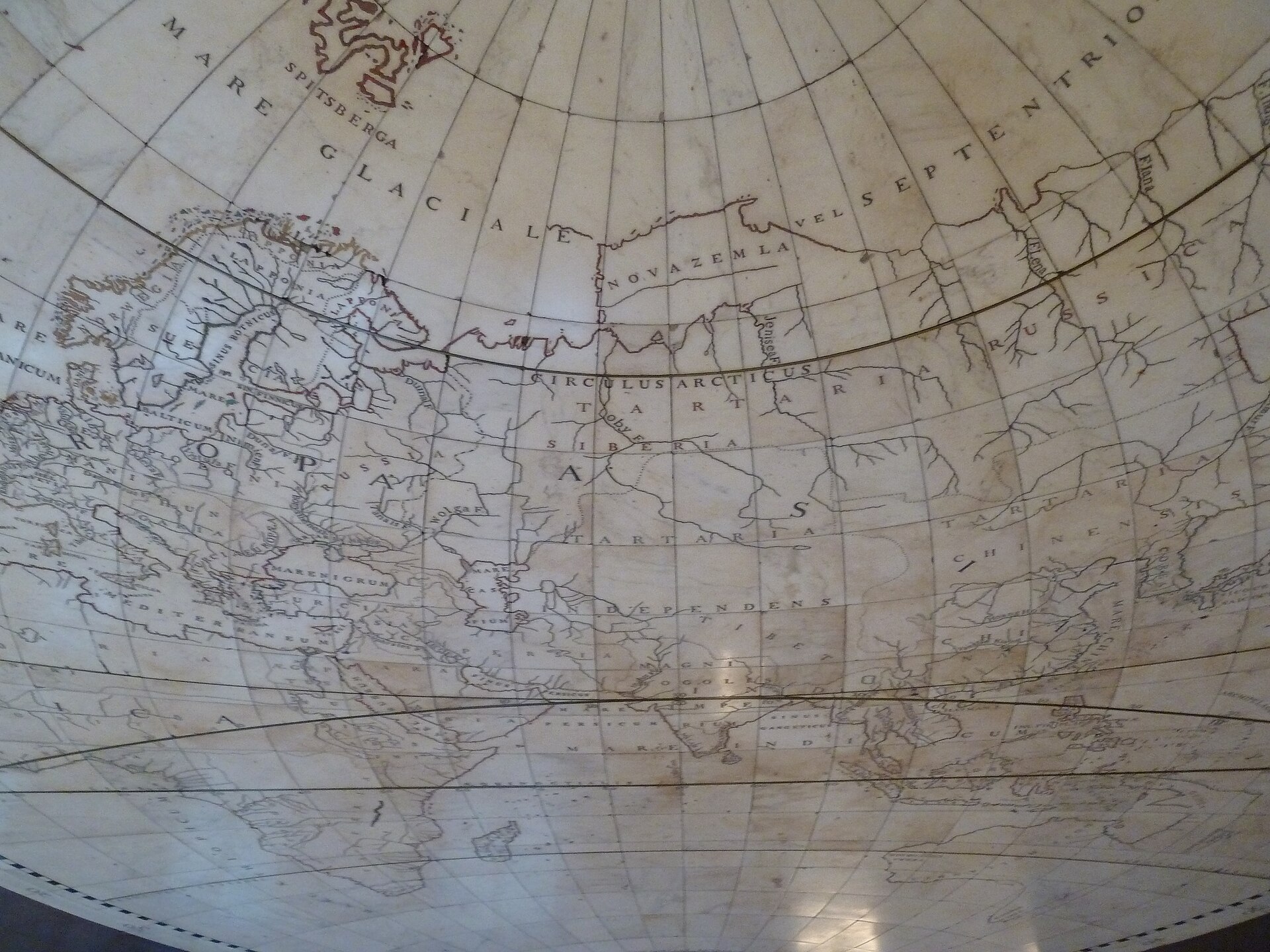
The reason to come. The Burgerzaal is roughly thirty metres long and thirty metres high, finished in white Italian marble, and it was deliberately open to any citizen who wanted to walk in. Set into the floor are three enormous inlaid maps in copper and marble: the eastern and western hemispheres, and between them the northern night sky. Amsterdam put itself at the centre of the universe, in a public room, in stone, and then invited people to walk across it. At the far end, Atlas carries the heavens on his shoulders. The sculptural programme throughout is by Artus Quellinus and his workshop, and it is a coherent argument in marble about justice, commerce and civic virtue, mostly aimed at the officials who worked here.
The Vierschaar
The tribunal, at ground level, faced in white marble and lined with allegorical figures of Justice and Prudence and mourning caryatids. This is where capital sentences were pronounced. Barred openings let the crowd on Dam Square watch and hear the judgement, and the condemned were then taken up to a wooden scaffold erected against the front of the building and executed in front of the same crowd. It is a small, cold, beautiful, genuinely unsettling room, and it changes how the square outside feels for the rest of the day.
The paintings, and the one that is not here
The galleries hold large history paintings by Govert Flinck, Ferdinand Bol and Jan Lievens, painted to draw a line between the Dutch revolt against Spain and the ancient Batavian revolt against Rome. Flinck had the whole commission and died in 1660 before he could start it, so the work was split between the others. Rembrandt was given one lunette — The Conspiracy of the Batavians under Claudius Civilis — and it was installed, taken down within about a year, and never returned. He cut it up; the surviving fragment is in Stockholm. It is the most famous rejection in Dutch art, and the empty space is more interesting than several of the paintings that stayed. Our Rembrandt in Amsterdam guide covers where the rest of his work actually is.
The Empire rooms
The upper rooms are furnished as Louis Napoleon left them: gilt, mahogany, ormolu, clocks, chandeliers, a French emperor’s brother playing at monarchy in a building that was designed to reject monarchy. The clash is the point. If you have any interest in the Dutch Golden Age as a political story rather than a painting style, this is where the story turns.
Tickets, opening days and the one thing that catches people out
Entry is €13.50 for adults and €9 for students, free for anyone 17 or under, and free on a Museumkaart or ICOM card. The audio tour is included and is unusually good — take it, because the rooms do not explain themselves. Opening hours are 10:00 to 18:00.
Here is the catch, and it is the only real complication with this attraction: the palace is a working state building, and it closes for royal and government functions. It manages roughly 230 open days a year, which means it is shut for around a third of them. The calendar on the palace website shows confirmed dates about six months ahead, and dates can change. Check it the week before you travel and again the morning you go. Turning up on spec is the single most common way to be disappointed here, and it is entirely avoidable.
If you hold a Museumkaart the palace is one of the strongest reasons to own one, and if you are working out whether a pass makes sense for your trip, we take the numbers apart in our I amsterdam City Card verdict. Full prices for every major attraction in the city sit on our Amsterdam attractions and tickets guide.
Dam Square: an honest verdict
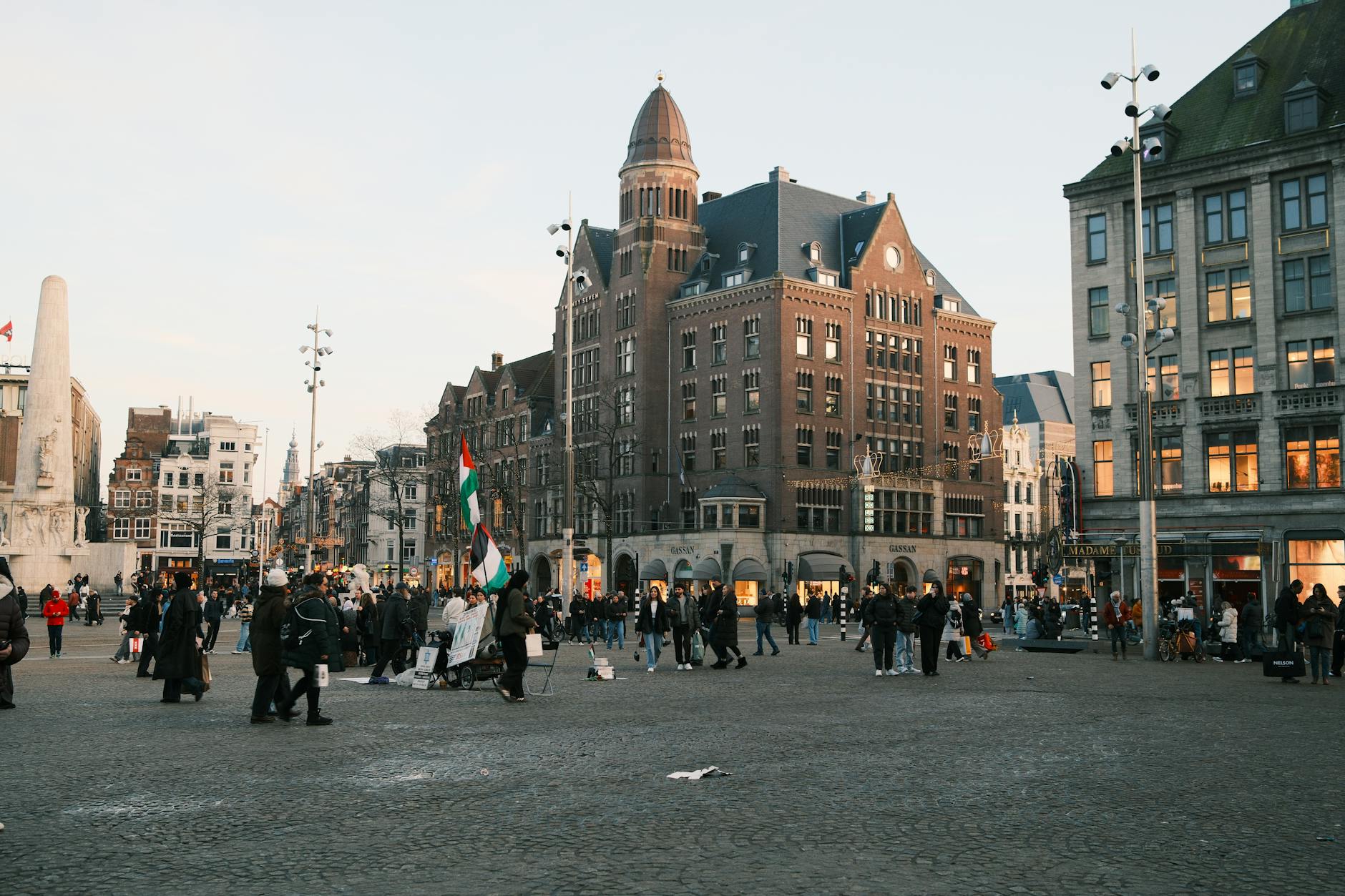
We will not pretend. Dam Square is a large paved rectangle that is busy, loud, covered in pigeons, ringed by chain stores and a wax museum, and worked hard by pickpockets and by street performers with a routine that ends in a hat. In summer a funfair sometimes occupies half of it. It is not a beautiful square in the way Prague’s Old Town Square or Brussels’ Grand-Place are beautiful, and every visitor who has been told it is the heart of Amsterdam arrives with expectations the place cannot meet.
What it is, instead, is the historical centre of gravity of the city and a place with three genuinely important buildings on it. Treat it as a junction with three things worth doing rather than as a destination in itself, and it works. Stand still on it for twenty minutes and you will simply be jostled. For a proper sense of the surrounding streets, our Amsterdam Centrum guide covers what is worth walking to from here.
The National Monument
The 22-metre white obelisk on the east side was unveiled in 1956 as the national memorial to the Dutch dead of the Second World War, designed by the architect J.J.P. Oud with sculpture by John Rädecker. Urns set into the wall behind it hold earth from execution sites in every Dutch province and from the former Dutch East Indies. For most of the year it is where backpackers sit with their bags. On the evening of 4 May it is the most solemn place in the country: the King lays a wreath, the whole nation observes two minutes of silence at 20:00, and Amsterdam — trams, bikes, conversation — genuinely stops. If you are in the city that night, go, stand at the back and say nothing. Our Amsterdam in the Second World War guide puts the monument in context.
De Nieuwe Kerk
The late-Gothic church attached to the palace stopped being a parish church long ago and now runs as an exhibition hall, which confuses people who queue expecting a church visit. It is still where Dutch monarchs are inaugurated — Willem-Alexander in 2013, in this building, not in the palace next door — and where royal weddings happen. Inside are the tomb of Admiral Michiel de Ruyter, a vast seventeenth-century organ and a carved pulpit that took nineteen years to finish.
Pricing follows the exhibition rather than the building. The World Press Photo exhibition, which runs there in most years, carried a €25 adult ticket in summer 2026, dropping back to €20 for the winter show, with 12–17s and students at €15 and €13.50 respectively and under-11s free. Museumkaart, the I amsterdam City Card and Go City all cover entry. Hours are 10:00 to 17:00 with last entry at 16:30, and it closes on royal and national dates including 27 April and 4–5 May. Decide by the exhibition, not by the architecture — if the show does not interest you, the interior alone is not worth €20.
The rest of the square
De Bijenkorf, the flagship Dutch department store, occupies the north-east corner and has a good top-floor food hall and clean toilets, both of which matter more than they should in this part of town. The NH Collection Grand Hotel Krasnapolsky, with its glass-roofed Winter Garden, takes the east side. Madame Tussauds sits above a shopping arcade on the south side, and whether it is worth what it charges is a separate argument.
We have taken that argument apart in full in our Madame Tussauds and Amsterdam Dungeon verdict.
What is not worth your time here
Skip the living statues and the shell game — the second is a straightforward con and is covered in our Amsterdam scams guide. Skip the bird seed. Skip eating anywhere with a photographic menu on Damrak; walk five minutes in any direction and you will eat better for less, as our cheap eats guide shows. And keep your bag in front of you: Dam and Damrak are the densest pickpocket ground in the Netherlands, not because Amsterdam is dangerous but because this is where the crowds stand still. Our safety guide is level-headed about the actual risk.
How to actually spend the time
A workable half-morning, and one that turns a square most people cross in ninety seconds into something worth the walk:
- 09:50 — walk from Centraal down Damrak, ignoring everything on it, and arrive as the palace opens.
- 10:00–11:15 — the palace with the audio tour. Vierschaar first, then the Citizens’ Hall, then the Empire rooms.
- 11:15–11:30 — the National Monument, and read what the urns actually hold.
- 11:30 — decide on De Nieuwe Kerk based on the current exhibition, or walk on.
- 12:00 — leave the square. Head west into the Nine Streets for lunch, or south down Kalverstraat if you want the shopping streets.
This slots neatly into the first morning of our two-day itinerary, and the palace pairs naturally with the Rijksmuseum later in the day: the town hall built the wealth, the museum shows what it bought.
Getting there
Dam Square is an eight to ten minute walk from Centraal, straight down Damrak with no turns. Several tram lines stop at Dam, but from the station the walk is usually faster than the wait, and the tram is only worth it in heavy rain or with luggage — our tram routes guide has the network laid out. Coming from further out, Rokin and Nieuwmarkt metro stations are both a short walk away.
The palace entrance is not on the square itself. It is around the corner on Nieuwezijds Voorburgwal, at the north-west end of the building, which trips up a surprising number of visitors standing hopefully in front of the seven closed doors on the Dam facade. Those doors are ceremonial and always have been.
Do not drive here under any circumstance. The centre is effectively closed to visitor traffic and parking is priced to keep you out; our getting around guide explains the P+R system, which is the only sane option if you have a car.
Is the Royal Palace worth €13.50?
Yes, and it is not close. This is a fraction of what the Rijksmuseum or the Van Gogh Museum charge, for a building of the first rank that is rarely crowded, never sold out, and takes about an hour. If you have any interest in how Amsterdam got rich and what it did with the money, it is the most efficient hour in the city centre.
The cases against it are narrow. If your trip is two days long and entirely about the big art museums, this is a legitimate cut — it is history and architecture rather than paintings. If you are travelling with children under about ten, an hour of marble halls will not hold them, and the family guide has better uses of the morning. And if the calendar says closed, it says closed; there is no queue-jumping a state banquet.
Everyone else: go early, take the audio tour, and give it ninety minutes rather than sixty.
Keep Exploring
- Amsterdam attractions and tickets: every price and booking window
- The Amsterdam Centrum neighbourhood guide
- The Dutch Golden Age in Amsterdam
- An architecture walk through the centre
- Amsterdam’s history, in order
- Amsterdam attractions grouped by area
- King’s Day in Amsterdam
- Free things to do in Amsterdam
- The complete things-to-do guide
Frequently asked questions
How much are Royal Palace Amsterdam tickets?
€13.50 for adults and €9 for students, with free entry for anyone aged 17 or under and for Museumkaart and ICOM holders. The audio tour is included in every ticket.
Does the King live in the Royal Palace?
No. Nobody lives here. The royal family’s working residence is in The Hague; this palace is used for state receptions, awards ceremonies and banquets, and stands empty and open to visitors the rest of the time.
Why is the palace sometimes closed?
Because it is still in official use. It manages roughly 230 open days a year and shuts for state functions, sometimes at short notice. The calendar on the palace website shows dates up to six months ahead — check it before you go, and again on the morning.
How long does a visit take?
Sixty to ninety minutes. There is no route to rush and the audio tour is worth listening to properly; ninety minutes is the better allowance.
Do I need to book in advance?
Not usually. It rarely sells out. Booking online does confirm that the palace is actually open on your date, which is the more useful reason to do it.
Is the Royal Palace the same as De Nieuwe Kerk?
No, they are two separate buildings and two separate tickets, joined at the shoulder on Dam Square. The palace is the sandstone block; the church next to it runs major photography and history exhibitions and is where Dutch kings and queens are inaugurated.
Is Dam Square worth visiting?
As a place to see three specific things — the palace, the National Monument, De Nieuwe Kerk — yes. As a square to sit and enjoy, no. It is crowded, commercial and one of the least attractive public spaces in central Amsterdam. Do what you came for and move on.
Is the palace accessible?
Largely, yes. There is lift access to the main floor and the principal rooms are level, which makes it one of the more accessible historic buildings in the centre. Contact the palace ahead if you need specific arrangements, and see our accessibility guide.
Can you take photographs inside?
Yes, for personal use and without flash or a tripod. The Citizens’ Hall is difficult to photograph well because of its scale and the light from the high windows; the marble floor maps photograph better than the room.
What is the marble floor in the big hall?
Three inlaid maps: the eastern and western hemispheres of the world as it was known in the mid-1600s, and the northern celestial sky between them. They are set into the floor of the Citizens’ Hall so that citizens walked across the known universe on their way to see an official. You are meant to walk on them.
Is there a cafe inside?
There is a small cafe and a shop, but the palace is not a place to plan lunch around. Walk five minutes off the square for anything better than adequate.
What happens on Dam Square on 4 May?
National Remembrance Day. The King lays a wreath at the National Monument and the country observes two minutes of silence at 20:00. The square is closed and extremely full from early evening; if you attend, arrive well before, dress soberly and stay quiet.