
Amsterdam sells more guided experiences per square kilometre than almost any city in Europe. Stand on Damrak for ten minutes and you will be offered a canal cruise, a hop-on hop-off bus, a red light district walk, a bike tour, a beer tasting, a windmill day trip and a boat with a bar on it. Some of these are among the best things you can do here. Some are a way of paying forty euros to be shown things you could have walked to. The difference is not obvious from the pavement, which is why this page exists.
This is our hub for Amsterdam tours: what each kind actually costs in 2026, which ones earn their money, which ones are a straightforward waste, and which are outright banned in the city centre — because several things you will be offered are illegal to run, and a few more are legal but socially loathed. The short version, if you want it now: one canal trip is worth doing, a good walking tour is the best value in the city, a bike tour is better than it sounds if you can already ride, and hop-on hop-off buses make no sense in a city this small. Everything below is the long version, with prices.
Amsterdam tours at a glance
Typical 2026 prices for one adult. Operators vary enormously, so treat these as the range you should expect to pay rather than a quote.
| Type | Typical price | Length | Our verdict |
|---|---|---|---|
| Canal cruise, standard | €16–22 | 1 hour | Do one, once. Worth it. |
| Canal cruise, evening | €30+ | 1–1.5 hours | Better than the daytime version |
| Dinner cruise | €75–95 | 2–3 hours | Pay for the boat or the dinner, not both |
| Free walking tour | Tip, €10–15 pp | 2–2.5 hours | Best value in Amsterdam |
| Paid small-group walk | €25–45 | 2–3 hours | Worth it for a specialist subject |
| Bike tour | €25–35 | 2.5–3 hours | Good, if you can already cycle |
| Hop-on hop-off bus | €18–30 | All day | Skip it. The city is too small. |
| Food tour | €60–95 | 3–4 hours | Expensive, occasionally excellent |
| Self-drive boat | €90–180 per boat | 2–3 hours | The best thing on this list, split between friends |
| Guided day trip | €45–90 | Half or full day | Usually beaten by a train ticket |
| Private guide | €250+ per group | 2–3 hours | Only for a specific need |
Canal cruises and boat trips
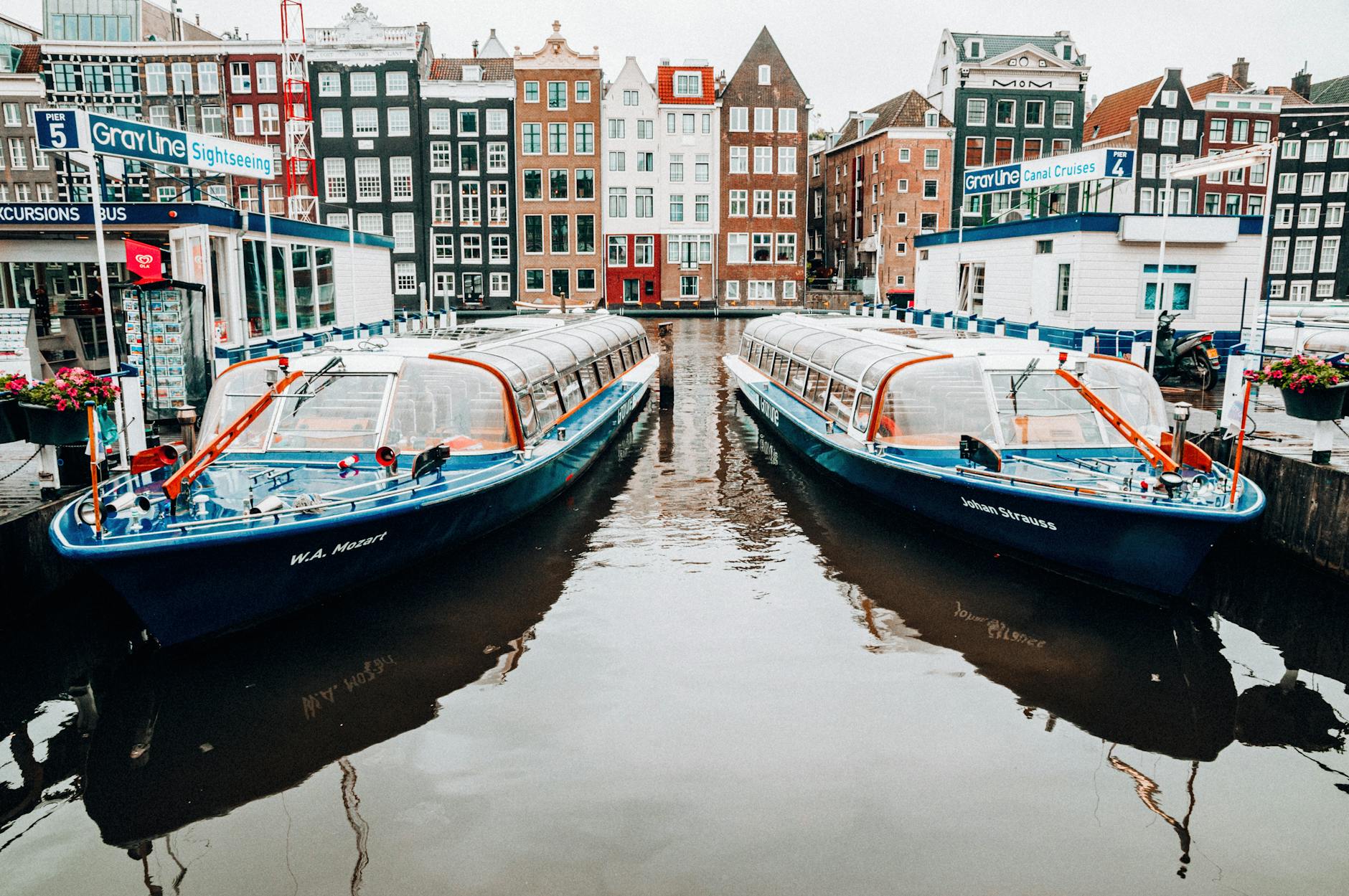
Amsterdam is a city built on water and seeing it from the water genuinely changes it. Bridge heights, gable shapes, the way the canal ring curves, the houseboats, the warehouse hoisting beams — all of it makes more sense from a metre above the waterline than it does from a pavement. If you do exactly one organised thing in Amsterdam, make it a boat.
The standard product is an hour on a glass-topped boat with recorded commentary in eight languages, from €16 to €22 depending on operator, season and how far in advance you book. It is fine. The commentary is bland, the glass reflects, and on a full boat in July you will be photographing the back of someone’s head. It is still worth doing, and we compare the operators properly in our canal cruises compared guide.
Open boats beat glass-topped ones
The single biggest improvement you can make is to book a smaller open or half-open boat with a live guide rather than a recorded loop. They cost a few euros more, carry a dozen people instead of eighty, and go into narrow canals the big boats cannot enter. In cold weather they hand out blankets. The difference in experience is much larger than the difference in price.
Evening is better than afternoon
The bridges are lit, the canal houses have their curtains open — Amsterdam does not do net curtains and looking in is not considered rude — and the crowd on the boat is smaller. Evening cruises run around €30. Between late November and mid-January the Light Festival puts illuminated installations along the route, and cruise tickets for it go on sale in October from about €27.50, with boats running through the evening.
Dinner cruises: pick one thing
€75 to €95 buys you a mediocre three courses eaten slowly while you pass things you cannot see properly because you are eating. Amsterdam has excellent restaurants and good boats. Buying both at once gets you a compromised version of each. Our restaurants by budget guide will spend that €90 better.
Or drive the boat yourself
You can rent a small electric boat and take it out on the canals without a licence. Split between four to eight people it costs less per head than a guided cruise, you choose the route, you bring your own picnic, and it is the single best afternoon available in this city on a sunny day.
Everything you need — operators, prices, the rules and the bits of canal to avoid — is in our Amsterdam boat rental guide.
Walking tours
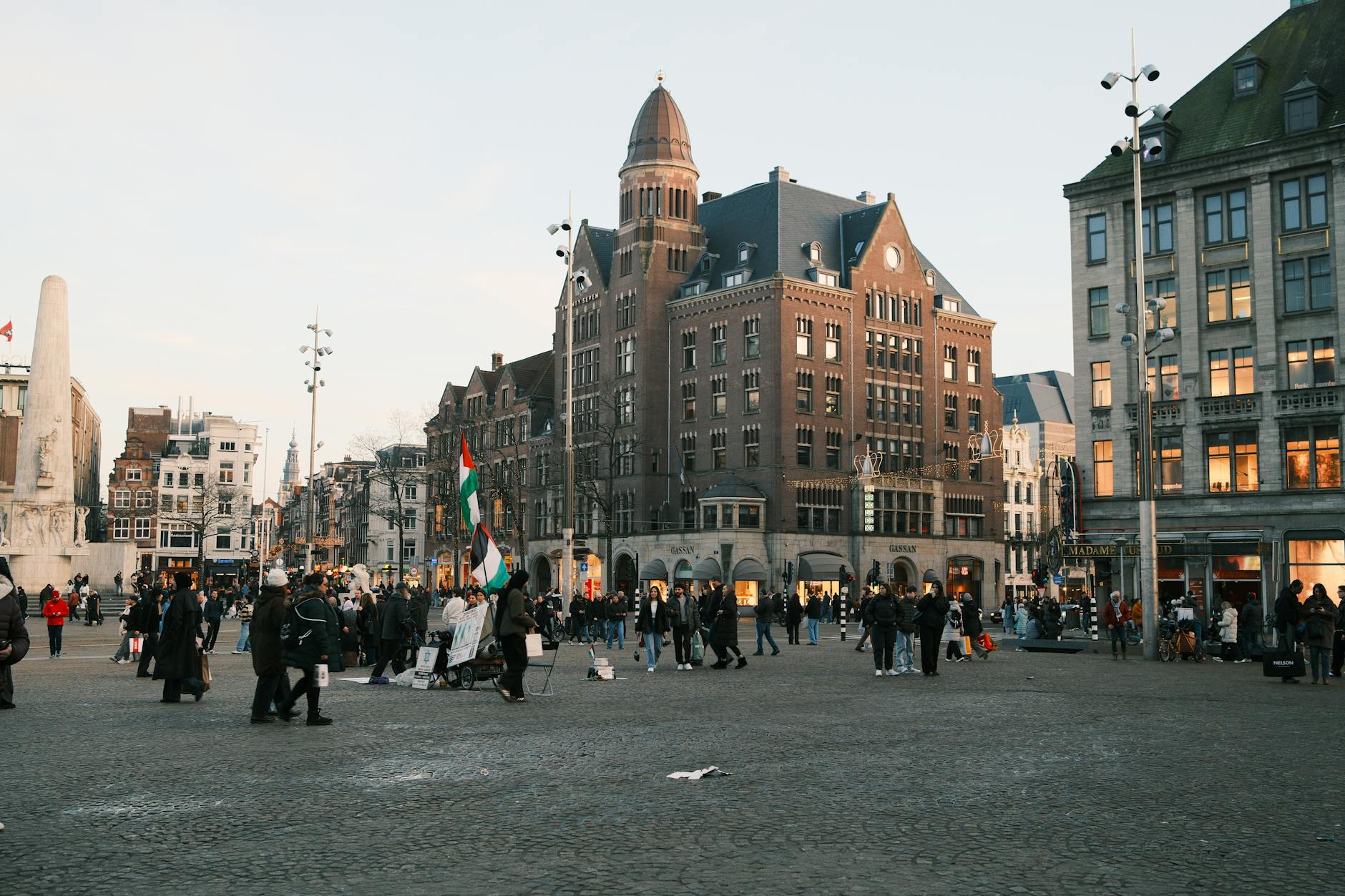
Amsterdam’s centre is roughly two kilometres across, flat, and dense with things that need explaining. It is close to a perfect walking-tour city, and a good guide here does something no audio guide manages: they answer the question you actually have, which is usually not the question the script anticipated.
Free walking tours, and how they really work
Several companies run tip-based tours from Dam Square and other central meeting points, typically two to two and a half hours, no booking fee, join and pay what you think it was worth at the end. It is a genuinely good model and the guides are often excellent, because a guide who is dull does not eat.
Be clear about the economics, though. Guides on these tours generally receive no base pay and in some arrangements pay the company a fee per walker, so a person who takes the tour and slips away at the end has cost the guide money rather than saved themselves some. The going rate in Amsterdam is €10 to €15 per person for a two-and-a-half-hour tour, and that is the number to budget. It is still the best value in the city — two and a half hours of live, adaptable, local explanation for the price of two beers. Just do not treat “free” as literal. Our tipping guide covers Dutch norms more broadly, which are otherwise far more relaxed than this.
Paid walks are for specific subjects
A general-interest paid walk at €30 has to beat a free one, and often does not. Where paid tours win decisively is specialism: Second World War and the occupation, Jewish Amsterdam, the Golden Age and the merchant trade, architecture, the canal ring’s engineering. Small groups, a guide with an actual field, and questions welcomed. For self-guided alternatives on the same subjects, our architecture walk, Jewish heritage guide and Second World War guide cover the ground for nothing.
We name the walks worth booking, free and paid, in our best walking tours in Amsterdam guide.
Bike tours
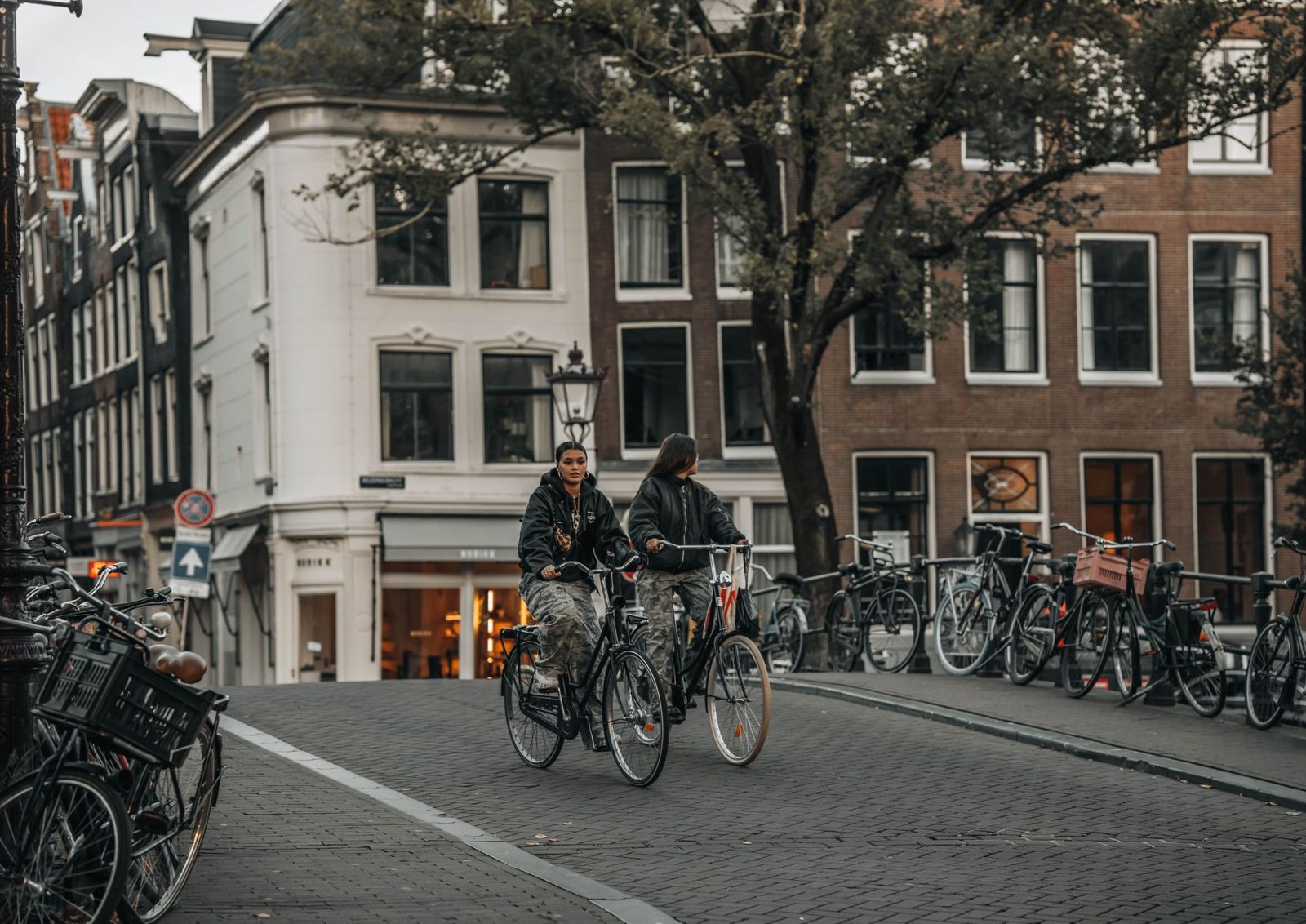
Two and a half to three hours, €25 to €35 including the bike, usually a loop through the canal ring and out to Vondelpark or the eastern docks. Done well it is the most Amsterdam thing on this list, and it covers three times the ground of a walking tour.
The honest warning: Amsterdam is not a beginner’s cycling city. It is a fast, dense, rule-governed system in which locals ride quickly, tourists who wobble are a genuine hazard, and the trams, scooters and bike lanes all interact in ways that take a day to learn. If you have not ridden a bike in ten years, a guided tour is not where you should relearn. If you cycle regularly at home, it is excellent — a guided group is much the least stressful way to start, because the guide takes the junctions for you.
Tours out of the centre — the Waterland countryside north of the IJ, or the polders — are calmer and, for many people, the better ride. If you would rather go alone, our bike rental guide covers hiring, and our Dutch etiquette guide explains the unwritten cycling rules that keep everyone from shouting at you.
Which operators are worth it, and which routes suit which riders, is in our Amsterdam bike tours guide.
Hop-on hop-off buses and boats
Our least favourite product in Amsterdam, and one of the most heavily sold. A hop-on hop-off bus makes sense in Rome, Berlin or London, where the sights are kilometres apart. Amsterdam’s centre is about two kilometres across, most of it is closed or hostile to buses, and the traffic means the bus is frequently slower than walking. You pay €18 to €30 to sit in a vehicle going past things you could reach on foot in twenty minutes.
The boat version is a better idea, because it uses the canals rather than the roads and the canals are the point of the city. It still has the same structural problem: waiting at stops for a boat that comes every twenty to thirty minutes eats an enormous amount of a short trip.
There are two situations where they are defensible — limited mobility, and a single very short stopover where a fixed loop saves all the decisions. Both are real, and both are covered properly, along with the honest comparison between the two versions, in the dedicated guide.
See our hop-on hop-off Amsterdam guide: bus versus boat.
Food and drink tours
€60 to €95 for three or four hours, five or six tastings and a guide. That is a lot of money in a city where you can eat extremely well for €20, and the honest answer is that these are worth it for a specific reason rather than as a default.
The good ones do something you cannot easily do alone: get you into places you would not have found, explain why Dutch food is the way it is, and give you the context behind rijsttafel, herring stalls, stroopwafels made in front of you and the difference between a brown cafe and a bar. The weak ones walk you between three tourist-facing snack counters. Our food tour reviews separate them, and if you would rather do it yourself, our must-try Dutch foods, street food and food markets guides are a free version of the same route.
Beer and jenever tastings are the drink equivalent, and the small-brewery ones are better than the big-name ones — our craft beer guide has the breweries worth visiting, and the Heineken Experience is a separate argument entirely.
Museum tours and skip-the-line tickets
Two different products, sold as if they were one, and this is where visitors lose the most money for the least benefit.
A guided museum tour is a real service. The Rijksmuseum‘s own guided tours, or a private guide for the Van Gogh Museum, will show you ten paintings properly instead of eighty badly, and for a first visit that is often the better experience.
A skip-the-line ticket from a reseller is usually just a ticket with a markup. Amsterdam’s major museums are timed-entry: the Van Gogh Museum admits by slot, the Rijksmuseum wants a start time, and the Anne Frank House sells only through its own site. There is no queue to skip that a normal online ticket does not also skip. Buy from the museum, at the museum’s price. Our attractions and tickets guide lists every current price, and our city passes compared handles the pass question.
Day trips: guided or on your own?
A guided day trip to the windmills, the tulip fields or Bruges runs €45 to €90. The Dutch train network is fast, frequent, cheap and easy, which means the coach tour has to justify itself against a €20 return ticket and a two-hour lie-in.
Sometimes it does. A coach makes sense where the destination is genuinely awkward by public transport, where the tour bundles admission you would pay for anyway, or where you want several places in one day. It rarely makes sense for a single town on a direct line.
- Do it yourself: Haarlem, Rotterdam, Delft, The Hague — all fast and direct by train.
- Consider a tour: Giethoorn, which is a genuine slog independently, and Bruges if you want it done in a day.
- Either works: Zaanse Schans, Volendam and Marken and Keukenhof in tulip season, where a combined coach ticket can genuinely save time.
Our day trips guide has the train times and the honest comparison for each.
Red light district tours: the rules changed
You will still be offered these, and you should know the position. Amsterdam banned guided tours along the windows of De Wallen in 2020, after years of complaints from sex workers about groups of tourists standing and staring at people at work. The ban is enforced, and it exists for a decent reason.
What remains legal, and worthwhile, is a history tour of the oldest part of the city that covers the trade seriously — the regulation, the 2000 legalisation, the Oude Kerk, the guild history, the current politics of the district — without parading you past the windows. If a tour markets itself on the windows themselves, it is either breaking the rules or lying about what it does. Our honest red light district guide and De Wallen guide cover the area, the etiquette and the law.
Tours outside the centre, which are usually the better ones
Almost every tour sold on Damrak stays inside the canal ring, which is where the crowds already are. The tours that consistently surprise people go somewhere else, and they are cheaper because they compete for fewer customers.
Noord. Across the free ferry, the north bank has the old NDSM shipyard, a street-art quarter, waterfront bars in shipping containers and a completely different scale of city. A guided walk or ride here is a genuine contrast rather than a variation. Our Noord guide and free ferry guide mean you can also do it alone for nothing.
De Pijp. Market, food, immigration history, nineteenth-century speculative housing and the best eating in the city. Food tours concentrate here for good reason, and it works as a self-guided walk too — see our De Pijp guide and Albert Cuyp Market guide.
The Jordaan. The classic small-group walking-tour neighbourhood: working-class history, courtyards, the hofjes that most visitors never enter, and enough intimacy that a guide actually matters. Our Jordaan guide covers what to look for.
Oost and the eastern docks. Modern architecture, artificial islands, the old harbour and a bike route that is calm enough to enjoy. This is where bike tours stop being a test of nerve.
The pattern is consistent: the further a tour goes from Dam Square, the more likely it is to be worth the money, and the more likely your guide is to be doing it because they like the subject rather than because it is the fifth loop of the day.
Specialist tours worth knowing about
Beyond the standard categories there is a long tail of tours that never appear on the boards outside the station, and some of them are the best things on offer.
- Architecture by boat. A canal cruise led by someone who can explain gables, hoisting beams, warehouse conversions and why the canal ring is shaped the way it is turns an hour of sightseeing into something you will still be thinking about a week later. Pair it with our canal ring UNESCO story.
- Second World War and resistance walks. Amsterdam lost a higher proportion of its Jewish population than almost any western European city, and the streets carry it — the stumbling stones, the deportation sites, the February strike memorial. A good guide on this subject is worth €40 and more.
- Jenever and brown cafe tastings. Small, cheap, informative and much more Dutch than a beer tour. Jenever is the drink this city actually invented, and most visitors leave without trying it.
- Photography walks. Early morning, small group, someone who knows where the light falls and which bridges are worth standing on before the crowds. Better value than it sounds if you care about the pictures.
- Houseboat and living-on-water tours. A small, specific niche explaining the mooring system, the permits and how 2,500 households actually live on the canals — a good companion to our houseboat stay guide.
- Private guides. From about €250 for two to three hours for the whole group. That is only sensible for a specific need — a family with very different interests, a mobility requirement, a subject nobody runs a public tour on — but for a group of four or five it is not as extravagant per head as the sticker suggests.
Which tours suit which season
Amsterdam’s weather changes what is worth booking more than in most cities, because so much of this list happens outdoors or on water.
Spring is the busiest tour season and the only time Keukenhof and the bulb fields are running, which means coach day trips sell out weeks ahead. Book early or skip them; our tulip season guide has the dates that matter, and our spring guide the rest.
Summer is when open boats and self-drive rentals come into their own, and when the standard cruises are at their most crowded and most expensive. Book boats for the evening rather than the middle of the day, and read our summer guide for the crowd pattern.
Autumn is the quiet sweet spot: walking and bike tours run in comfortable temperatures with far smaller groups, and prices soften. See our autumn guide.
Winter shortens the outdoor list and improves the indoor one. Evening canal cruises during the Light Festival are the strongest winter product in the city, brown-cafe and jenever tours suit the weather, and walking tours are shorter and colder than you expect. Our winter guide and packing list both apply.
Why tours here cost what they do
It is worth understanding the market you are buying in, because it explains both the prices and the rules. Amsterdam has roughly 900,000 residents and receives many times that in visitors, concentrated in a historic centre of a few square kilometres. The city has spent the last decade actively trying to reduce the pressure: capping river cruise berths, restricting new tourist shops, moving events out of the centre, banning the beer bikes, banning window tours, and running a discouragement campaign aimed at a particular kind of visitor.
For the tour market that has two effects. It has squeezed out the cheapest and rowdiest end of the business, which is why the offer you see today is more expensive and better behaved than it was ten years ago. And it has pushed serious operators towards smaller groups, quieter routes and neighbourhoods outside the ring — which happens to be where the good tours are.
It also means the etiquette matters. Groups blocking a bridge, standing in a bike lane or talking loudly on a residential canal at eleven at night are the specific behaviours that generated these rules, and a decent guide will manage the group accordingly. If yours does not, they are part of the problem the city is legislating against. Our etiquette guide and laws guide cover what is expected and what is enforced.
What to avoid outright
- Beer bikes. Banned in the city centre since 2017. Anyone selling you one in the centre is selling something that should not be running.
- Loud party boats. Legal, widely hated, and increasingly restricted. The canals are residential; people are asleep two metres from your speaker. Our stag and hen guide is blunt about what the city now tolerates.
- Street sellers on Damrak. Tickets sold by people approaching you are at best full price and at worst worthless. Buy from the operator. Our scams guide has the rest.
- “Secret” or “hidden” tours at premium prices. Almost always a normal walk with better marketing. Check the itinerary before you pay for mystery.
- Anything promising to skip an Anne Frank House queue. There is no such product. Tickets come from the museum, in timed batches, and no third party has privileged access.
How to choose and book
Five rules that will save you money and a wasted afternoon.
- Book the guide, not the brand. On any tour under twenty people the individual guide is 80 per cent of the experience. Read recent reviews and look for named guides mentioned repeatedly.
- Check the group size. “Small group” means anything from six to forty. If the listing does not state a maximum, assume it is large.
- Book direct where you can. Operators’ own sites are usually the same price or cheaper than the big platforms, and easier to deal with when something changes.
- Book popular tours two to four weeks ahead in season. Small-group walks, self-drive boats on summer weekends and anything during tulip season sell out. Our booking timeline sets out what needs how much notice.
- Read the cancellation terms before the weather forecast. Free cancellation up to 24 hours is standard and worth insisting on in a city with Amsterdam’s rainfall — see our weather by month guide.
Where to book, and where not to
There are four places to buy a tour in Amsterdam and they are not equivalent.
The operator’s own site is almost always the best option. Same price or lower, no platform margin, and if the weather turns or your flight slips you are dealing with the people who actually run the tour rather than a support queue in another country. For small operators — the ones running the tours worth taking — the difference in service is substantial.
The big booking platforms are useful for one thing: finding out what exists and reading a volume of recent reviews. Use them for research, then check whether the operator sells direct. Where a platform genuinely helps is flexible cancellation and payment protection, which some small operators do not match.
Your hotel desk is fine for the big commodity products — a standard canal cruise, a coach day trip — and is usually selling the same tickets at the same price on commission. It is not where you will find the small specialist walks.
People on the street are the one to avoid. Ticket sellers approaching you on Damrak, around Centraal or on Dam Square are at best charging full price for something cheaper online and at worst selling you nothing at all. No legitimate operator in this city needs to solicit on a pavement. Our scams guide covers the variants.
One more thing worth doing before you pay: check the meeting point on a map. A surprising number of tours meet somewhere that takes twenty-five minutes to reach from where you are staying, and a tour you arrive at flustered and late is a tour you will not enjoy. Our public transport guide will tell you how long it really takes.
Accessibility, children and older travellers
Tour suitability varies far more than the listings admit. Canal boats differ enormously: some have step-free boarding and space for a wheelchair, many are reached by a steep gangway and a drop into a low cabin. Ask the operator directly rather than trusting a website icon, and see our accessibility guide.
For children, boats work and walking tours generally do not — two and a half hours of standing and listening is a long time at eight years old. Bike tours have minimum ages and usually offer child seats or tandem attachments. Our Amsterdam with kids guide has the alternatives, and our guide for older travellers covers pace and seating.
What we would actually book
If you have two days: one open-boat canal cruise with a live guide, and one free walking tour on your first morning to get your bearings. Total, about €35 a head. Nothing else.
If you have four days: add a specialist walk on a subject you care about, and a self-drive boat if the weather is good and there are four of you. If you cycle at home, swap the specialist walk for a Waterland bike tour out into the countryside.
If you have a week: all of the above, plus one day trip — by train, not by coach, unless you are going somewhere genuinely awkward. Spend the rest of the money on the museums and on eating well. Amsterdam rewards wandering more than it rewards being shown around, and after your first day you will not need a guide to find anything.
Keep Exploring
- Amsterdam canal cruises compared
- Amsterdam food tour reviews
- Renting a bike in Amsterdam
- Day trips from Amsterdam
- Amsterdam attractions and tickets
- Amsterdam city passes compared
- The complete things-to-do guide
- First-time mistakes to avoid
- The three-day Amsterdam itinerary
- Amsterdam pub crawls and bar tours
Frequently asked questions
Which Amsterdam tours are actually worth it?
A canal trip, ideally on a small open boat with a live guide, and a walking tour on your first morning. Those two cover most of what a visitor needs. Self-drive boat rental is the best of the lot if you have a group and decent weather.
How much do Amsterdam tours cost?
A standard canal cruise is €16 to €22, a bike tour €25 to €35, a paid walking tour €25 to €45, a food tour €60 to €95, and a private guide €250 or more for a group. Free walking tours run on tips, and €10 to €15 per person is the going rate.
Are free walking tours really free?
To join, yes. Guides are usually paid only in tips and sometimes pay the company per walker, so the expectation is real: budget €10 to €15 a head for a two-and-a-half-hour tour. It is still the best value in the city.
Is the hop-on hop-off bus worth it in Amsterdam?
For most visitors, no. The centre is two kilometres across, much of it is closed to buses, and traffic makes the bus slower than walking. It is defensible only for limited mobility or a very short stopover.
Should I do a canal cruise during the day or in the evening?
Evening, if you only do one. The bridges are lit, the boats are quieter, and the canal houses are visible through open curtains. Expect to pay around €30 rather than €18.
Can I rent a boat without a licence?
Yes. Small electric boats can be rented and driven without a licence, and split between a group they cost less per head than a guided cruise. There are rules about alcohol, speed and which canals you can use.
Are red light district tours banned?
Guided tours along the windows were banned in 2020 and the ban is enforced. History tours of the district that do not parade groups past sex workers are still legal and still worth taking.
Are beer bikes allowed?
Not in the city centre. They have been banned there since 2017. If someone offers you one in the centre, they are selling something that should not be operating.
Do I need to book tours in advance?
In season, yes, for anything small-group: two to four weeks ahead for popular walks, self-drive boats and anything in tulip season. Large canal cruises and buses can be bought on the day.
Are guided day trips better than going by train?
Usually not. Dutch trains are fast, frequent and cheap, and most day-trip towns are on direct lines. Coaches earn their price for awkward destinations like Giethoorn, or when you want several stops in one day.
Are skip-the-line tickets worth paying extra for?
No. Amsterdam’s major museums are timed-entry, so a normal online ticket already gets you in at your slot. Resold “skip the line” tickets are generally the same ticket with a markup.
What is the best tour for a first-time visitor?
A free or small-group walking tour on your first morning, followed by a canal cruise on your first evening. You will understand the layout of the city by lunchtime on day one, which makes everything after it easier.
Are tours suitable for wheelchair users?
It varies enormously and the listings are unreliable. Some canal boats board step-free and some do not; ask the operator directly before booking rather than relying on a website symbol.
Is it better to book direct or through a platform?
Direct, in almost every case. The price is the same or lower, and when something changes you are dealing with the people running the tour. Use the big platforms to find out what exists and to read recent reviews, then book with the operator.
Should I buy a tour from someone on the street?
No. Sellers approaching you on Damrak, Dam Square or outside Centraal are at best charging full price for something cheaper online. No legitimate Amsterdam operator needs to solicit on a pavement.
Do tours run in the rain?
Yes, almost all of them, and Amsterdam gets rain in every month of the year. Boats are covered or hand out blankets, walking and bike tours go ahead regardless. Check the cancellation terms when you book: free cancellation up to 24 hours ahead is the standard worth insisting on.
How far ahead do self-drive boats book up?
On summer weekends and warm evenings, weeks. It is the one thing on this list where availability rather than price is the constraint, so book as soon as you know your dates and the forecast.