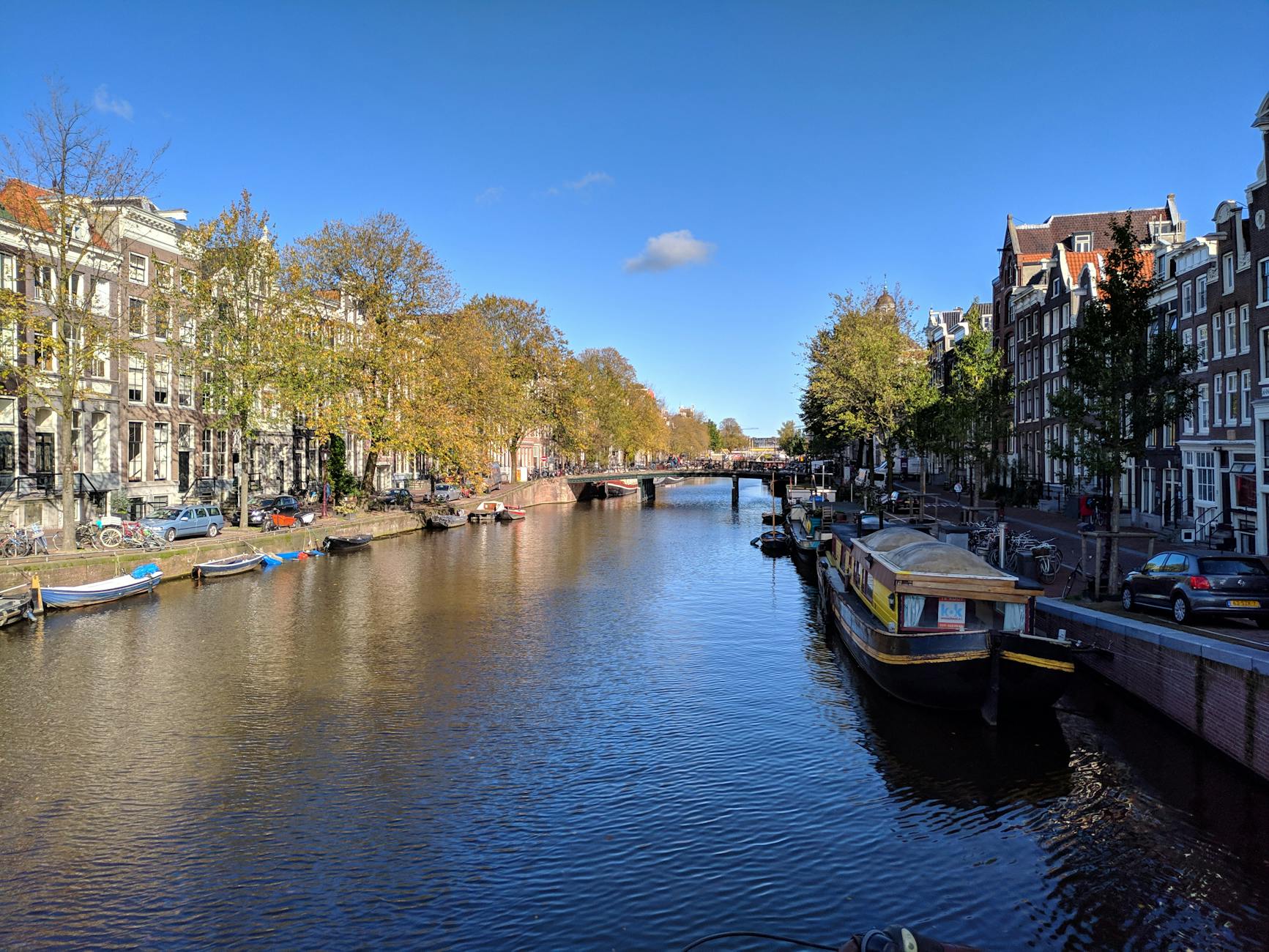
Amsterdam is close to the ideal walking-tour city. The centre is about two kilometres across and completely flat. It is dense with things that need explaining and that explain nothing about themselves: why the houses lean forward, why there are hooks at the top of them, why the canals are in that particular order, why a church is hidden in someone’s attic, why a third of the buildings on one street have a different door height from the ones opposite. And it has a large pool of guides who mostly live here and mostly like the place, which is not true everywhere.
The result is that a good Amsterdam walking tour is the best value in the city, paid or unpaid. Two and a half hours with a competent guide on your first morning will change the rest of your trip, because you will stop navigating and start noticing. This page covers the free tip-based tours honestly — including how the money actually works, which the word “free” obscures — the paid specialist walks that are worth €30 or more, when a private guide makes sense, and how to tell a good listing from a bad one before you pay.
Walking tours at a glance
Typical 2026 rates. Individual operators vary, and the tip figures are what guides in this city actually expect rather than a suggestion we invented.
| Type | Cost | Length | Group size |
|---|---|---|---|
| Free, tip-based | €12–15 per person | 2–2.5 hours | 15–35 |
| Paid general walk | €25–35 | 2–3 hours | 8–20 |
| Specialist / themed | €30–45 | 2.5–3 hours | 6–15 |
| Food walk | €60–95 | 3–4 hours | 6–12 |
| Private guide | From about €250 per group | 2–3 hours | Yours |
| Self-guided | Free | Your call | One |
Free walking tours: how they actually work
Several companies run tip-based tours here. The best known is the international operator that popularised the format, alongside a couple of Amsterdam-specific outfits and a neighbourhood tour based in the Jordaan, plus the peer-to-peer platforms where individual guides list their own walks. Most meet on or beside Dam Square or in front of Centraal, most run two to two and a half hours, and most go two or three times a day — typically a mid-morning, an early-afternoon and a late-afternoon departure.
The money, stated plainly
The tour is free to join. It is not free to run. Guides on this model generally receive no salary, are paid entirely in tips, and under some arrangements pay the company a fee for every person who walks with them. That last detail is the one worth knowing: a person who joins, enjoys it and slips away at the end has not saved €15, they have cost the guide money.
The going rate in Amsterdam is €12 to €15 per person for a two-and-a-half-hour tour. That is the number the guides themselves quote, and it reflects a city with a high cost of living. Two people rounding up to €30 is normal and appreciated rather than lavish. If a guide was genuinely poor, pay less — that is the point of the model — but pay something. Dutch tipping is otherwise very relaxed, as our money and tipping guide explains; this is the one context where a specific expectation exists.
Even at €15, it remains the best-value organised thing in Amsterdam. Compare it to €27.50 for a hop-on hop-off ticket that shows you the ring roads.
What the standard route covers
The classic circuit is broadly the same across operators, and it is a genuinely well-designed two and a half hours: Dam Square and the Royal Palace, the oldest part of the city and the edge of De Wallen, the Oude Kerk, a stretch of the canal ring, the Jordaan, the Westerkerk and the outside of the Anne Frank House, usually with a pass through the Jewish quarter or the Begijnhof depending on the guide.
Along the way you get the standard set-pieces: why the houses lean, what the hoisting beams are for, how the canal ring was planned and financed, the tolerance arrangements, the drug policy explained accurately rather than as a punchline, and the Second World War. A good guide will hang all of that on the buildings in front of you, which is exactly what a book cannot do.
The three catches
- Group size. Free tours can run to thirty-five people in high season. At the back of a group that size you will hear about two thirds of it. Arrive early and stand near the front, or book a paid small-group walk instead.
- The red light district. Guided tours along the windows were banned in 2020. Free tours now skirt the district and talk about it from the edge, which is the correct and legal approach. Any tour promising to walk you past the windows is either misleading you or breaking the rules.
- Booking still matters. Most free tours ask you to reserve a place even though there is no charge, and popular slots fill in summer. Turning up unbooked on a July morning does not always work.

Five things a good guide will explain
If you want to judge a tour while you are on it, these are the standard questions, and how well they are answered tells you what kind of guide you have.
- Why the houses lean forward. Deliberately, most of them. Staircases in an Amsterdam canal house are near-vertical, so furniture goes in through the windows, hauled up on a rope. A forward tilt keeps the load off the facade on the way up. The hook at the top of the gable is the pulley point, and most are still in use on moving day.
- Why the houses are narrow. Frontage was the scarce commodity on a planned canal, and plots were sold and taxed by width, so buildings went deep and tall instead. That is the entire shape of central Amsterdam explained in one sentence.
- What the gables date. Step gables are the oldest, then neck and bell gables, then the flat cornices of the eighteenth century. Learn three shapes and you can date half the street.
- Why the canals are in that order. Herengracht, Keizersgracht, Prinsengracht — gentlemen, emperor, prince — dug as a single planned expansion from 1613 onwards, with the grandest plots on the inner ring and the working canals and the Jordaan outside them. Amsterdam’s class structure is legible as a set of concentric semicircles.
- What the hofjes are. Almshouse courtyards founded by wealthy citizens, hidden behind plain street doors all over the Jordaan, several of them still occupied and quietly open to visitors who behave. A guide who knows which doors you can push is worth the whole tip on their own.
A guide who can answer all five, and who tells you where the money for the canal ring came from rather than skirting it, is a good guide. One who has only anecdotes about bicycles in canals is not.
Paid walks: what is worth €30 or more
A paid general-interest walk has to beat a free one, and often does not. Where paid tours win decisively is subject expertise and group size. Eight people with a guide who has an actual field is a different product from thirty with a generalist, and these are the categories where the difference shows.
Second World War, the occupation and Jewish Amsterdam
The strongest paid category in the city. Amsterdam lost a higher proportion of its Jewish population than almost any city in western Europe, and the evidence is in the streets: the brass stumbling stones outside front doors, the deportation sites, the Hollandsche Schouwburg, the site of the February 1941 strike, the emptied streets of the old Jewish quarter. A guide who knows this material is worth €40 and takes the visit far beyond the Anne Frank House. Our Second World War guide and Jewish Cultural Quarter guide cover the ground if you would rather walk it alone.
The Golden Age and the canal ring
How a marsh became the richest port on earth, what the canal ring was actually for, how the plots were sold, what the tax on frontage did to the shape of the houses, and where the money came from — including the parts that are uncomfortable. A good guide will not skip the colonial trade or the slave trade, and the ones who do are giving you a worse tour as well as a dishonest one. Pair it with our Dutch Golden Age guide and the canal ring UNESCO story.

Architecture
Gables, from step to neck to bell to spout, and what each one dates a house to. The Amsterdam School’s brick expressionism in the south. The modern housing on the eastern islands. This is a subject where knowing three things transforms an ordinary street, and a two-hour walk gives you all three. Our architecture walking guide is the free self-guided version.
The red light district, done properly
Since the 2020 ban on window tours, what remains — and it is better — is a history walk covering the oldest part of the city, the guild era, the 2000 legalisation, how the current regulation works, what sex workers themselves say about the tourism, and the politics of the district’s future. Booked with a serious operator this is a genuinely informative two hours. Our honest red light district guide takes the same approach.
Neighbourhood walks
The Jordaan is the classic: working-class history, the courtyards, the hofjes that most visitors walk past without knowing they can enter. De Pijp covers immigration, the market and nineteenth-century speculative housing. Noord and the NDSM wharf give you post-industrial Amsterdam and a free ferry ride. All three are cheaper than the centre walks and less crowded.
Food walks
A different product at a different price — €60 to €95 for three or four hours with tastings. Sometimes excellent, sometimes three snack counters and a stroll. We separate them in our food tour reviews.
Private guides
From roughly €250 for two to three hours, for the whole group rather than per person. That sounds enormous and for two people it is. For five it is €50 a head, which is in the range of a good paid walk with a great deal more flexibility.
Private makes sense in four situations: a family with wildly different interests, a mobility requirement that needs the pace and route adapted, a subject nobody runs a public tour on, and a very short trip where you want everything compressed into one expert afternoon. Otherwise a small-group specialist walk gets you most of the value for a fifth of the money.
Or walk it yourself, for nothing
Amsterdam is unusually good for self-guided walking, because it is small, safe and impossible to get seriously lost in — the canals are concentric, so if you keep crossing them you are going in or out of the centre. Three routes we would actually recommend:
- The canal ring loop. Herengracht, Keizersgracht, Prinsengracht, out along one and back along another, with a detour into the Nine Streets. About two hours with stops.
- The hidden churches walk. Our Our Lord in the Attic and Begijnhof guide lays out a morning covering four centuries for €18.
- Noord. The free ferry across the IJ and a wander round the old shipyard — see our free ferry guide.
Our free things to do guide has more, and our hidden gems guide is essentially a self-guided walk in list form.
How to pick a good one
- Book the guide, not the company. On a walk of under twenty people the individual guide is most of the experience. Read recent reviews and look for the same names praised repeatedly.
- Check the stated maximum group size. “Small group” is a marketing term with no fixed meaning. If a listing does not give a number, assume it is large.
- Check the language. Multilingual tours where the guide repeats everything twice halve the content. Book a single-language departure.
- Look at the itinerary, not the adjectives. “Secret”, “hidden” and “off the beaten path” usually describe the marketing rather than the route. A listed street-by-street itinerary is a good sign.
- Check the meeting point on a map. A twenty-five minute journey to a 10:00 start is a bad beginning. Our transport guide gives you real journey times.
- Book direct where you can. Operators’ own sites are usually the same price and better to deal with when plans change.
Practicalities
Weather. Amsterdam gets rain in every month. Tours run anyway. Bring a hood rather than an umbrella — umbrellas in a group of thirty on a narrow canal path are a menace — and read our packing list before you assume you have the right coat.
Footwear. Cobbles, brick paving and humpback bridges for two and a half hours. This is not the day for new shoes.
Bike lanes. The single most important thing to understand on any Amsterdam walking tour. Groups stopping in a bike lane are the main reason locals resent tours, and the cyclists will not slow down. Look before you step back to photograph something. Our etiquette guide covers the rest.
Accessibility. The centre is flat, which helps, but it is also cobbled and crossed by stepped bridges. Many operators will adapt a route on request; ask before booking and see our accessibility guide.
Children. Two and a half hours of standing and listening is a lot at eight years old. Family-specific walks exist and are shorter; otherwise our Amsterdam with kids guide has better uses of the morning.
Toilets. Amsterdam is poorly supplied and most public options cost 50 cents to a euro. Go before you start; a tour will not wait comfortably.
When to go, and when not to
Timing changes a walking tour more than the operator does.
Take the earliest departure. Mid-morning tours are the fullest, the streets are busiest, and the guide spends half their energy keeping thirty people together on a bridge. An early start gets a smaller group and a quieter city, and you still have the whole afternoon.
Go on your first morning. A walking tour on your last day is a nice afternoon. On your first it changes everything that follows, because you will spend the rest of the trip recognising things. This is the single most common piece of advice we give, and the most commonly ignored.
Autumn and winter are underrated. Groups are a third of the size, guides are less worn down, and the light on the canals between October and December is the best of the year. You will be cold. It is worth it — see our autumn guide and winter guide.
Avoid King’s Day and the peak of tulip season for a general tour. On 27 April the centre is an enormous street party and no tour will function; in late April the crowd density makes standing and listening genuinely unpleasant. Our festivals and events calendar has the dates to plan around.
What we would book
On a two-day trip: one free tour on your first morning, at the earliest departure, and nothing else. Budget €15 a head. You will spend the remaining day and a half navigating a city you understand rather than one you are guessing at.
On a four-day trip: the free tour on day one, and one paid specialist walk later — Second World War, the Golden Age or architecture, whichever you care about most. Around €50 a head in total, and better spent than almost anything else on the list.
On a week: add a neighbourhood walk outside the centre, which will be cheaper, quieter and more interesting than a third tour of the canal ring. Then stop booking and walk on your own; by then you will not need anyone.
If you would rather cover more ground, a guided ride does three times the distance — see our Amsterdam bike tours guide.
And for a group of four on a good day, driving your own boat beats any walk in the city — our Amsterdam boat rental guide has the details.
Keep Exploring
- Amsterdam tours and experiences: the full guide
- The self-guided architecture walk
- Amsterdam food tour reviews
- The Jordaan neighbourhood guide
- The Jewish Cultural Quarter
- Hidden gems in Amsterdam
- Free things to do in Amsterdam
- The two-day Amsterdam itinerary
Frequently asked questions
Is an Amsterdam walking tour worth it?
Yes, and it is the best value organised activity in the city. Two and a half hours on your first morning will make the rest of your trip easier, because you stop navigating and start noticing. Do it early rather than on your last day.
How much should I tip on a free walking tour in Amsterdam?
€12 to €15 per person for a two-and-a-half-hour tour is the going rate, and guides here quote it themselves. Two people rounding up to €30 is normal. Guides are usually paid only in tips and sometimes pay a fee per walker, so the expectation is real.
Are free walking tours actually free?
Free to join, not free to run. There is no charge at the start and no obligation to pay a set amount, but the model assumes you will tip at the end, and the guide’s income depends entirely on it.
Do I need to book a free walking tour?
Usually yes, even though there is no charge. Popular departures fill in summer and most operators ask you to reserve. Turning up unbooked works out of season and can fail in July.
How long are Amsterdam walking tours?
Free tours run two to two and a half hours. Paid walks are two to three. Food walks are three to four. All of them involve standing on cobbles for most of that, so dress and shoe accordingly.
Are red light district walking tours banned?
Guided tours along the windows were banned in 2020 and the ban is enforced. History walks covering the district from its edges are legal, and are the better product anyway.
What is the best walking tour for a first-time visitor?
A general free or small-group tour on your first morning, covering Dam Square, the old centre, the canal ring and the Jordaan. Save the specialist walks for a second or third day, once you have the map in your head.
Are paid walking tours better than free ones?
Not automatically. A paid general tour has to beat a free one and often does not. Paid tours win clearly on specialist subjects and small group sizes, which is what you should be buying rather than a generic upgrade.
Are walking tours suitable for children?
From about ten upwards for a standard tour, and even then two and a half hours is a stretch. Shorter family-oriented walks exist, and a canal boat holds younger children far better.
What should I wear?
Comfortable worn-in shoes, a waterproof with a hood rather than an umbrella, and a layer more than you think. Amsterdam is windy and the canals funnel it.
Do tours run in winter?
Yes, all year, often with fewer departures and much smaller groups — which makes winter one of the better times to take one, provided you are dressed for it.
How big are the groups?
Free tours run from fifteen to thirty-five people depending on the season, and at the back of a large one you will miss a fair amount. Paid walks are typically eight to twenty and specialist ones six to fifteen. If a listing does not state a maximum, assume the higher end.
Can I join a walking tour on the day?
Often, outside summer. From roughly May to September the popular free departures fill and paid small-group walks sell out days ahead. Book when you know your dates, and arrive ten minutes early either way.
Is it rude to leave a tour early?
No, and guides expect it — people have museum slots and tired children. Do it quietly between stops rather than mid-explanation, and on a tip-based tour, pay the guide before you go.
Can a guide get me into the Anne Frank House?
No. Tickets come only from the museum, in timed batches released online, and no tour operator has privileged access. Walks will show you the building from outside and put it in context, which is worth doing either way.