Amsterdam Centrum is the historic heart of the city — the area inside the canal belt where Amsterdam began in the 13th century. This compact 1-square-kilometre district packs in Dam Square, the Royal Palace, Centraal Station, the Red Light District, the Nine Streets, Spui, Nieuwmarkt, plus the major shopping streets. It’s where most first-time visitors stay, and where you’ll spend a meaningful chunk of your trip. This guide covers every part of the Centrum, what to see, where to eat, where to stay, and how to handle the crowds.

Centrum at a Glance
- What it is: Amsterdam’s historic core — inside the canal ring (Singel to the west and east of the canal belt).
- Size: Roughly 1.5 km north-south by 1 km east-west.
- Major landmarks: Dam Square, Royal Palace, Centraal Station, Begijnhof, Bloemenmarkt, Nieuwmarkt, Red Light District, Nine Streets.
- Best for: First-time visitors; short visits; landmark sightseeing; nightlife.
- Atmosphere: Busy and touristy in the centre; quieter in the side streets and the early morning.
- Walking: 25-30 minutes to cross north-south on foot; everything within 15 minutes.
Sub-Areas of Centrum

- Dam Square & Royal Palace: the medieval heart.
- Damrak / Centraal Station: the main tourist axis from the station to Dam.
- Red Light District (De Wallen): medieval district east of Damrak.
- Nieuwmarkt: small square with the Waag castle; restaurants and bars.
- Spui & Begijnhof: bookish corner with the famous Begijnhof courtyard.
- The Nine Streets (De 9 Straatjes): charming canal-side shopping district.
- Singel & Bloemenmarkt: the floating flower market.
- Rembrandtplein: nightlife square.
- Leidseplein: theatres, restaurants, nightlife.
- Rokin & Kalverstraat: main north-south shopping streets.
Dam Square & Royal Palace
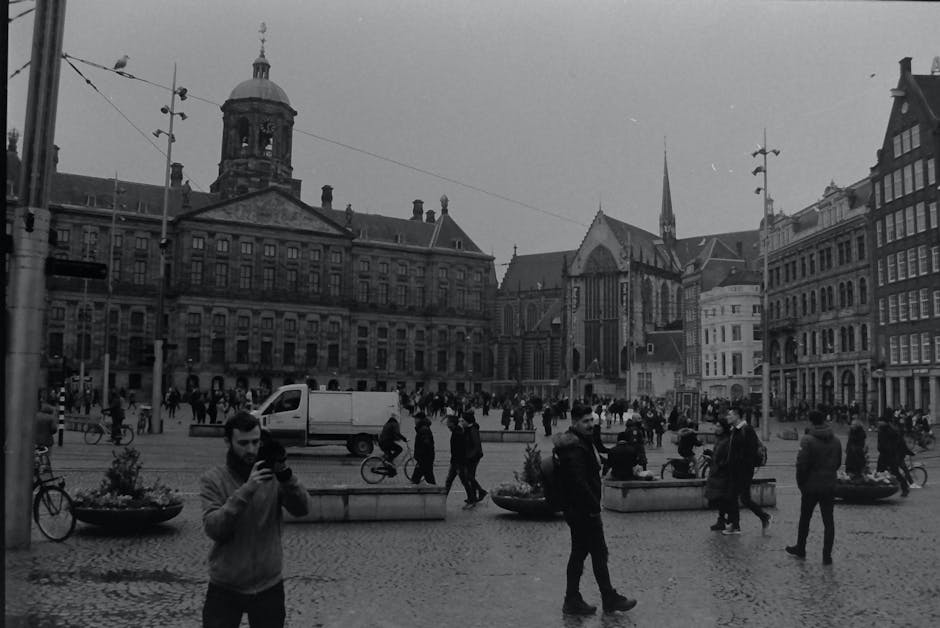
Dam Square is where Amsterdam was founded — built on the original dam across the Amstel river in the 13th century. The square is dominated by the Royal Palace Amsterdam (1665), the working palace of the Dutch monarchy when in town, and beside it the Nieuwe Kerk (15th century) where Dutch kings and queens are inaugurated. Across the square, the white obelisk is the National Monument (1956), commemorating WW2 victims; the Dutch hold annual Remembrance Day ceremonies here on 4 May.
- Royal Palace: open most days; €12. The interior is grand — book online.
- Nieuwe Kerk: usually hosts art exhibitions; €13 typical.
- Madame Tussauds: on the corner of the square — €25.
- Ripley’s Believe It or Not: also on Dam; €22.
- De Bijenkorf: Amsterdam’s most upscale department store — Dior, Gucci, Burberry; lovely top-floor Brasserie.
Centraal Station & Damrak
Amsterdam Centraal (1889) is the country’s busiest station and one of Europe’s most beautiful. Behind it is the IJ waterfront with free ferries to Noord. South of Centraal, Damrak is the half-kilometre boulevard linking the station to Dam Square — touristy, lined with souvenir shops, fast-food spots, and the city’s most overpriced restaurants. Stick to the side streets for better food and prices. The historic Beurs van Berlage (the 1903 stock exchange building) sits on Damrak — now an event venue.
Red Light District (De Wallen)
Amsterdam’s most-visited and most-photographed neighbourhood — for better or worse. The district covers a few blocks east of Damrak, centred on the Oude Kerk (Old Church, 1306). By day: charming canals, old houses, normal cafés. By night: red-lit windows, sex shops, party crowds. The city has tightened rules since 2023: no public alcohol, no street smoking, no large guided tours after 19:00, no "sex shows" promotion in the area. Treat it with respect — these are real working windows, photography of sex workers is forbidden, and the area is increasingly residential.
See our Red Light District guide.
Nieuwmarkt
Charming square on the eastern edge of Centrum. The Waag, a 15th-century gatehouse turned restaurant, sits in the middle — Rembrandt painted his famous anatomy lesson here. Surrounding the square: Asian eateries (Centrum’s Chinatown is just south), cafés, and one of the city’s loveliest farmers’ markets on Saturdays. Less touristy than Dam Square. The area connects to Zeedijk (Café ‘t Mandje and historic gay bars) and the Red Light District.
Spui & Begijnhof
Spui is Amsterdam’s intellectual heart — the city’s biggest bookstores (Athenaeum, the American Book Center), beautiful old university buildings, and the famous Friday book market (Mar-Dec). Tucked behind it is the Begijnhof, a 14th-century courtyard of houses originally built for a community of Catholic women. Enter through the unassuming arch off Spui — inside, a quiet green courtyard with the oldest wooden house in Amsterdam (1420), England’s Reformed Church, and the hidden Catholic Chapel. Free, atmospheric, a hidden gem.
Bloemenmarkt & Munttoren
The famous floating flower market stretches along the Singel canal from Koningsplein to Muntplein. Founded 1862, it’s been on barges ever since. Today it’s more tulip bulbs and souvenirs than fresh flowers, but still beautiful for a quick stroll. The Munttoren (Mint Tower, 1480) at the eastern end is one of the city’s oldest landmarks. From here you’re 5 minutes to the Bloemenmarkt and to Rembrandtplein.
Shopping in Centrum

- Kalverstraat: the main pedestrian shopping street; H&M, Zara, Bershka, Mango. Busy but useful.
- Heiligeweg: connects Kalverstraat west toward Leidseplein.
- De Bijenkorf (Dam): the premier department store.
- Magna Plaza: stunning 1899 former post office turned shopping centre.
- Nine Streets: independent boutiques in the canal belt.
- Spuistraat: indie shops, vintage, bookstores.
- Damrak: souvenirs (overpriced) and cheap chains.
See our shopping pillar.
Best Restaurants in Centrum
- Restaurant Greetje (Peperstraat) — modern Dutch.
- De Silveren Spiegel (Kattengat) — historic Dutch fine dining in a leaning 1614 house.
- Tempo Doeloe (Utrechtsestraat) — classic Indonesian rijsttafel.
- Bord’Eau (Hotel de l’Europe) — Michelin-starred elegance.
- Bistrot Neuf (Haarlemmerstraat) — French bistro.
- Loetje (Johannes Vermeerstraat) — iconic Amsterdam steakhouse.
- Café Luxembourg (Spuistraat) — grand café for any time of day.
- De Bijenkorf rooftop — quick option with city view.
- FEBO (everywhere) — Dutch fast-food kroketten from the wall.
Bars & Cafés in Centrum
- Café Hoppe (Spui) — 17th-century brown café institution.
- Café ‘t Mandje (Zeedijk) — Europe’s oldest gay bar (1927).
- In de Wildeman (Kolksteeg) — historic beer café.
- Proeflokaal Wynand Fockink — 17th-century jenever tasting room.
- Café De Jaren (Nieuwe Doelenstraat) — grand canal-side terrace.
- Café Chris — quaint 17th-century brown café.
- Tales & Spirits — cocktail bar.
Where to Stay in Centrum

Luxury
- Hotel de l’Europe — 5-star on the Amstel; classic grand hotel.
- NH Collection Krasnapolsky — historic 5-star on Dam Square.
- Sofitel Legend The Grand — luxury in a 17th-century convent.
- W Amsterdam — modern luxury near Dam.
- Anantara Grand Hotel Krasnapolsky — historic grand hotel.
Boutique & Mid-Range
- INK Hotel Amsterdam – MGallery — stylish boutique near Dam.
- Hotel Estheréa — canal-house style on the Singel.
- The Hoxton — buzzy and central.
- Pulitzer Amsterdam — heritage hotel on Prinsengracht.
- Hotel V Nesplein — design-forward.
Budget
- citizenM Amsterdam — sleek modern budget.
- Bob’s Youth Hostel — cheap dorms on Dam.
- Hotel CC — affordable boutique.
- Flying Pig Downtown — party hostel near Centraal.
See our where to stay pillar.
A Perfect Day in Centrum
- 09:30 — Coffee at Café Hoppe on Spui.
- 10:00 — Hidden Begijnhof courtyard.
- 11:00 — Bloemenmarkt and Munttoren.
- 11:45 — Walk to Dam Square via Kalverstraat.
- 12:00 — Royal Palace (book ahead).
- 13:30 — Lunch at Café Luxembourg or Loetje.
- 15:00 — Walk through the Nine Streets.
- 17:00 — Pre-dinner drink at Wynand Fockink (jenever tasting).
- 18:30 — Dinner at Greetje or Tempo Doeloe.
- 21:00 — Brown café crawl: Hoppe → In de Wildeman → Café Chris.
Practical Tips
- Crowds peak 11am-4pm: walk Dam Square at 09:00 or 19:00 for breathing room.
- Pickpocket-prone areas: Damrak, Centraal Station, Kalverstraat. Front-zip bags only.
- Avoid restaurants directly on Damrak: tourist traps. Side streets are better.
- The Red Light District at night: avoid solo wandering as a woman, keep valuables hidden.
- Free public toilets: rare. Use café toilets with a purchase.
- Transport: trams 2, 4, 5, 12, 13, 14, 17, 19, 24 all serve Centrum.
Frequently Asked Questions
Is Centrum a good place to stay?
Yes for first-timers and short visits — everything within 10 minutes’ walk. Downside: it’s busy and noisy; not for those seeking quiet.
Is the Red Light District safe?
Generally yes — heavily policed and CCTV. Still, common-sense applies, especially late at night.
What’s the must-see in Centrum?
Dam Square, Begijnhof, Bloemenmarkt, Nine Streets, Oude Kerk in the Red Light District.
How is parking in Centrum?
Almost impossible. Use a P+R car park outside the city and tram in.
Is Centrum too touristy?
Damrak and Dam are very touristy. The side streets, the Nieuwmarkt, and the inner Nine Streets retain real character.
Final Thoughts
Amsterdam’s Centrum is where you’ll start any trip — the medieval heart that survived 800 years of trade, war, and tourism. It is crowded, especially around Dam Square and Damrak, but the side streets reward exploration. Stay here on your first visit, walk everywhere, eat off Damrak, and use the early mornings to see the famous sights without the crowds.
For more, see our Neighbourhoods pillar, our Red Light District guide, and our Jordaan guide.